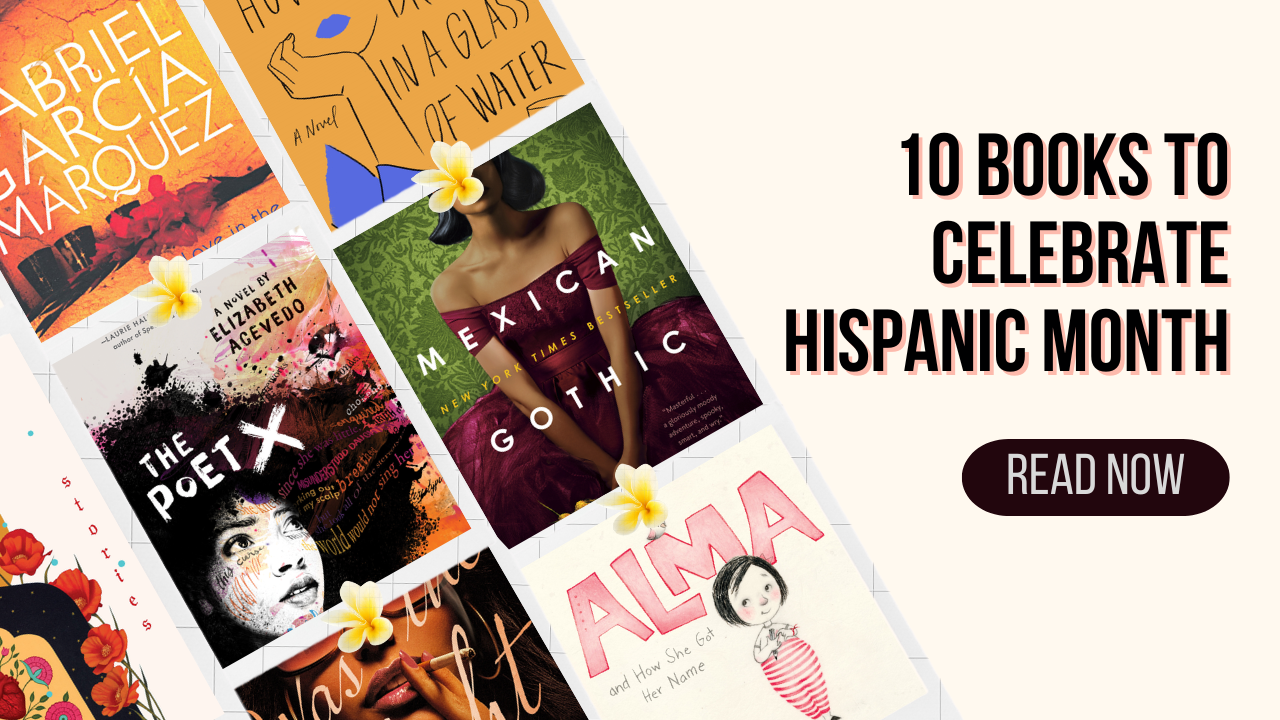
Hello, dear readers! How is October treating you? What are you reading?
Do you know about Hispanic Heritage Month? It is the annual celebration of Hispanic Heritage Month that honors the many cultures, customs, and contributions of Hispanic and Latino Americans to the history and culture of the United States. It is celebrated from September 15 to October 15, each year.
This is a chance to acknowledge and celebrate the great contributions that Hispanic and Latino Americans have made to the history, culture, economy, and society of the nation. People of all backgrounds can use it as a platform to learn about the rich and varied cultures, traditions, languages, and history of Hispanic and Latino groups in the United States and throughout the Americas. So, what are you waiting for?

I’ve put together a collection of the best Hispanic books to celebrate the month. Let’s go!
The Poet X

Xiomara Batista feels unheard and unable to hide in her Harlem neighborhood. Ever since her body grew into curves, she has learned to let her fists and her fierceness do the talking.
But Xiomara has plenty she wants to say, and she pours all her frustration and passion onto the pages of a leather notebook, reciting the words to herself like prayers—especially after she catches feelings for a boy in her bio class named Aman, who her family can never know about.
With Mami’s determination to force her daughter to obey the laws of the church, Xiomara understands that her thoughts are best kept to herself. So when she is invited to join her school’s slam poetry club, she doesn’t know how she could ever attend without her mami finding out. But she still can’t stop thinking about performing her poems.
Because in the face of a world that may not want to hear her, Xiomara refuses to be silent.
Where There Was Fire

In 1968, a fire at the American Fruit Company’s banana plantation in Costa Rica led to the death of Teresa Cepeda Valverde’s family. Twenty-seven years later, Teresa and her daughter Lyra are left to pick up the pieces, haunted by a missing husband and the bitter ghost of her mother, Amarga. The story revolves around a family’s rupture, teeming with machismo, jealousy, labor uprisings, and the havoc caused by banana plantations in Central America. John Manuel Arias weaves a captivating tale of love, loss, secrets, and redemption, weaving a tapestry of love, loss, secrets, and redemption.
Family Lore

Family Lore is a novel by Elizabeth Acevedo, a National Book Award-winning author, that tells the story of a Dominican-American family. The story revolves around Flor, who has a gift to predict death, and her sisters, Matilde, Pastora, and Camila, who are surprised by her decision to hold a living wake. The novel explores the secrets and tumultuous lives of the Marte women, who are preparing for a life-changing event. The novel is told through the voices of the sisters, helping them navigate their past and future.
Love in the Time of Cholera

In their youth, Florentino Ariza and Fermina Daza fall passionately in love. When Fermina eventually chooses to marry a wealthy, well-born doctor, Florentino is devastated, but he is a romantic. As he rises in his business career he whiles away the years in 622 affairs–yet he reserves his heart for Fermina. Her husband dies at last, and Florentino purposefully attends the funeral. Fifty years, nine months, and four days after he first declared his love for Fermina, he will do so again.
Alma and How She Got Her Name

If you inquire of Alma Esperanza Sofia Six names is definitely too much for José Pura Candela. How did a person so diminutive come to have such a famous name? When Alma asks her father for clarification, he tells her about her namesake Sofia, a grandmother who enjoyed reading and flowers, as well as her namesake Esperanza, a great-grandmother who yearned to travel, José, a grandpa who liked art, and other namesakes. Alma begins to wonder that her name might actually be a great fit when she learns the origin of it, and she also begins to realize that she will one day have her own tale to tell. For kids who could be interested in their own origin tales or names, Juana Martinez-Neal opens a treasure box of discovery in her debut as an author-illustrator.
With the Fire on High

Emoni Santiago, a senior in high school, must make the difficult choices and do the necessary actions since she has to take care of her daughter and assist her abuela. In the kitchen, where she infuses everything she prepares with a little bit of magic and transforms it into pure goodness, she can let her obligations go by the wayside. She is aware, however, that she doesn’t have enough time to complete the new culinary arts course at her school, she lacks the funds to travel to Spain with the class, and she shouldn’t still be daydreaming about working in a real kitchen someday. However, once Emoni starts cooking, she has no real choice but to let go of all the standards she has for her life—and all the rules everyone expects her to follow.
Mexican Gothic

After receiving a frantic letter from her newly-wed cousin begging for someone to save her from a mysterious doom, Noemí Taboada heads to High Place, a distant house in the Mexican countryside. She’s not sure what she will find—her cousin’s husband, a handsome Englishman, is a stranger, and Noemí knows little about the region.
Noemí is also an unlikely rescuer: She’s a glamorous debutante, and her chic gowns and perfect red lipstick are more suited for cocktail parties than amateur sleuthing. But she’s also tough and smart, with an indomitable will, and she is not afraid: Not of her cousin’s new husband, who is both menacing and alluring; not of his father, the ancient patriarch who seems to be fascinated by Noemí; and not even of the house itself, which begins to invade Noemí’s dreams with visions of blood and doom.
Her only ally in this inhospitable abode is the family’s youngest son. Shy and gentle, he seems to want to help Noemí, but might also be hiding dark knowledge of his family’s past. For there are many secrets behind the walls of High Place. The family’s once colossal wealth and faded mining empire kept them from prying eyes, but as Noemí digs deeper she unearths stories of violence and madness.
And Noemí, mesmerized by the terrifying yet seductive world of High Place, may soon find it impossible to ever leave this enigmatic house behind.
Velvet Was the Night by Silvia Moreno-Garcia

In the 1970s, Mexico is a dangerous country, with a dangerous atmosphere. Maite, a secretary, seeks romance in comic books and ignores protests. When her neighbor, Leonora, disappears, she becomes obsessed with her secret life. Meanwhile, Elvis, a goon with a passion for rock ‘n’ roll, is assigned to find Leonora. They embark on a blood-soaked search for Leonora and their soul, encountering hitmen, government agents, and Russian spies. Mexico in the 1970s is a noir where life is cheap and the price of truth is high.
How Not to Drown in a Glass of Water

Cara Romero thought she would work at the factory of little lamps for the rest of her life. But when, in her mid-50s, she loses her job in the Great Recession, she is forced back into the job market for the first time in decades. Set up with a job counselor, Cara instead begins to narrate the story of her life. Over the course of twelve sessions, Cara recounts her tempestuous love affairs, her alternately biting and loving relationships with her neighbor Lulu and her sister Angela, her struggles with debt, gentrification and loss, and, eventually, what really happened between her and her estranged son, Fernando. As Cara confronts her darkest secrets and regrets, we see a woman buffeted by life but still full of fight.
Structurally inventive and emotionally kaleidoscopic, How Not to Drown in a Glass of Water is Angie Cruz’s most ambitious and moving novel yet, and Cara is a heroine for the ages.
Sabrina & Corina by Kali Fajardo-Anstine

Kali Fajardo-Anstine’s debut story collection explores the deep-rooted truths of Latinas of indigenous ancestry in the American West. Set in Denver, Colorado, the collection features Latina characters who navigate the land with caution, grace, and quiet force. The stories explore themes of ancestry, heritage, and abandonment, as well as the experiences of mothers and daughters. The collection highlights the importance of navigating the land with caution and grace, as seen in “Sugar Babies,” “Any Further West,” “Tomi,” and “Sabrina & Corina.” The collection is a moving narrative of feminine power and the experiences of abandonment, heritage, and a sense of home.
Which is your favorite book on the subject?