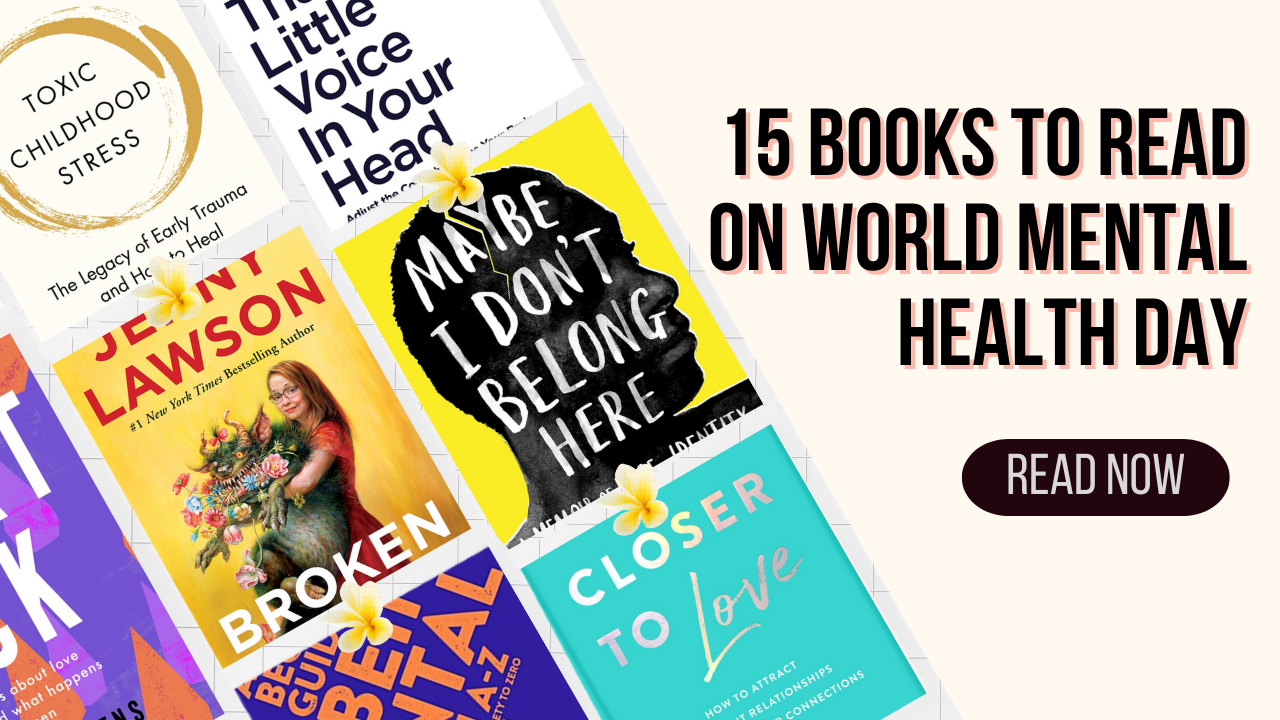
Today is World Mental Health Day. World Mental Health Day aims to increase awareness of the subject. It’s an opportunity to discuss mental health, how to care for it, and how crucial it is to seek aid for someone having problems. Reading has proven benefits on mental health by reducing stress, improving focus, and enhancing empathy. It provides an escape from daily worries, stimulates the mind, and promotes relaxation, ultimately supporting overall well-being.
This World Mental Health Day, let’s look at books that have been striving to educate and empower masses on the subject of mental health. These books have been read and cherished by millions because let’s face it, at some level, we are all facing mental health issues and seeking the right guidance or riddance from it. These books will just leave you better equipped in understanding importance of mental health and tackling it sensibly.

Today, on World Mental Health Day, let’s contribute in helping those who have been struggling mentally. Let’s make it easier for them to be able to talk, deal, and heal from it. Hope these recommendations of the best mental health books helps us all.

Maybe I Don’t Belong Here
At the age of 23, just as David Harewood’s acting career was beginning to take off, he experienced what he now knows to have been a mental breakdown. Six police officers had to physically restrain him before giving him a tranquilizer, hospitalizing him, and then moving him to a locked ward. He has only just, thirty years later, been able to comprehend what he endured. David Harewood, a critically acclaimed actor, explores a traumatic family history and the very real effects of racism on black mental health in this compelling and thought-provoking tale of a life lived after insanity.

That Little Voice in Your Head
That Little Voice in Your Head by Mo Gawdat is a helpful manual on rewiring your brain for joy. He explains that we can alter our thoughts, change greed into kindness, change indifference into compassionate action, and create our own happiness by quieting the critical voice inside. Gawdat’s brain exercises are based on his neuroscience research as well as his experience as a former Google engineer and Chief Business Officer. In addition, he describes how, despite their complexity, human brains typically exhibit predictable behaviors. Gawdat has created a guide to happiness that is rooted in empathy and inspired by the life of his late son. It educated people about mental health awareness in a very comprehensive manner.

What Happened to You?
Oprah Winfrey and Dr. Perry discuss how our early experiences, both positive and negative, shape who we become in a wide-ranging and frequently intensely intimate dialogue. The two discuss understanding people, behavior, and ourselves in the context of personal experiences throughout the entire book. They eliminate judgment and self-criticism and create room for reconciliation and comprehension. This book illuminates a vital path to recovery, rooted in the most recent findings in brain science and brought to life through gripping stories. It demonstrates our amazing power to recover from hardship. This book is a good example of mental health education, which anybody could use to educate themselves on this subject.

Toxic Childhood Stress
We must go back in order to move forward. Up to two-thirds of us have suffered some form of childhood adversity, and in her book Toxic Childhood Stress: The Legacy of Early Trauma and How to Heal, Dr. Nadine Burke Harris hopes to help unearth, identify, and heal childhood trauma. It’s vital work, too, because childhood trauma has an impact on both physical and mental health. Dr. Burke Harris, the Surgeon General of California as well as the founder and CEO of the Center for Youth Wellness in San Francisco, compiles tales and findings from her groundbreaking study connecting childhood trauma to health in this engrossing and astounding read.

Heartsick
‘Heartbreak does not seem to be a brand of grief we respect. And so we are left in the middle of the ocean, floating in a dinghy with no anchor, while the world waits for us to be okay again.’
Heartsick by Jessie Stephens is a gripping narrative non-fiction depiction of the numerous lows and sporadic unexpected highs of heartbreak that is based on three genuine stories. It serves as a reminder that storytelling has the greatest ability to cure us from emotional trauma. It is bruising, beautiful, painfully specific, yet utterly universal.

The Green Sketching Handbook
We are all aware of the positive effects of creativity and outdoor activity on our mental health and overall wellbeing. There is a solution for those of us who find it difficult to take breaks and put down our screens. The Green Sketching Handbook will have you reaching for your pencil thanks to its alluring combination of fast exercises with natural research and creative activities. Dr. Ali Foxon, a climate scientist and nature enthusiast, helps you overcome feelings of inadequacy and produce memorable accounts of your outdoor experiences.

How to Feel Better
Although we have no control over all of life’s ups and downs, we can decide how to react to them. However, Cathy Rentzenbrink treats this book with loving, compassionate instruction rather than lecturing us on how to live and provides consolation for when we most need it. She discusses subjects in a manner that is distinctly empathetic, such as her protocol for receiving terrible news and the life lessons she would like to impart to her son. Anyone trying to understand a major upheaval or just navigating the daily ups and downs of life should read How to Feel Better for better mental health support.

Untamed
A New York Times bestseller with over a million copies sold and mentions in publications like Oprah’s O Magazine and Reese Witherspoon’s Book Club, had to be included in our list of the finest books about mental health. Glennon discusses the calm and happiness that may be discovered in letting go of the stress of the outward expectations around us. Her book is centered around the theme of learning to listen internally in order to find yourself. This stirring book serves as both a wake-up call to begin living for ourselves and the author’s personal account of how, when, and why she decided to quit appeasing others.

On Agoraphobia
Graham Caveney started having unusual symptoms in his early twenties and was eventually given the diagnosis of agoraphobia. Over the years, he had to manage his illness and adjust to a variety of limitations, including being unable to go on freeways or dual carriageways, going nowhere near stores, and spending little time outside. Graham turned to literature again as he sought to comprehend his sickness. And he found that literature is full of examples of agoraphobics, from Ford Madox Ford, Emily Dickinson, and Shirley Jackson to Harper Lee’s Boo Radley. This is an intriguing, though occasionally difficult, look at an illness that defies simple description.

How Emotions Are Made
What if our bodies and minds didn’t have pre-set emotional responses? In her book How Emotions Are Made: The Secret Life of the Brain, Lisa Feldman Barrett poses this query. She contends that the majority of our beliefs about emotions are false. It’s exciting to consider where your own emotional reactions come from and how they manifest physically. It doesn’t mean that biological reactions or feelings are arbitrary, according to Lisa. It suggests that the same emotion category might cause various body reactions depending on the situation. The norm is variation, not consistency.

Closer to Love
This is a helpful manual for forging enduring partnerships. He is now imparting his knowledge to help readers on their own journeys after discovering serenity and joy in his own romantic partnership. He takes into account the difficulties of contemporary relationships and how to manage them in a society that is constantly changing, aids us in overcoming our anxieties, expectations, and insecurities, and explains our sense of who we are, finally assisting us in moving closer to love and mental wellness. Closer to Love by the best-selling author of Good Vibes, Good Life, and Healing is the New High is a must-read from one of the country’s most popular self-help experts.

Broken
Numerous tens of thousands of Jenny Lawson’s admirers are aware that she battles depression. In Broken, Jenny makes the issues we all face seem more relatable, letting us know we’re not alone and making us laugh in the process. We discover why she is unable to visit the post office again, how her vacuum machine nearly burned her home on fire, and how she was assaulted by three bears. Naturally, Victor, Jenny’s patient husband, and Lucille Ball, Jenny’s Ricky, are there throughout. Broken is a source of joy and hope at a time when we all need it most. It is a treat for Jenny Lawson’s existing fans and is sure to win over new ones.

In Love with the World
The inspiring and spiritual tale of meditation teacher Yongey Mingyur Rinpoche’s four-year traveling retreat into the woods includes a near-death experience. Through his personal tale of his struggle to find himself, Rinpoche shows us how to change our dread of dying into a life full of joy.

The Cambridge Code
Why do we act in certain ways, think in certain ways, and react in certain ways? In order to understand the “DNA” of your mind, or more simply, why you are the way you are, the authors of The Cambridge Code have developed a test in collaboration with a group of scientists at Cambridge University. The test is intended to help you “uncover subconscious potential that lies beyond the reach of established psychological measurement.” To help you better understand yourself and identify the areas of your life you may want to focus on in order to develop and flourish on a more profound level, the book offers step-by-step analysis in addition to the exam to remove mental health stigma.

A Beginner’s Guide to Being Mental
“We all exist somewhere along a mental health spectrum.” Natasha’s contribution to this list is a hilarious read that takes us on a journey through the alphabet of mental health, from anxiety to ZERO FUCKS GIVEN (or the art of having high self-esteem), with a few pit stops along the way at drugs, the Internet, therapy, and other useful themes connecting to mental health. This observational comedy meets mental health advice blends expert guidance with the author’s own hilarious personal experiences to give the impression that no matter how you feel or what you’re going through, you’re not alone.
Which is your favorite book on mental health?