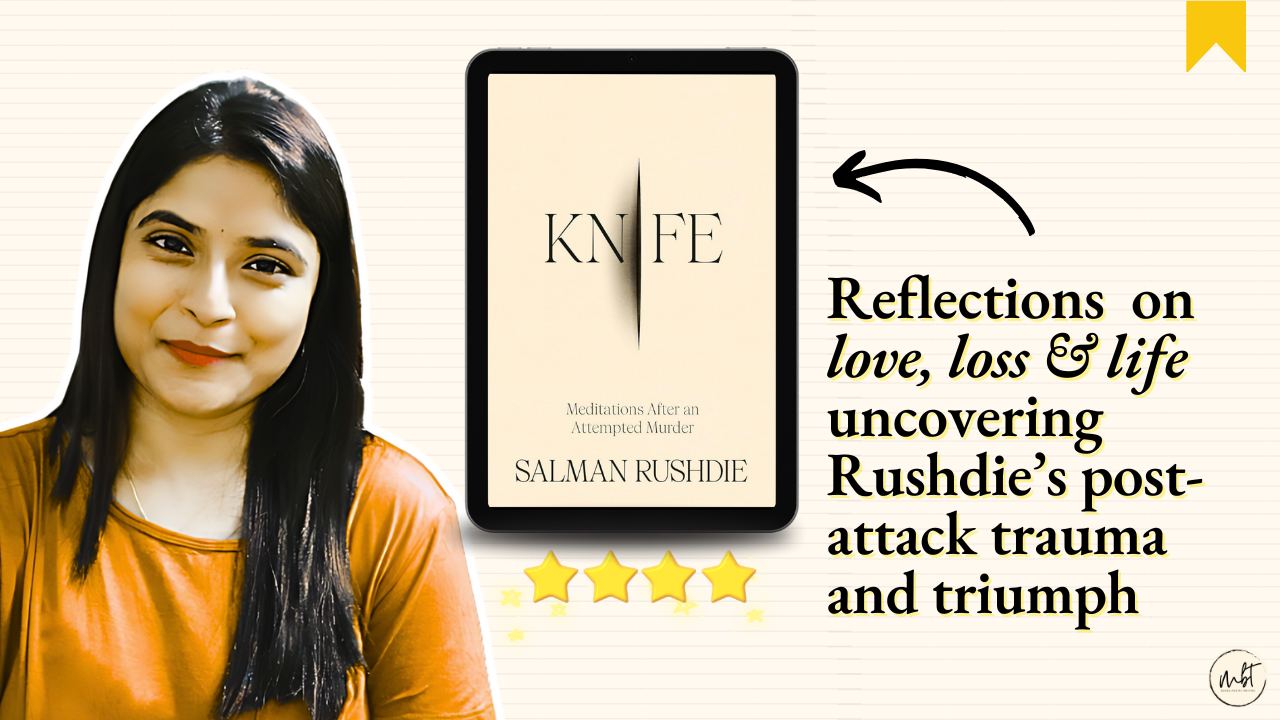
Knife
Summary
On August 12, 2022, Salman Rushdie took the stage at the Chautauqua Institution to speak on the importance of protecting writers. Suddenly, a man dressed in black rushed toward him, wielding a knife, and carried out a violent attack that shocked the literary world. This memoir is more than a recounting of violence; it’s a powerful meditation on love, resilience, and literature’s unique ability to make sense of unimaginable pain, offering readers a poignant reminder of the strength it takes to rise again.

On August 12, 2022, Salman Rushdie took the stage at the Chautauqua Institution to speak on the importance of protecting writers. Suddenly, a man dressed in black rushed toward him, wielding a knife, and carried out a violent attack that shocked the literary world. In his memoir, Knife, Rushdie recounts the traumatic experience, sharing his journey through physical recovery made possible by the unwavering support of his wife, Eliza, his family, and his worldwide community of readers.
In Knife, Rushdie describes the attacker, whom he refers to as “A,” as a “murderous ghost from the past,” a reference to the lasting threat from the fatwa he has faced since 1989. He even uses humor as a coping mechanism, dubbing his assailant the “Asinine Man” and “Imam Youtubi,” in reference to the online radicalism that may have influenced him. Rushdie’s knack for finding wit amid terror is striking, speaking volumes of his unbreakable spirit. The book is split into two main sections. The first part covers the attack itself, as well as Rushdie’s intense journey through hospitalization and rehabilitation. His description of the assault is raw, gut-wrenching, leaving readers stunned and surprised at the consequences of the event on his life. The second part is more reflective, where Rushdie tries to reclaim normalcy and make sense of the incident’s lasting impact on his life.
“During those empty, sleepless nights, I thought a lot about The Knife as an idea. A knife was a tool, and acquired meaning from the use we made of it. Language, too, was a knife. I could cut open the world and reveal its meaning, its inner workings, its secrets, its truths. It could cut through from one reality to another. It could call bullshit, open people’s eyes, create beauty. Language was my knife. If I had unexpectedly been caught in an unwanted knife fight, maybe this was the knife I could use to fight back.”
The book dives deep and brings to the fore Rushdie’s speculations on the concept of existence and survival, after his close encounter with death and everything that changed within him. He recalls a doctor’s remark that he was “lucky” his attacker didn’t know where to strike to kill, underscoring how narrowly he had escaped death. His reflections reveal an enhanced appreciation for life, captured in his realization that every day post-attack feels like “pure gravy,” quoting author Raymond Chandler, and dissecting the layers of what the violence did to him and how it changed his beliefs, principles, and take on life, in general. He covers topics such as privacy in a digital world, power of meaningful relationships, ambitions and apprehensions of old age, etc. Not much however, is shared on the side of his life that he is most-known for – the writer’s life.
“When Death comes very close to you, the rest of the world goes far away and you can feel a great loneliness. At such a time kind words are comforting and strengthening.”
The memoir explores deeply the role of love and support in his recovery; particularly from his wife, poet Rachel Eliza Griffiths, and he has gone to great lengths describing how much he admires and adores her. A significant part of the book sheds light on his relationship with his wife and how it proved transformative throughout his healing. The memoir then shifts gears to talk about his personal life, the relationships that remained, people who visited him, the conversations that stimulated him, but all from a very superficial lens capturing mundane details; all of which rather feels like a journal of an ailing man. There’s scarce albeit succinct reference to the physiological and psychological reverberations of an event as catastrophic as the one Mr. Rushdie was subject to and thus the relevance of the prose falls drastically; especially since a reader would approach the book to unearth the lesser known details of his life as a writer in the aftermath of the harrowing incident. Even though the language is kept simple and the prose pithy, the overall context seems lost due to the lack of literary richness; as expected from an author of his stature. Taking this book on the face value without surreal expectations would be rule number one for readers!
Where attention has become the thing most hungered for, where the quest for followers and likes is the new gluttony, privacy has become unnecessary, unwanted, even absurd.
Knife once again showcases Rushdie’s knack at writing – blending urgency, honesty, and reflection – recounting his encounter with violence and making sense of it all. His courage, his will to bounce back, and his determination to share with readers his plights and ponderings from the incident is rampant through the book, and highlights that the author has what it takes to face death, not be deterred or daunted by it, and rise up again stronger, ready to face life’s trials and triumphs. The memoir will leave readers wondering where does one achieve the courage to rise and shine in the moments of life-altering events; the answer to which lies between the pages of this book.
Author Profile

Sir Ahmed Salman Rushdie, a novelist and essayist, set much of his early fiction at least partly on the Indian subcontinent. His style is often classified as magical realism, while a dominant theme of his work is the story of the many connections, disruptions and migrations between the Eastern and Western world.
His fourth novel led to some violent protests from Muslims in several countries. Faced with death threats and a fatwa (religious edict) issued by Ayatollah Ruhollah Khomeini, then Supreme Leader of Iran, which called for him to be killed, he spent nearly a decade largely underground, appearing in public only sporadically. In June 2007, he was appointed a Knight Bachelor for “services to literature”, which “thrilled and humbled” him. In 2007, he began a five-year term as Distinguished Writer in Residence at Emory University.
Have you read ‘Knife’? What did you think?