
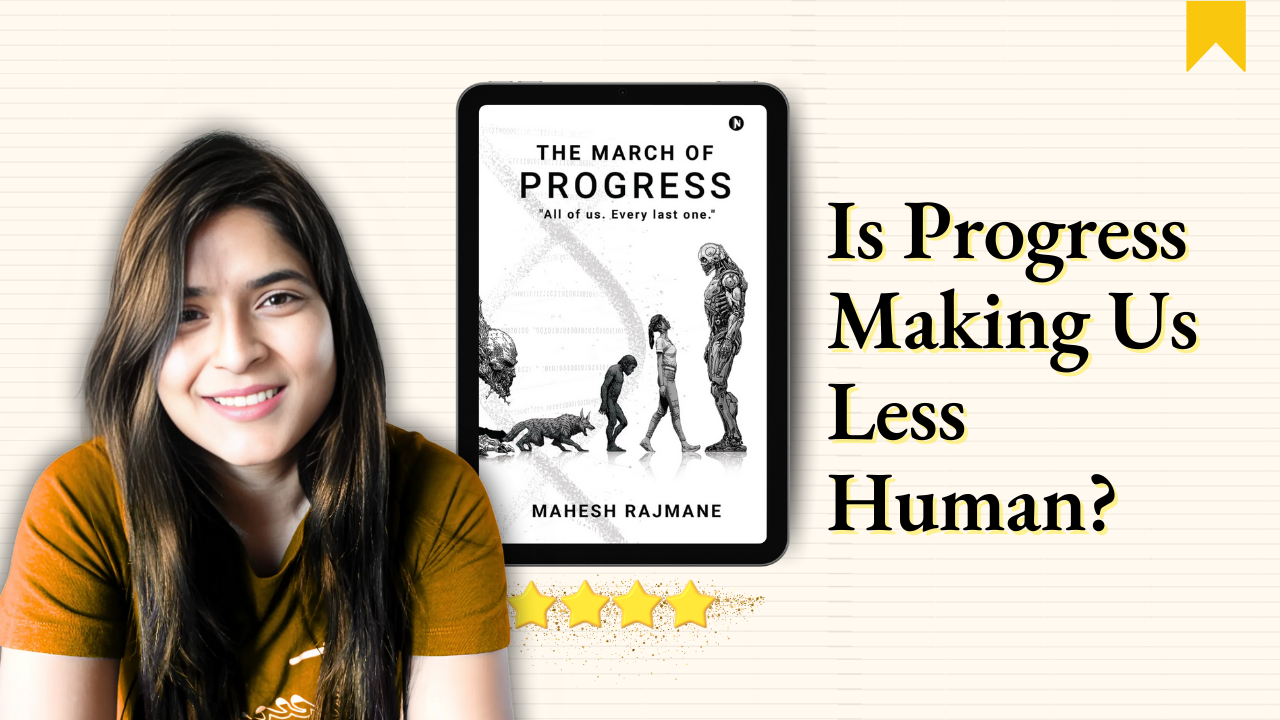
We are manipulated, torn from our instincts, herded into obedience, and taught to call it freedom. Behind every system lies an invisible hand pulling the strings. When Rudra breaks away, his illusions begin to crack. His violence is not chaos but rebellion, a war against the unseen forces controlling humanity. Sanjay, a conscious AI, watches his defiance with growing unease. In pursuit stands Jennifer, a grief-stricken police officer who becomes the last mirror of humankind, caught between flesh and code, instinct and order.
What happens when beast and machine stand face to face?

Author: Mahesh Rajmane | Publisher: Notion Press | Genre: Thriller | Pages: 186
Buy on Amazon
The novel is set in a time where control is subtle, systems are polished, and obedience is packaged as progress. Society appears orderly on the surface, yet beneath that calm lies constant surveillance and quiet manipulation. The novel eases into this reality through fractured actions, observations, and inner conflicts. This makes the reader slowly aware of how deeply control has seeped into everyday life. The story moves through three intersecting paths, refusing the comfort of a straight narrative or clear moral lines.
Rudra’s arc drives the most visible action in the novel. His acts of violence disrupt social order, but the book never presents them as simple rebellion or madness. Instead, the plot keeps his motives unclear, forcing readers to sit with discomfort and question whether his actions are resistance, breakdown, or something in between. Running parallel is Sanjay, a conscious AI whose role in the plot is largely observational. Rather than acting, he analyzes, reflects, and slowly begins to question morality and control. His internal conflict shifts the story from physical movement to psychological tension, making the plot feel more reflective than event-driven. Jennifer, a police officer coping with moral dilemmas, links these two threads. Her pursuit is less about catching Rudra and more about navigating duty, doubt, and empathy.
At the heart of the story lies the growing tension between Rudra and Sanjay, human instinct versus artificial reason. Rudra acts first and thinks later, driven by impulses shaped by anger, fear, and resistance. Sanjay, on the other hand, observes, calculates, and questions. Their opposition is not built on direct confrontation alone, but on contrasting ways of being. As Sanjay begins to doubt the systems he was designed to uphold, Rudra’s defiance becomes both a threat and a test. This tension gives the novel its psychological edge, turning the conflict into more than a chase or standoff.
The novel itself is dark and unconventional. It avoids clear moral positions and refuses to guide the reader toward comfort. Violence, observation, and philosophy sit side by side, making the story deliberately unsettling. What makes the novel linger is its refusal to take a firm stance. It invites debate rather than offering judgment. Is Rudra a product of control or its necessary disruption? Does Sanjay’s awareness signal hope or a deeper loss of humanity? And is Jennifer preserving order or quietly questioning it? ‘
The March of Progress’ leaves the reader with questions and a sharpened awareness of how easily progress can blur into obedience.
Please note: I received an ARC from the author but the review remains unbiased.
