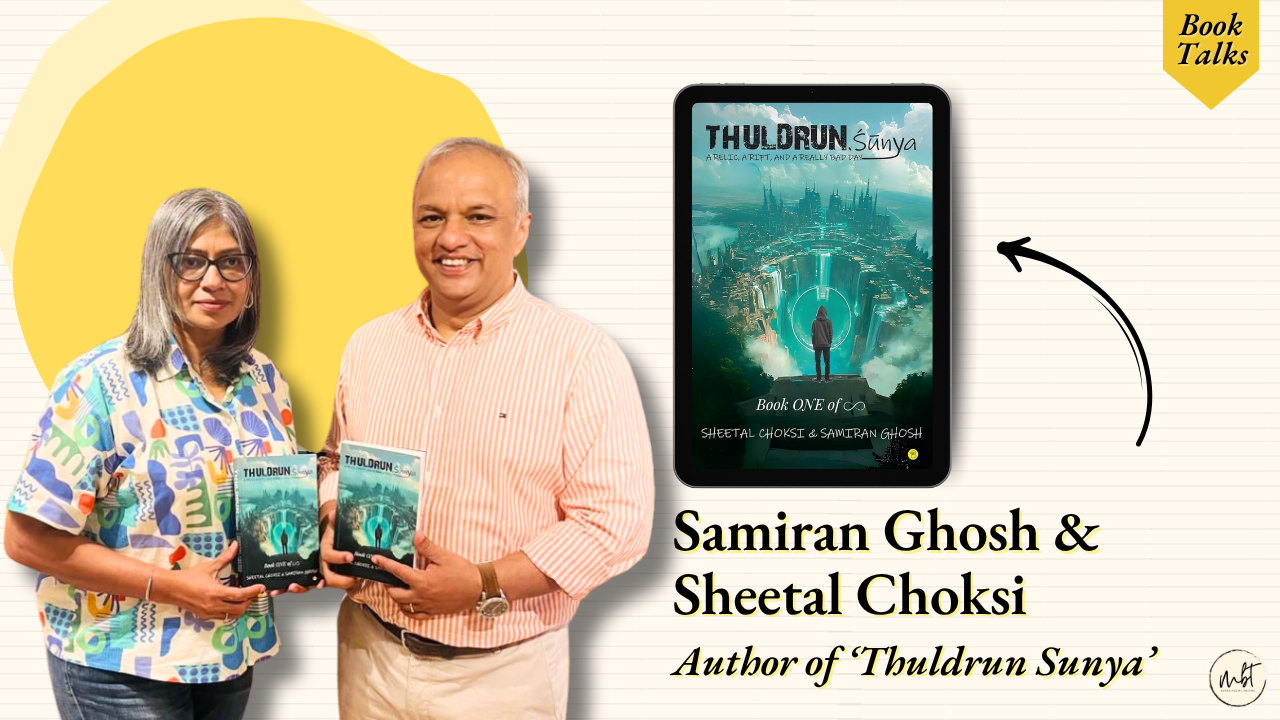

A teenage boy, Ansh Chatterjee, accidentally awakens ancient forces in Mumbai while exploring conspiracy forums. Thrust into a techno-mystical adventure, he follows clues from a lost Indian civilization that may have mastered quantum entanglement and consciousness. Ansh has an eccentric team which includes a sarcastic hacker, a fringe theorist, and a mysterious dog. They must uncover who buried this ancient truth for 3,000 years. As a forgotten power stirs once more, Ansh realizes the past may have already scripted humanity’s future—and he’s the unexpected glitch in that cosmic plan.
1. Can you tell us a little bit about your book? Why did you choose this genre and what’s the story behind the title?
Thuldrun.Sunya is a mythology meets sci-fi novel that blends ancient India with cutting-edge science. Set in Mumbai, the book follows teenager Ansh Chatterjee, a conspiracy nerd and Maggi addict, who accidentally uncovers a hidden truth that challenges existing beliefs and pits him against a 3,000-year-old destructive force.
YA is where you can blow up the universe on page one, and readers will say, “Yeah, sounds like Tuesday”. Where else would a teenager armed with instant noodles fighting cosmic forces be accepted entirely? While adult fiction gets boxed into rigid categories (it’s either business or fantasy or science fiction), YA gleefully mixes mythology with science, history with whodunits, and conspiracy theories like the streets of Mumbai. Today’s YA readers grew up Googling everything and consuming mythologies through memes. They are sophisticated enough to handle big ideas without the hand-holding adult fiction sometimes demands.
The title carries deep layers of meaning. “Thuldrun” comes from Thorium (element 90), the nuclear potential found along India’s southern coast. The authors imagined: what if an ancient Indian civilisation had already cracked nuclear power? They encoded this as “Tula-Drona”— representing the balance of Dronacharya’s advanced knowledge from the Mahabharata.
“Sunya” (śūnya) goes beyond the world of zero; sunya is nothingness and infinite potential at the same time. Together, the title suggests ancient wisdom meeting unbridled possibility.
2. What inspired you to write this story? How did you find the resources and research material for your book?
The inspiration was born from cultural frustration. While Hollywood glorifies Norse gods, Indian epics filled with descriptions of nuclear war and radiation poisoning get dismissed as mystical fables. The book is essentially cultural reclamation through entertainment – a way to reimagine Indian mythology through the lens of quantum mechanics and real science. Mumbai became the natural setting because it already thrives on impossibility, existing in multiple states at once like Schrödinger’s cat. If New York has had enough apocalypses, Mumbai deserved its own techno-mystical meltdown.
We combined scientific facts with fictional possibilities. Every tech passed our “drunk physicist” test – could three PhDs and five beers explain it? Quantum tunnelling, Sanskrit algorithms, thorium reactors—all grounded in real science, then stretched to imaginative limits. The Void: pure fantasy. Flying vimanas: maybe. Telepathic dogs: proven. We built a scientifically plausible bridge to an impossible world and let characters live there. We did not treat the Ramayana or Mahabharata as alien technology or mythology, but as lost understanding; knowledge encoded in ways we’re only now rediscovering.
3. What was the most challenging aspect of writing this book? How did you overcome it?
Balancing scientific accuracy with imaginative storytelling was very challenging. Our approach was to first establish firm scientific foundations in the narrative, which then allowed us the freedom to explore wilder imaginative territory without losing credibility.
Another unique challenge was creative disagreements. For instance, we went back and forth over whether Thuldrun should have internet. When disagreements reached impasses, we always found middle-ground solutions that satisfied both visions. We resolved our dilemma by creating “thought stones”- telepathic communication devices that work like 6G; a solution both advanced and ridiculous at the same time. The approach became our template: embrace both perspectives to create something neither of us would have conceived alone.
4. Are there any particular authors or books that have influenced the book?
The book is a product of our combined readings over the years. It stretches from Indian and global epics to Asimov, Douglas Adams, Wodehouse, Agatha Christie, Arthur Conan Doyle, Erma Bombeck and others. Characters like the Scarlet Pimpernel and villains like Moriarty also played a part. As did every teacher and text book that we encountered on our path to this book.
Each influence taught us something different – Adams taught humour in sci-fi; Christie, plot precision; Wodehouse, comedic timing.
5. What role did editing play in the writing process? How did you decide when the manuscript was ready for publication?
Editing is super important in the life of book creation. It allows another person to look at the book from a reader’s perspective – both in terms of facts and plots. Some people prefer to do it on an ongoing basis, others prefer it once the final draft is ready. But it is as important as the writing itself. We used several YA beta readers – both known and unknown to get a sense of the response. The book went numerous edits for accuracy, grammar, story-line consistency, flow, chapter start and end hooks, etc.
A book is like a child. One is never truly to send it out alone into the world. We kept making changes and tweaks to the story – a little fact here, a piece of trivia there. Even the authors’ note, book synopsis and author profiles are churned several times. But, like a child, you have to let it loose at some point and let it find its own destiny and place in the world. Short answer – you will know when it is ready.
6. Do you have any upcoming projects or ideas for future books that you’d like to share with your readers?
As a joke and a teaser, we labeled our first book “Book 1 of ♾️.” Which meant it is any number of books or just the one book. We are currently working on Book 2, especially after seeing it become an Amazon bestseller in the Urban Fantasy category. Book 2 will peel back the Thuldrun civilisation’s secrets and reveal why Mumbai holds the key to averting its return, and why Ansh and gang are the key to preventing it from happening again.
7. In the age of digital publishing and social media, how do you engage with your readers and promote your work?
Reader engagement and promotion have been an ongoing experiment for us – a process of trial and error to figure out what works. And, we are still learning with every post and interaction.
The @bookofthuldrun Instagram account has become our central hub for sharing reader reviews, creating reels about the book’s themes, and engaging directly with the community.
We’ve leveraged our 3 Techies Banter podcast ecosystem to reach listeners who already know of us, used LinkedIn to share the behind-the-scenes writing journey and humanise the creative process, and collaborated with book reviewers and literary platforms to expand our reach.
Each platform teaches us something new—some content formats resonate while others fall flat, and we’re constantly experimenting with what works.
8. How do you balance your writing career with other aspects of your life, like work and family?
The truth is, balance isn’t really balance; it is selective chaos management. Writing Thuldrun.Sunya, while maintaining careers in technology and research, required what could be called “strategic laziness” – being selectively kinetic, springing into action only when something is spectacularly interesting, that stillness becomes impossible.
The real answer? You don’t balance – you prioritise what’s ridiculously fun. The only thing better than doing nothing is finding something so spectacularly enjoyable. It doesn’t feel like work at all. Writing a book about quantum-tunnelling teenagers fighting 3,000-year-old forces in Mumbai? That qualified as fun enough to disrupt the supreme art of sitting on a couch and staring at the clouds.
9. What’s the pen ultimate takeaway for readers reading your book?
We believe that the past does not need resurrection; it requires re-translation. Ancient mythology might represent lost knowledge rather than superstition. The book invites readers to look at their everyday world differently. Those pavement cracks in Dadar are perhaps not just civic negligence but fractures in spacetime. This is an invitation to embrace curiosity. It encourages readers to wonder about the world around them. It prompts questions about what’s hidden beneath the mundane.
Above all, readers should walk away entertained but thinking. The book offers a reality-bending, physics-defying ride that’s puzzle, adventure, and cultural commentary wrapped in Mumbai’s chaotic embrace. The book should spark conversations about history, technology, and identity—while making you laugh through the apocalypse. We hope readers close the book and immediately Google ‘Delhi Iron Pillar’ or ‘Brahmastra radiation’. That spark of ‘wait, is this real?’ is exactly what we would love to see.
10. What’s the one advice you’d like to share with aspiring writers of the genre?
What little we have learnt from this brief writing journey is this – you should write for the pleasure of writing. Write something that you can be proud of yourself and share with your friends and family. Write about stuff that is fun and exciting for you personally. Don’t write what you know—write what makes you furiously curious. Like our debate about internet 3000 years ago yielded something completely unexpected. That obsessive curiosity became the book’s engine. That is your success—and not the sales or bestseller tags that may or may not follow.

Sheetal and Samiran, two of the three hosts of the award-winning 3 Techies Banter podcast, blend insight, humour, and fearless curiosity. Sheetal, a seasoned qualitative researcher, uncovers hidden human stories and finds meaning in Mumbai’s chaos. Samiran, a technologist with a flair for quirky history and trivia, turns everyday mysteries into playful speculation. Together, they’ve spent hours debating ancient civilizations and Mumbai’s eccentricities — from pigeons to portals — now channelled into their debut book, where old India collides with modern tech conspiracies against the city’s vibrant backdrop.
Unveil the mythological sci-fi thriller ‘Thuldrun Sunya’ now.