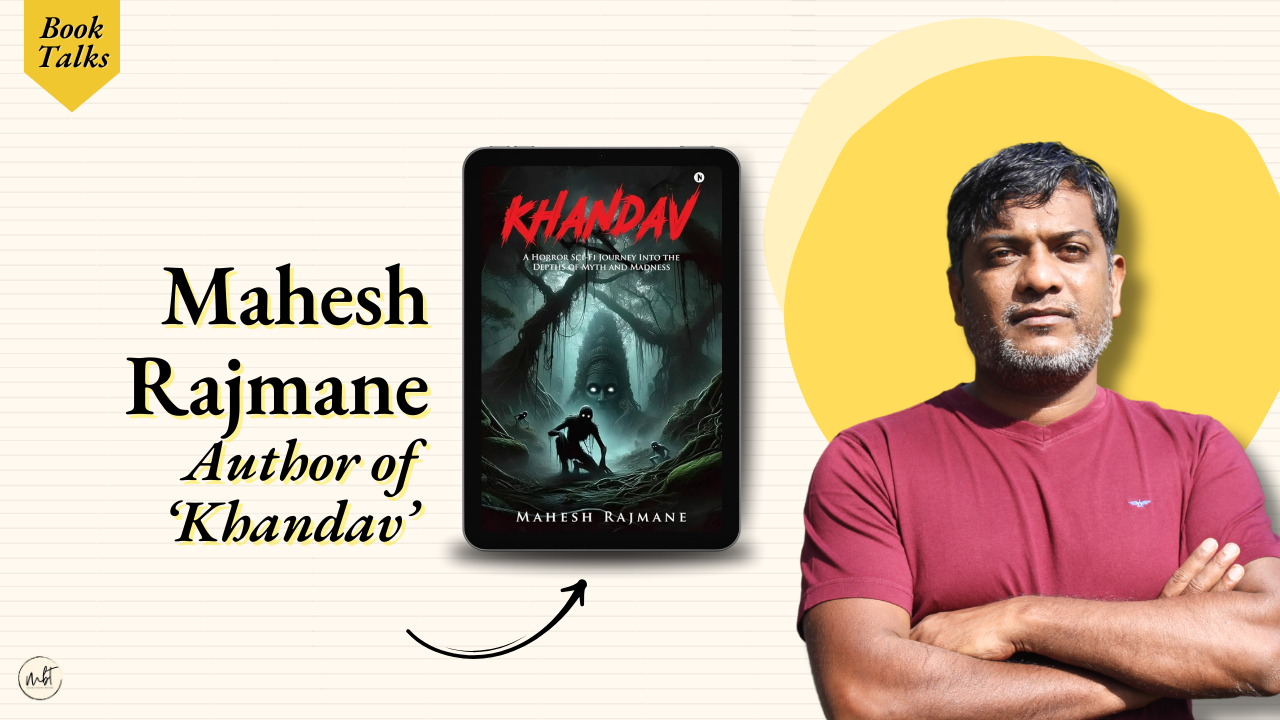

Deep within an ancient, uncharted jungle, something stirs―something that should have remained buried. When a daring botanist disappears while uncovering its secrets, Maya, a journalist, sets out to investigate Khandav’s mysteries. But what begins as a search soon becomes a waking nightmare. ‘Khandav’ is one of those rare horror novels that instantly pulls you in and doesn’t let go. From the very first page, it builds an eerie, slow-burn suspense that wraps around your mind like jungle vines—tightening, creeping, whispering. If you’re a fan of psychological horror books, sci-fi thrillers, or mythological suspense novels, this can’t go missed.
1. Can you tell us a little bit about your book? Why did you choose this genre and what’s the story behind the title?
Khandav operates on two parallel levels. For someone rooted in faith, it’s the story of an ancient curse—of Goddess Chendkai and the wrath of a jungle wronged by humans. But for someone with a scientific mind, it’s about fungal infections, parasitic intelligence, and the terrifying possibility of mind control by natural forces we’ve barely begun to understand. It’s designed to be read both ways—myth or science, spiritual or psychological. I chose horror and science fiction because they’re the only genres that dare to ask the deeper questions: What lies beyond what we see? Is there a purpose to this universe, or just cold indifference? These genres don’t just entertain—they unsettle, provoke, and expand the boundaries of thought. Unlike love stories or thrillers, which are bound to the world as we know it, horror and sci-fi venture into the unknown, the forbidden, the unimaginable.
As for the title—Khandav—it comes from a feeling I’ve carried since childhood. I remember reading the Mahabharata and feeling disturbed by the burning of the Khandava forest, sanctioned by Lord Krishna himself. Even as a child, I wondered—what if the jungle could feel? What if it could respond? What if nature, ancient and alive, could take revenge—not with fire, but with decay? That seed of unease stayed with me, and Khandav is its full-grown shadow.
2. What inspired you to write this story? How did you find the resources and research material for your book?
Like I said before, the inspiration for Khandav came from a strange mix of childhood guilt, adult curiosity, and a deep discomfort with how we treat nature as passive. Every now and then, we keep reading or hearing about forests being wiped out to make space for human greed—mining, lumber, highways, housing. Forests—homes to countless beings—are sacrificed in the name of progress, often without a second thought. Years later, I stumbled upon a BBC documentary on Ophiocordyceps, a parasitic fungus that hijacks the minds of ants and other insects. That’s when something clicked: what if nature could fight back—not with brute force, but with intelligence? What if the forest wasn’t just alive, but conscious? What if it had its own system of control, its own will?
My research took me through everything from ancient Indian mythological texts to modern biology journals. I read about fungal networks—how fungi connect the living and the decaying, the visible and the hidden. How plants communicate chemically under our feet. How spores can alter the minds of insects and animals. And how tribal oral traditions often preserve truths science is only now beginning to uncover. There are around 3 million species of fungi on Earth—about 14,000 of them are mushrooms. They range from the deadly poisonous to the edible delicacies we put on our plates… and then there are the mind-altering ones—like the psychedelic Psilocybin mushrooms, often called “magic mushrooms.” That’s when it hit me: we’ve barely scratched the surface of what fungi can do to us—physically, psychologically, even spiritually. That blend of metaphysics, folklore, and frontier science became the soul of Khandav—a world where both gods and microbes can shape your fate.
3. What was the most challenging aspect of writing this book? How did you overcome it?
The biggest challenge was balance—walking that tightrope between science and mythology without diluting either. I’m a scientific person, and I love to write horror. Sounds like an oxymoron, but a truly scientific mind acknowledges the unknown—yet refuses to fall back on superstition. There has to be nuance. Khandav isn’t meant to explain things in black and white. It thrives on ambiguity—what one person sees as a curse, another sees as a biological anomaly. Crafting a story that speaks to both a believer and a skeptic was the hardest part. The second challenge was tone. I didn’t want Khandav to be just another horror story full of jump scares and gore. I wanted it to haunt the reader philosophically. That meant countless rewrites, fine-tuning scenes so the fear wouldn’t just jolt—it needed to linger. It had to crawl beneath the surface and whisper: What if the jungle could really go to war with humans? What if it thinks? What if trees are conscious? These are the kind of questions that stick—quietly resurfacing every time you walk past a tree.
To overcome it, I worked in layers. I let characters interpret events differently—some through faith, others through science. I trusted the reader to find their own truth, rather than spoon-feed answers. And most importantly, I kept reminding myself: this isn’t just a book about a forest. It’s about what happens when everything we believe—God, science, civilization—starts to unravel.
4. Are there any particular authors or books that have influenced the book?
Definitely. Every writing is rewriting. While Khandav is a unique story, it stands on the shoulders of giants—both in horror and philosophy. I’m a voracious reader, and over the years, I’ve read almost everything by Arthur C. Clarke, Isaac Asimov, Philip K. Dick, and Michael Crichton, to name a few. In horror, Stephen King, Shirley Jackson, and Edgar Allan Poe have left lasting impressions. But Lovecraft’s work had a particularly strong impact—not because of the monsters, but because of the cosmic indifference he explored. That idea—that the universe doesn’t care, and that human sanity is just a thin veneer—deeply resonated with the themes I wanted to explore. I’ve also been drawn to Kafka’s raw minimalism, where horror isn’t loud, but quietly existential and deeply personal. In terms of Indian influence, it’s the Mahabharata—not as a religious scripture, but as a complex, morally ambiguous epic. The burning of the Khandava forest haunted me as a child. That moment, where the jungle is destroyed for human ambition, never sat right with me. Khandav is, in many ways, a response to that silence—what if the jungle had a voice? Scientific non-fiction also played a huge role. Works on fungi, plant intelligence, and behavioral biology helped me root the horror in real, observable phenomena. Entangled Life by Merlin Sheldrake, in particular, opened my mind to the unseen networks beneath us—ancient, intelligent, and quietly watching.
5. What role did editing play in the writing process? How did you decide when the manuscript was ready for publication?
Editing was everything. For me, writing Khandav wasn’t just about telling a story—it was about sculpting an experience. Interestingly, Khandav was originally written as a script for a web series. I’m still pitching it to producers because I believe it has strong cinematic potential. But the story felt bigger—more internal, more layered—something that deserved the immersive depth of a novel. So I rewrote it from scratch. The first draft was raw, almost feral. But horror—especially philosophical horror—demands precision. You can’t rush fear. You have to layer it, tease it, and most importantly, let silence and ambiguity do their work. I went through multiple drafts, refining the tone, tightening the pace, and making sure every scene served the larger theme. I wasn’t just cutting what didn’t work—I was cutting what didn’t haunt. I kept asking myself: does the fear linger after the page is turned? Does it provoke a question, or just provide a jolt? Deciding when it was done wasn’t easy. There’s no moment where the manuscript feels perfect. But there is a point where you stop rewriting and start letting go.
6. Do you have any upcoming projects or ideas for future books that you’d like to share with your readers?
Yes—several, actually. I’ve always got stories bubbling beneath the surface, and after Khandav, I feel even more compelled to explore the darker, deeper layers of human experience. Right now, I’m working on a new novel where the “demon” isn’t just a creature—it’s a metaphor for our primal instincts, raging against the moral, civilized, clockwork zombie-civilization we’ve built. The philosophical directions this story is taking are terrifying—at least to me. It’s disturbing my sleep. It’s changing the way I think. In a strange way, this novel is rewriting me as I write it. It’s about instinct versus logic, primal rage versus programmed ethics, and ultimately, what happens when truth itself becomes toxic. I hope to complete it in, aggressive timeline of next 3–4 months. I’m also adapting Khandav into a screenplay format, aiming to bring it to life on screen—either as a web series or a film. I genuinely believe that visual horror in India hasn’t even begun to scratch the surface, especially when it comes to intelligent, existential storytelling. There are other things in the pipeline too—short stories, essays, and maybe even a collection of horror folktales. But at the core, my purpose remains the same: to write stories that disturb not just your sleep, but your worldview.
7. In the age of digital publishing and social media, how do you engage with your readers and promote your work?
I’ll be honest—I’m not someone who enjoys shouting into the void just to stay visible. I believe stories should speak louder than algorithms. That said, I do recognize the value of digital presence, especially for independent authors trying to reach beyond their immediate circles. So far, I’ve spread the word primarily through social media and personal networks—WhatsApp groups, friends, and family. I’ve also been experimenting with AI-generated short visuals and cinematic teasers to expand the world of Khandav beyond the written page. Tools like Midjourney, Runway, and Eleven Labs are helping me bring my horror vision to life in new and engaging formats. Recently, I’ve started reaching out to prominent reviewers and book bloggers. One of them is Asha Seth, one of India’s top literary voices, and I’m excited to see how that unfolds. I’m also encouraging friends and readers to leave honest reviews on Amazon and Goodreads. So far, I haven’t received any bad reviews—which either means the book is really good… or it’s still circulating mostly within the safe zone of friends and family. At the end of the day, the best promotion is still word of mouth. If someone reads Khandav and feels disturbed, moved, or haunted enough to talk about it—that’s all the success I need.
8. How do you balance your writing career with other aspects of your life, such as work and family?
There’s no perfect balance—it’s more like a controlled imbalance. Dedicating yourself to any form of art or science requires sacrifice. And more often than not, it’s your family and friends who pay that price. Writing, for me, isn’t a hobby or a side project—it’s a compulsion. The story keeps knocking until I open the door. So I write in bursts—late nights, early mornings, stolen hours between work calls and family responsibilities. I have a demanding professional life and a family I care deeply about, so I don’t romanticize the struggle. But I’ve also learned never to wait for the perfect, quiet moment—it rarely comes. I write amidst noise, chaos, deadlines. And somehow, that very tension fuels the horror. The support I receive from my family makes all the difference. They understand that when I’m deep inside a story, I’m not fully here—I’m suspended somewhere between this world and another. And they’ve been generous enough to let me chase that madness. But this new novel I’m working on… it’s different. I don’t know where it’s taking me. And maybe that’s the point—sometimes, the story doesn’t just demand your time. It demands pieces of you. And by the end of the book, you’re no longer the same person. Your family has to meet someone new—and learn to live with who you’ve become.
9. What’s the pen ultimate takeaway for readers reading your book?
I don’t want to preach or offer any neat takeaways. Khandav isn’t a moral story—it’s a mirror, a question mark. If anything, I want readers to walk away unsettled. I want them to look at a tree and wonder—what if it’s watching me? What if it remembers? I want them to feel the fragility of the human world we’ve built—how quickly it can crumble when something older, deeper, and more patient decides to wake up. On a deeper level, I hope Khandav makes people rethink our relationship with nature—not as owners, not as saviors, but as invaders who’ve mistaken dominance for understanding. And for those drawn to science, I want them to see how close the lines are between mythology and biology, between folklore and hard data. But mostly, I want Khandav to linger—not just as a story, but as a feeling. The kind that sneaks up on you days later, when you’re alone, and the forest is quiet.
10. What’s the one advice you’d like to share with aspiring writers of the genre?
Don’t write to scare—write to disturb. A good sci-fi story can be a window into the future or a glimpse into the unseen. It can take a “what if” and stretch it into an alternate reality—one we’re too blind or too comfortable to imagine. And horror, being the oldest of human emotions, can attach itself to that “what if” and magnify it a thousandfold. Together, they reveal just how fragile our world really is. Horror and sci-fi aren’t about cheap thrills or flashy tech. They’re about peeling back the layers of reality and exposing what lies beneath—cosmic indifference, primal instinct, the illusion of control. If you’re not uncomfortable while writing it, chances are the reader won’t feel anything either. And don’t play it safe. These are the last true genres where you can question everything—religion, society, science, even the self. Use that freedom. Take risks. Break form. Let the story challenge you first. Also—rewrite. Then rewrite again. You’re not just telling a story. You’re building a world that lingers long after the final page. That takes time, pain, and obsession. But if done right, it’s worth every drop. But… one last thing. Remember, there are loved ones just outside the room who care for you. These stories that haunt you, that wake you at 2 AM and drag you back to your laptop—they’re not just infecting you. They’re infecting everyone around you. So be aware of where you’re going. Some paths are far too dark. And sometimes, you don’t come back the same.

Mahesh Rajmane is a writer, filmmaker, and storyteller with a deep passion for horror and science fiction. His works blend mythology, psychology, and cosmic horror, exploring the fragile boundary between reality and the unknown. Beyond writing, he has directed two Marathi horror films and is currently developing a horror web series. With a background in software development and a career in programming and product design, he infuses his narratives with analytical depth, crafting intricate, immersive worlds that linger long after the final page. His latest novel, Khandav, is a chilling descent into an ancient jungle where science and myth collide, unraveling a terrifying revelation. When not writing or directing, Mahesh explores philosophy, the mysteries of the universe, and the evolving landscape of horror storytelling across different mediums.
Live the exciting sci-fi thriller ‘Khandav‘.