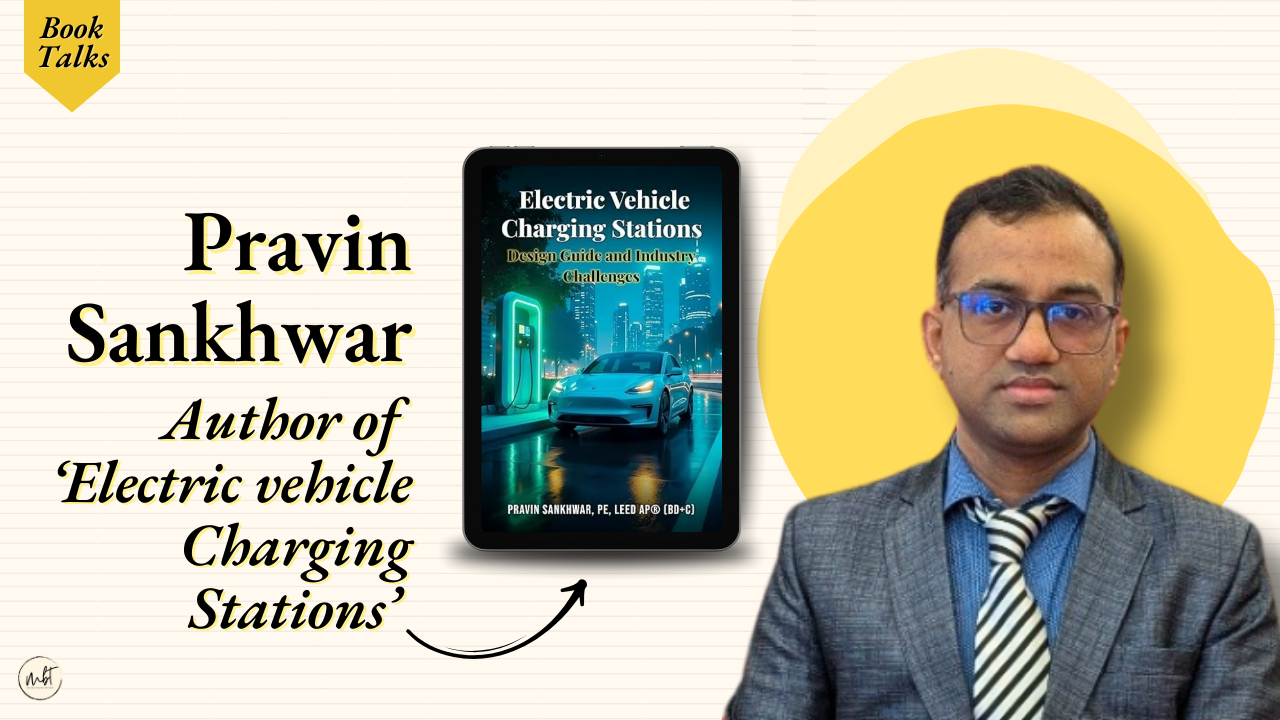

Electric Vehicle Charging Stations: Design Guide and Industry Challenges’ sheds light on the Electric Vehicle (EV) ecosystem encompassing types of EVs, Design technology, EV charging stations and its infrastructure needs, recent developments in growing markets, its co-relation with environment sustainability, usage and applications, international challenges, marketing and distribution strategies, case studies, and more. Everything one needs to know and learn about EVs, is well-researched and explained in this handbook that is nothing short of an encyclopedia for understanding how EVs work. As EVs gain momentum globally, the need for well-designed and efficient charging stations has become fundamental everywhere, making this book a valuable resource for professionals of the field.
1. Can you tell us a little bit about your book? Why did you choose this genre and what’s the story behind the title?
The market is seeing a shift towards sustainable development by increasing the use of either renewable energy or use of energy efficient systems. This book is focused on Electric Vehicles Charging Stations, which have a promising future both in electrification of the roadway transportation sector and increasing the decarbonization efforts in the electrical engineering industry. The motivation to select this genre that combines engineering knowledge into simplified concepts for readers without engineering background comes from my strong interest and expertise in electrical power industry.
The chosen title is driven by recent large-scale transition to electric vehicles and charging needs globally. More than 500 GW of installed capacity of renewable energy is anticipated in the Indian market; thereby, many researchers and authors like me are contributing from their academic and professional careers to materialize them. When I met young professionals and industry professionals during major academic and professional conferences, what I see as a major gap in electrification is lack of study material and reference books that explain the complex electrical power engineering standards is simplified manner. So, this book will assist both young emerging professionals and industry experts to learn and apply principles governing the power distribution systems design for electric vehicles charging infrastructure.
2. What inspired you to write this story? How did you find the resources and research material for your book?
The inspiration lies in my deep foundation in electrical power engineering principles, which is helpful in solving challenges with electrification. I am an active researcher and after reading current trends and developments in the electric vehicles industry, I realized how important it is for emerging professionals to learn about this rapidly growing technology. Given that my enthusiasm for power engineering applications are strengthened by professional experiences and licensure, I was inspired from my engineering career as well. The research materials I used were primarily latest engineering standards, journal papers, and reference manuals. It is hard to enlist because many of the concepts I demonstrated regarding sizing electrical system come from my years of academic and professional experience.
3. What was the most challenging aspect of writing this book? How did you overcome it?
Writing the book was a challenge not only from coming up with right framework but also building content that suits the needs of emerging academic and working professionals. Additionally, to dedicate time to a book is a challenging,; given most working professionals are bound by tight schedules. So, to overcome these challenges, I started by brainstorming the layout of the book. Eventually, after a couple of months, I was able to draft a manuscript ready to be proofread and published. This required following a schedule for writing and focusing on making necessary edits at frequency intervals. However, the challenges were never a limitation for me as they allowed me to become a better person. After writing this book, I see a positive outlook in me.
4. Are there any particular authors or books that have influenced the book?
I am influenced by Paulo Coelho work “The Alchemist”. The key to learning from this book is to follow your passion by overcoming challenges and utilizing the opportunities your way. Since my poetry books written in the past few years, I had never thought about writing a book in the power engineering genre. But somehow I overcame the challenges and used the opportunities my way to complete this book and present for my esteemed readers.
5. What role did editing play in the writing process? How did you decide when the manuscript was ready for publication?
This required me to consistently check my drafts after completion of a given chapter. So, my editing process was not focused on the very end but chapter by chapter. This helped me keep track of the editing processes in an organized and easy manner. Thus, my manuscript was ready for publication right upon completion of the final chapter.
6. Do you have any upcoming projects or ideas for future books that you’d like to share with your readers?
I am working on a research publication to be released later this year. The focus of this book is power engineering economics and how renewable energy can positively impact the industry when adopting electric vehicles. This is a more extensive research book backed up by analysis, calculations, simulations, and existing literature review. I hope my readers would like to learn about my book soon to be available on bookpi.org/bookstore/
7. In the age of digital publishing and social media, how do you engage with your readers and promote your work?
I strongly believe good content performs the magic. Word of mouth becomes a self-pilot for your books.
8. How do you balance your writing career with other aspects of your life, such as work and family?
Scheduling is a must in life. Writing needs focus and a tonnes of brainstorming that not only requires time but also patience. Trust me, if you have the patience to deal with varying types of situations; either personal or professional, there are no limits to finding useful time for pursuing a writing career. I took this as my statement as a key driver in my writing journey. I am lucky to have a great family. They motivate me; especially when I see my kids learning the alphabet and creating amazing drawings and sketches, I feel more responsibility towards my research and writing.
9. What’s the pen ultimate takeaway for readers reading your book?
Readers will love the concepts of electric vehicle charging, starting with learning about electric vehicles and the constituent components such as electric motors and battery packs. Eventually, there are concepts of electric vehicle charging and design that allow a practical understanding of how to provide power distribution for varying types of chargers (alternating current slow and direct current fast chargers). Someone with limited electrical engineering background would be able to apply their knowledge either as a user or a design professional.
10. What’s the one advice you’d like to share with aspiring writers of the genre?
The industry is growing, and to be environmentally responsible. Why not contribute towards balancing the social, economic, and environmental pillars of sustainability through books that integrate clean energy and their applications in our daily lives?

Pravin Sankhwar has been recognized with a 2024 Global Recognition Award for his significant contributions to the electrical engineering industry, particularly in advancing best practices in electrical design engineering, promoting sustainability, and driving innovations in renewable energy. His extensive academic background, including a master’s degree from Michigan Tech, a bachelor’s degree from Malaviya National Institute of Technology, and PhD candidacy, combined with years of practical experience, position him as a leader in his field. Sankhwar’s commitment to environmental stewardship is evident in his leadership on various projects to reduce carbon footprints and foster eco-friendly initiatives in electrical power generation, distribution, and consumption.
Explore the importance of ‘Electric Vehicle Charging Stations‘.