Howdy, reader?
The world is a potpourri of varied cultures and languages, isn’t it? To really understand this world and to connect with it, you have got to read books written in all the different languages of the world. It will not only expose you to the cultural differences, but also show you how beautiful every little part of the world is, how different the people are, how varied yet inclusive cultures are. Ever since I started reading books, I made it a habit to include at least one translated book in my reading list every month. I’ve explored a great many translated books including German, Italian, French, Russian, Spanish, Greek, etc. and of course, not to forget, our very own Indian languages.
Today on International Translation Day, I bring to you the choicest; if not all, of the world’s most translated books. I have read most of these titles and highly recommend whichever you choose to pick. I hope this gives you a taste of some of the best translated works in history and encourages you to read more of the world’s translated literature.

International Translation Day
International Translation Day (ITD) is celebrated on September 30th each year and is organized by the International Federation of Translators (FIT). Its main goal is to highlight the crucial role of translators worldwide. In 2023, the theme for ITD is ‘Translation unveils the many faces of humanity,’ emphasizing how translation reveals the diversity of human experiences, ideas, and cultures within our global community.
ITD serves as a platform to recognize and create awareness about the essential work of translators and interpreters who bridge linguistic and cultural gaps. Translation acts as a vital link between different societies, shedding light on and even influencing power dynamics. International Translation Day aims to shed light on these complexities and promote a better understanding of the challenges faced by translators, especially those working with indigenous languages.
Let’s peek into the list now.

Love in the Time of Cholera
Original Language: Spanish
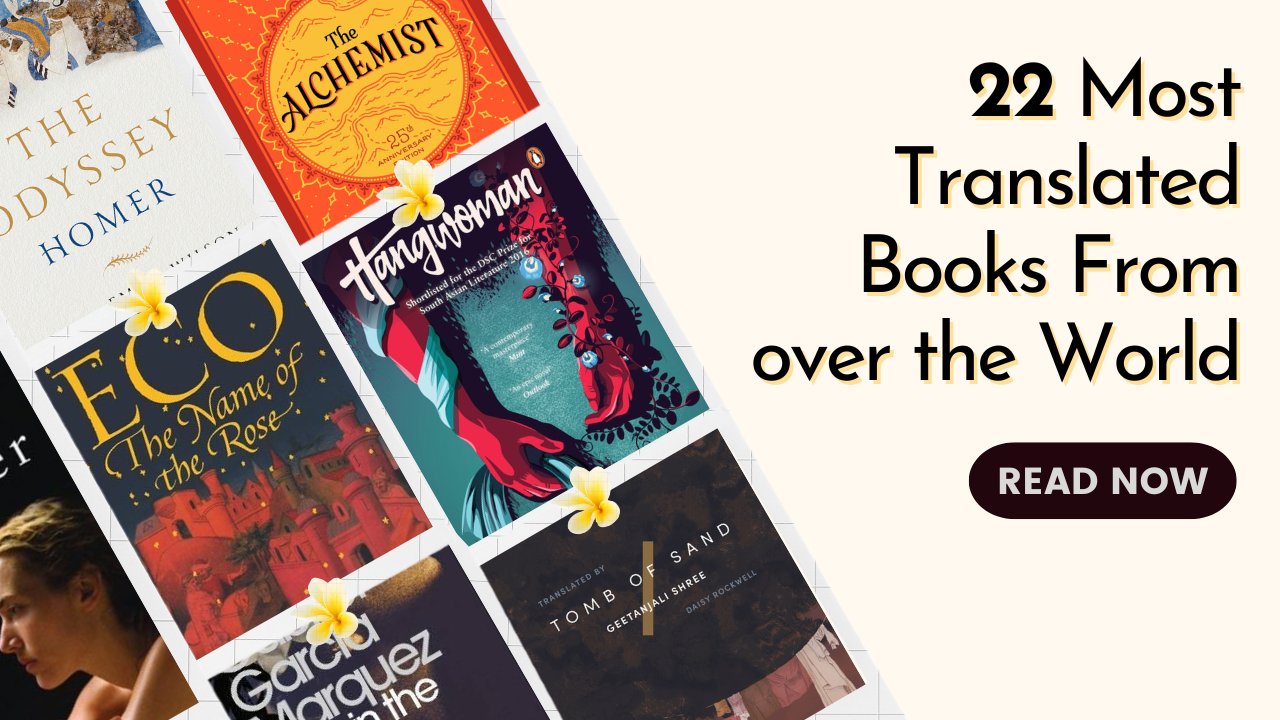
Florentino Ariza is a hopeless romantic who falls passionately for the beautiful Fermina Daza. Instead Fermina marries a distinguished doctor, while Florentino can only wait silently for her. He can never forget his first and only true love. Then, fifty-one years, nine months and four days later, Fermina’s husband dies unexpectedly. At last Florentino has another chance to declare his feelings and discovers if a passion that has endured for half a century will remain unrequited. García Márquez tells a tale that is a rich, fantastic, and humane celebration of love in all its many forms.

Tomb of Sand
Original Language: Hindi
An elderly woman overcomes depression after her husband’s death, embarking on an unconventional journey with a trans friend, confusing her modern daughter. They return to Pakistan, confronting her Partition trauma and redefining their identities as women, mothers, and feminists. Geetanjali Shree’s book, while addressing serious issues, maintains a playful and original tone, offering a timely protest against destructive borders and boundaries.

The Name of the Rose
Original Language: Italian
The year is 1327. Franciscans in a wealthy Italian abbey are suspected of heresy, and Brother William of Baskerville arrives to investigate. When his delicate mission is suddenly overshadowed by seven bizarre deaths, Brother William turns detective. He collects evidence, deciphers secret symbols and coded manuscripts, and digs into the eerie labyrinth of the abbey where extraordinary things are happening under the over of night. A spectacular popular and critical success, The Name of the Rose is not only a narrative of a murder investigation but an astonishing chronicle of the Middle Ages.

The Odyssey
Original Language: Greek
Wilson’s Odyssey captures the beauty and enchantment of this ancient poem as well as the suspense and drama of its narrative. Its characters are unforgettable, from the cunning goddess Athena, whose interventions guide and protect the hero, to the awkward teenage son, Telemachus, who struggles to achieve adulthood and find his father; from the cautious, clever, and miserable Penelope, who somehow keeps clamoring suitors at bay during her husband’s long absence, to the “complicated” hero himself, a man of many disguises, many tricks, and many moods, who emerges in this translation as a more fully rounded human being than ever before.

Bombay Stories
Original Language: Hindi
Arriving in 1930s Bombay, Saadat Hasan Manto discovered a city like no other. A metropolis for all, and an exhilarating hub of license and liberty, bursting with both creative energy and helpless despondency. A journalist, screenwriter, and editor, Manto is best known as a master of the short story, and Bombay was his lifelong muse. Vividly bringing to life the city’s seedy underbelly—the prostitutes, pimps, and gangsters that filled its streets—as well as the aspiring writers and actors who arrived looking for fame, here are all of Manto’s Bombay-based stories, together in English for the very first time. By turns humorous and fantastical, Manto’s tales are the provocative and unflinching lives of those forgotten by humanity.

Kafka on the Shore
Original Language: Japanese
Kafka on the Shore is a book with two interesting characters: Kafka, a teenager who runs away from home, either to escape a strange prophecy or find his missing family, and Nakata, an older man who is not very smart but has a unique connection to Kafka. As their stories come together, strange things happen in their world, like talking cats, fish falling from the sky, and spirits doing unusual things.

The Stranger
Original Language: French
Published in 1942 by French author Albert Camus, The Stranger has long been considered a classic of twentieth-century literature. Le Monde ranks it as number one on its “100 Books of the Century” list. Through this story of an ordinary man unwittingly drawn into a senseless murder on a sundrenched Algerian beach, Camus explores what he termed “the nakedness of man faced with the absurd.”

Death in Venice
Original Language: German
One of the most famous literary works of the 20th century, the novella “Death in Venice” embodies themes that preoccupied Thomas Mann (1875–1955) in much of his work; the duality of art and life, the presence of death and disintegration in the midst of existence, the connection between love and suffering, and the conflict between the artist and his inner self. Mann’s handling of these concerns in this story of a middle-aged German writer, torn by his passion for a Polish youth met on holiday in Venice, resulted in a work of great psychological intensity and tragic power.

Poonachi
Original Language: Tamil
In a twist of fate, an elderly couple receives a day-old female goat kid as a gift from the universe, marking the beginning of Poonachi’s remarkable journey. From the wilderness to civilization, independence to motherhood, her story mirrors our own fears and desires, driven by the instinct for survival. Poonachi, a goat who grapples with being different, embodies resilience against all odds, while also standing as a symbol of solidarity with the animal world and the female experience. This tale serves as a commentary on our society’s choices and the increasing vulnerability of those, especially writers and artists, who resist submission in our times.

If On a Winter’s Night a Traveller
Original Language: Italian
Based on a witty analogy between the reader’s desire to finish the story and the lover’s desire to consummate his or her passion, If on a Winter’s Night a Traveller is the tale of two bemused readers whose attempts to reach the end of the same book, If on a Winter’s Night a Traveller by Italo Calvino, of course, are constantly and comically frustrated. In between chasing missing chapters of the book, the hapless readers tangle with an international conspiracy, a rogue translator, an elusive novelist, a disintegrating publishing house, and several oppressive governments. The result is a literary labyrinth of storylines that interrupt one another—an Arabian Nights of the postmodern age.

Hangwoman
Original Language: Malyalam
The Grddha Mullick family is very proud of their long history that goes back 400 years before Christ. They have many exciting stories about hangmen and hangings in India. In today’s time, the youngest family member, Chetna, becomes India’s first female executioner, taking over from her father Phanibhushan. She becomes famous, even having her reality TV show. As her first execution date nears, she breaks free from her controlling father and manipulative lover, becoming a charismatic performer. Will she escape her love bonds, can she take a life, and will she honor her family’s name? The tale balances voyeurism and violence as it rushes toward its climax.

The Alchemist
Original Lanugage: Portuguese
Combining magic, mysticism, wisdom and wonder into an inspiring tale of self-discovery, The Alchemist has become a modern classic, selling millions of copies around the world. Paulo Coelho’s masterpiece tells the mystical story of Santiago, an Andalusian shepherd boy who yearns to travel in search of a worldly treasure. His quest will lead him to riches far different—and far more satisfying—than he ever imagined. Santiago’s journey teaches us about the essential wisdom of listening to our hearts, of recognizing opportunity and learning to read the omens strewn along life’s path, and, most importantly, to follow our dreams.

Cobalt Blue
Original Language: Marathi
A paying guest seems like a win-win proposition to the Joshi family. He’s ready with the rent, he’s willing to lend a hand when he can and he’s happy to listen to Mrs Joshi on the imminent collapse of our culture. But he’s also a man of mystery. He has no last name. He has no family, no friends, no history and no plans for the future. The siblings Tanay and Anuja are smitten by him. He overturns their lives and when he vanishes, he breaks their hearts. Elegantly wrought and exquisitely spare, Cobalt Blue is a tale of rapturous love and fierce heartbreak told with tenderness and unsparing clarity.

The Reader
Original Language: German
Originally published in Switzerland and gracefully translated into English by Carol Brown Janeway, The Reader is a brief tale about sex, love, reading and shame in post-war Germany. Michael Berg is 15 when he begins a long, obsessive affair with Hanna, an enigmatic older woman. He never learns very much about her and when she disappears one day, he expects never to see her again. But, to his horror, he does. Hanna is a defendant in a trial related to Germany’s Nazi past and it soon becomes clear that she is guilty of an unspeakable crime. As Michael follows the trial, he struggles with an overwhelming question: what should his generation do with its knowledge of the Holocaust?

Diary of a Young Girl
Original Language: Dutch
Anne Frank’s The Diary of a Young Girl is among the most enduring documents of the twentieth century. Since its publication in 1947, it has been a beloved and deeply admired monument to the indestructible nature of the human spirit, read by millions of people and translated into more than fifty-five languages. Anne was thirteen when the family went into the “Secret Annex,” and in these pages, she grows to be a young woman and proves to be an insightful observer of human nature as well. A timeless story discovered by each new generation, The Diary of a Young Girl stands without peer.

Hymns in Blood
Original Language: Punjabi
In 1947, Chakri, a picturesque village by the Soan near Rawalpindi, unites Muslims, Hindus, and Sikhs in joyful anticipation of Lohri. Baba Bhana, the wise village elder, is concerned about his foster daughter Naseem’s future. However, their happiness is shattered when news of India’s possible partition arrives, triggering communal violence. Forced to leave their beloved village, Baba Bhana’s family embarks on a perilous journey, realizing their lives may change forever. ‘Khoon de Sohile,’ first published in February 1948 and now available in English for the first time, serves as a poignant reminder of the sorrow and trauma caused by religious division.

Master and Margarita
Original Language: Russian
The Master and Margarita boldly reimagines the tales of Faust and Pontius Pilate, earning its place as a quintessential classic in modern Russian literature. Its portrayal of 1930s Soviet life was so brutally accurate that it couldn’t be published during the author’s lifetime and only emerged in a censored form in the 1960s.In this tale, the devil and his eccentric entourage descend upon Moscow one hot spring, causing chaos in a city that has abandoned belief in God and Satan. Yet, they also bring solace to two unhappy residents: the Master, a persecuted writer, and Margarita, who loves him enough to venture into hell. The novel brims with boundless energy, humor, and philosophical depth, with these nuances beautifully captured in Diana Burgin’s and Katherine Tiernan O’Connor’s English translation.

Four Chapters
Original Language: Bengali
‘Char Adhyay’ (1934), Rabindranath Tagore’s final novel, explores the complex interplay between passion and politics against the backdrop of pre-Independence India. Ela, a young working woman, is drawn to the charismatic political activist Indranath, who advocates using terror for the nationalist cause. She swears off marriage and commits herself to the struggle but falls in love with Atindra, a romantic poet from an aristocratic family. Their relationship exposes the shallowness of Indranath’s politics. Fearing Ela may expose them to the police, the political group assigns Atin the task of eliminating her, leading to a dramatic and tragic climax.

Phoolsunghi
Original Language: Bhojpuri
When Dhelabai, Muzaffarpur’s renowned tawaif, offends powerful zamindar Babu Haliwant Sahay from Chappra, he resolves to imprison her forever. Thus, the elusive phoolsunghi is ensnared within the Red Mansion’s walls. Dhelabai starts a new life of luxury, comfort, and respect, leaving her past behind. However, when she falls for Mahendra Misir’s soulful voice, they become entangled in a love story filled with challenges and separations due to circumstances and their own actions. “Phoolsunghi” offers the first-ever English translation of a Bhojpuri novel, immersing readers in a forgotten world of mujras, mehfils, court cases, counterfeit currency, and the flowing River Saryu.

Anna Karenina
Original Language: Russian
Anna Karenina seems to have everything – beauty, wealth, popularity and an adored son. But she feels that her life is empty until the moment she encounters the impetuous officer Count Vronsky. Their subsequent affair scandalizes society and family alike and soon brings jealously and bitterness in its wake. Contrasting with this tale of love and self-destruction is the vividly observed story of Levin, a man striving to find contentment and a meaning to his life – and also a self-portrait of Tolstoy himself.

Temple Lamp
Original Language: Persian
The poem ‘Chirag-e-Dair’ or Temple Lamp is an eloquent and vibrant Persian masnavi by Mirza Ghalib. While we quote liberally from his Urdu poetry, we know little of his writings in Persian, and while we read of his love for the city of Delhi, we discover in temple Lamp, his rapture over the spiritual and sensual city of Banaras.
Chiragh-e-dair is being translated directly from Persian into English in its entirety for the first time, with a critical Introduction by Maaz Bin Bilal. It is Mirza Ghalib’s pean to Kashi, which he calls Kaaba-e-Hindostan or the Mecca of India.

Les Miserables
Original Language: French
Victor Hugo’s tale of injustice, heroism and love follows the fortunes of Jean Valjean, an escaped convict determined to put his criminal past behind him. But his attempts to become a respected member of the community are constantly put under threat: by his own conscience, when, owing to a case of mistaken identity, another man is arrested in his place; and by the relentless investigations of the dogged Inspector Javert. It is not simply for himself that Valjean must stay free, however, for he has sworn to protect the baby daughter of Fantine, driven to prostitution by poverty.
Which is your most favorite translated book?