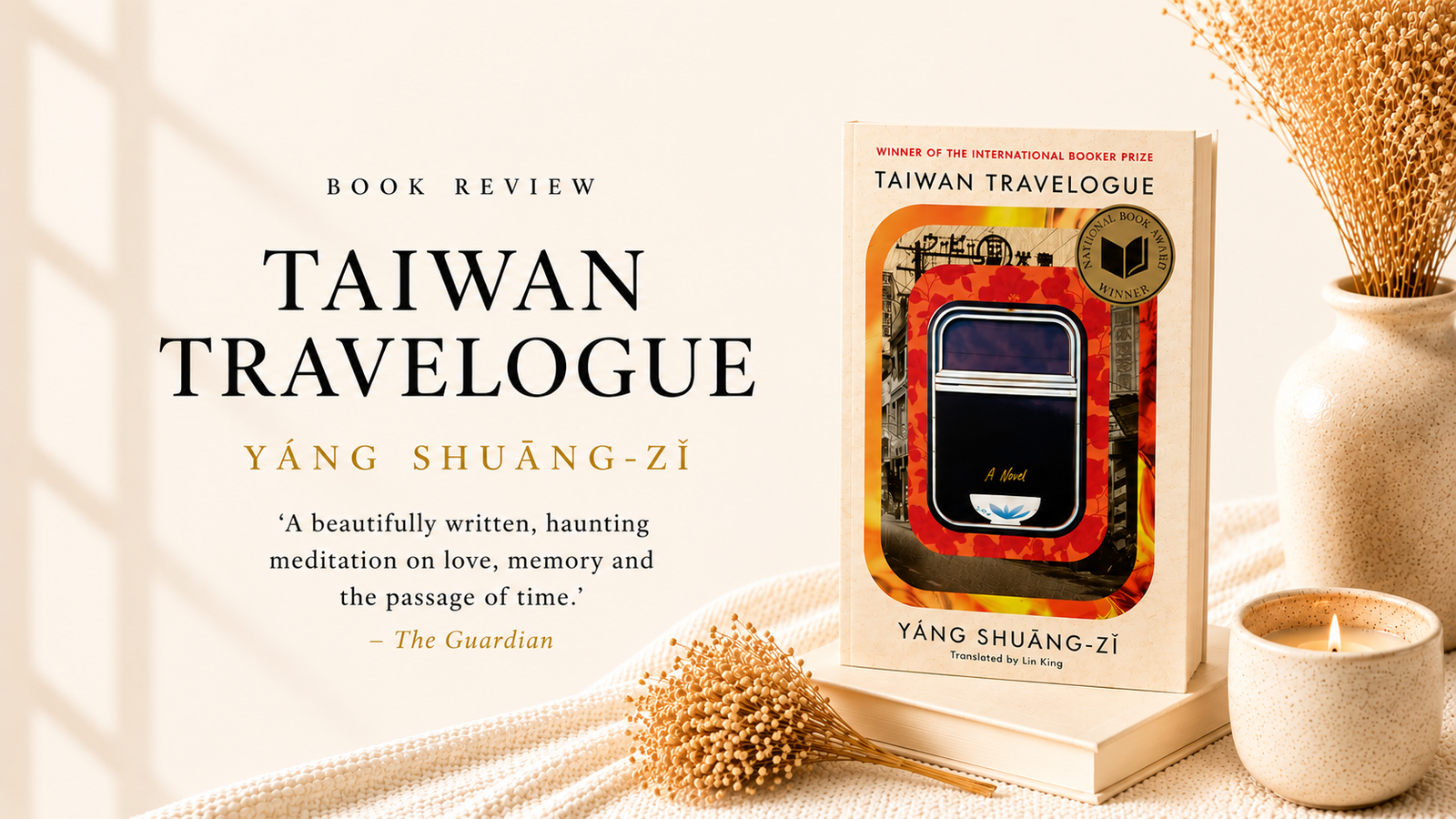
Taiwan Travelogue by Yáng Shuāng-zǐ: Review & Analysis
Plot Summary of Taiwan Travelogue
Set in 1938 during Japan’s colonial rule of Taiwan, Taiwan Travelogue by Yáng Shuāng-zǐ follows Aoyama Chizuko, a celebrated young Japanese novelist invited to Taiwan for a lecture tour. Although the colonial authorities expect her to participate in official cultural events, Chizuko arrives with a different objective. Instead of limiting herself to formal engagements, she hopes to experience the “real” Taiwan through its people, landscapes, and, most importantly, its food.
To help navigate the island, she is accompanied by Ō Chizuru, a Taiwanese interpreter whose intelligence, poise, and quiet reserve immediately capture Chizuko’s attention. As the two women journey across Taiwan, sharing meals, conversations, and observations, their relationship gradually develops into something far more complex than friendship. At the same time, an uncomfortable reality begins to surface. Beneath the warmth of their growing connection lie the unequal power dynamics of colonial rule, cultural hierarchy, and unspoken desires that neither woman can fully escape.
Review of Taiwan Travelogue, International Booker Winner
At first glance, Taiwan Travelogue reads like a historical travel narrative, rich with descriptions of food, train journeys, and cultural encounters. As the story unfolds, however, Yáng uses these seemingly ordinary experiences to explore larger questions of colonialism, identity, language, desire, and power.
Rather than driving the narrative through dramatic events, she builds it through shared meals, train rides, conversations, and observations gathered along the journey. Consequently, deeper tensions emerge gradually, often revealing themselves through seemingly mundane interactions. Throughout the novel, translation functions as a form of negotiation, while personal relationships mirror the broader power structures that define colonial society.
Instead of relying on dramatic confrontations, Yáng allows meaning to accumulate slowly. In doing so, she invites readers to pay attention not only to what is said, but also to what remains unsaid. Ultimately, much of the novel’s emotional and intellectual richness resides in the spaces between words, actions, and silences.
Characters Analysis in Taiwan Travelogue
Aoyama Chizuko
Chizuko is a fascinating protagonist because she embodies both curiosity and contradiction. On the one hand, she genuinely admires Taiwan and develops a deep affection for Chizuru. On the other, she remains largely unaware of the privileges afforded to her as a Japanese citizen within a colonial system.
As a result, her enthusiasm, curiosity, and enormous appetite make her immediately engaging, while her blind spots reveal the limitations of her perspective. It is precisely this combination of warmth and unawareness that makes her such a memorable character.
Ō Chizuru
By contrast, Chizuru emerges as the novel’s most compelling and enigmatic figure. Intelligent, multilingual, and emotionally guarded, she navigates a world shaped by social hierarchy and colonial power. Throughout the novel, she carefully controls what she reveals, keeping parts of herself hidden from both Chizuko and the reader.
Consequently, a sense of distance and ambiguity surrounds her character. Yet rather than creating frustration, this mystery deepens the novel’s emotional impact. In many ways, Chizuru embodies the tensions at the heart of the story, making her impossible to fully understand and, therefore, impossible to forget.
Taiwan
Perhaps most impressively, Yáng transforms Taiwan from a backdrop into an active presence within the narrative. Rather than simply housing the story, the island actively shapes it.
As Chizuko and Chizuru travel across Taiwan, its cities, railway lines, food stalls, markets, and landscapes reveal layers of history, contradiction, and cultural exchange. Meanwhile, the island’s diverse influences continuously intersect, creating a setting that feels dynamic rather than static. As a result, Taiwan becomes inseparable from the novel’s emotional and thematic core.
Setting & Themes in Taiwan Travelogue
Through train journeys, bustling markets, restaurants, rural settlements, and detailed descriptions of local cuisine, Yáng brings colonial era Taiwan vividly to life. More importantly, she grounds the narrative in everyday experiences, allowing food to guide readers through the island’s history, customs, social structures, and cultural traditions.
At the same time, she highlights Taiwan’s layered identity by weaving together Japanese, Taiwanese, Chinese, Indigenous, and Western influences. Rather than presenting these traditions separately, she shows how they overlap, interact, and occasionally conflict with one another. Consequently, the setting becomes a powerful lens through which readers can examine questions of identity, belonging, and cultural memory.
Key themes include:
- Colonialism and cultural power
- Food as identity and memory
- Translation and miscommunication
- Female desire and intimacy
- National identity and belonging
- History told through personal stories
Writing Style in Taiwan Travelogue
Yáng Shuāng-zǐ writes with sophistication while remaining remarkably accessible. To begin with, she structures the novel as a translated historical text, incorporating notes, annotations, and multiple perspectives that continuously encourage readers to question authorship, memory, and interpretation.
At the sentence level, her prose shines through its sensory richness, particularly in scenes centered on food. Rather than merely describing meals, she uses them to explore emotion, identity, politics, and power. Through vivid imagery, she evokes the aromas of soups, the textures of local delicacies, and the atmosphere of crowded markets and dining halls.
That said, the novel’s layered structure occasionally slows the pace. Footnotes, narrative framing devices, and shifting viewpoints demand close attention. Even so, readers who embrace these complexities will likely discover a richer and more rewarding experience. In the end, the novel’s formal ambition becomes one of its greatest strengths.
Strengths and Weaknesses of Taiwan Travelogue
Strengths:
- Brilliantly layered narrative structure
- Rich exploration of colonial Taiwan
- Memorable and emotionally complex characters
- Stunning food writing and cultural detail
- Nuanced exploration of power and identity
Weaknesses:
- Slow pacing may challenge some readers
- Dense metafictional structure requires concentration
- Emotional revelations are often understated
Who Should Read Taiwan Travelogue?
This novel is ideal for readers who enjoy:
- Historical literary fiction
- International Booker Prize winners
- Books about food and culture
- Queer literary fiction
- Postcolonial narratives
- Character-driven stories
If you loved Pachinko, The Vegetarian, Butter, or A Tale for the Time Being, there is a good chance Taiwan Travelogue will resonate with you.
Final Verdict for Taiwan Travelogue
Taiwan Travelogue begins as a journey through food, travel, and cultural discovery. Gradually, however, Yáng expands its scope to explore questions of power, identity, memory, and belonging.
Through the evolving relationship between Chizuko and Chizuru, she examines how history shapes personal connections and how stories transform as they pass through different voices, languages, and interpretations. At the same time, she uses food, travel, and translation to illuminate the cultural and political forces that influence everyday life.
Ultimately, Taiwan Travelogue offers far more than a historical travel narrative. Instead, it delivers a layered and thought provoking reading experience that continues to resonate long after the final page, inviting readers to reflect on the complex relationship between history, identity, and storytelling itself.
Buy your copy of ‘Taiwan Travelogue’

FAQs
Is Taiwan Travelogue, the International Booker Prize Winner worth reading?
Yes. It is one of the most inventive and rewarding works of translated literary fiction in recent years, combining history, food, identity, and emotional depth.
What genre is Taiwan Travelogue?
It is historical literary fiction with elements of queer fiction, metafiction, travel writing, and postcolonial literature.
Is Taiwan Travelogue based on real history?
Yes. The novel is set during Japan’s colonial occupation of Taiwan and draws heavily from historical realities.
Why is food so important in the novel?
Food functions as a way of exploring culture, memory, identity, and colonial power, making it one of the novel’s central storytelling devices.
Why has Taiwan Travelogue received so much attention?
The novel has been widely praised for its innovative structure, rich historical detail, and nuanced exploration of power, identity, and desire. It also became the first Mandarin language novel to win the International Booker Prize.