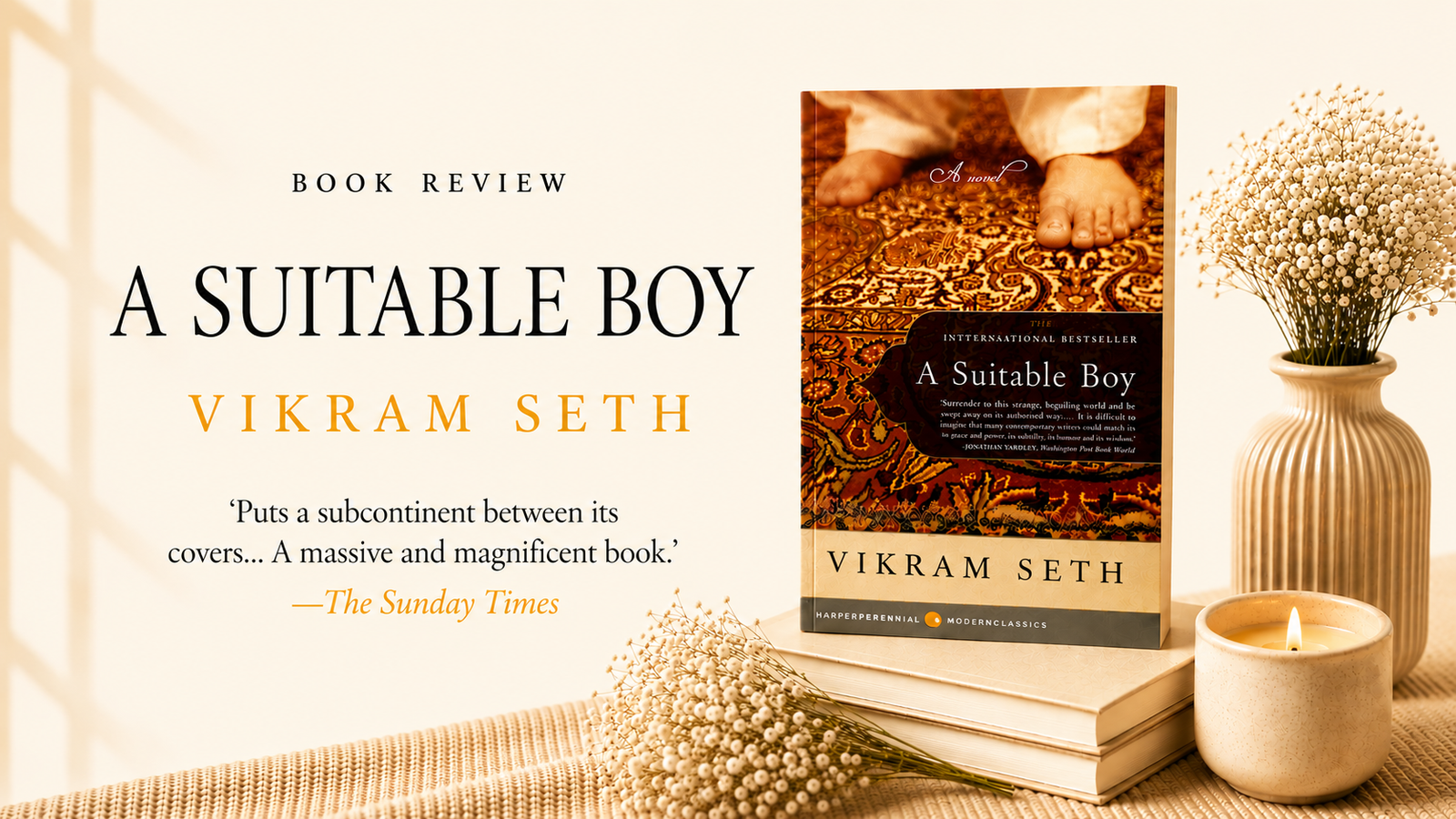
Few novels attempt to capture an entire nation in transition. Fewer still succeed. Yet with A Suitable Boy, Vikram Seth accomplishes exactly that. Published in 1993, this monumental novel remains one of the defining achievements of Indian English literature, not merely because of its size but because of its extraordinary ambition, emotional depth, and historical richness.
At nearly 1,500 pages, A Suitable Boy is often remembered as one of the longest novels written in English by a single author. However, reducing it to its length misses the point entirely. At its heart, this is a deeply human story about family, love, identity, and choice, unfolding against the backdrop of a newly independent India trying to define itself.
More than three decades after publication, the novel continues to attract new readers, inspire academic discussions, and find fresh audiences through its acclaimed television adaptation. It remains one of the most immersive portraits of India ever written, offering readers not only a compelling story but also a remarkable window into a nation at a pivotal moment in its history.
Plot Summary of A Suitable Boy by Vikram Seth
Set in the early 1950s, shortly after India’s independence, the story revolves around nineteen-year-old Lata Mehra and her family’s determination to find her a suitable husband.
Lata, however, has ideas of her own.
As she navigates her feelings for three very different suitors, Haresh Khanna, Amit Chatterji, and Kabir Durrani, her personal journey unfolds alongside the stories of four interconnected families whose lives reflect the social, political, and cultural realities of a changing nation.
What begins as a seemingly simple marriage story gradually expands into an intricate exploration of post-Independence India. Through elections, land reform debates, religious tensions, educational institutions, and family dynamics, Seth creates a sweeping portrait of a country standing at the crossroads of tradition and modernity.
Review of A Suitable Boy by Vikram Seth
At first glance, A Suitable Boy appears to be a novel about arranged marriage. As the story unfolds, however, it becomes clear that Vikram Seth is interested in far more than romantic matchmaking.
Through the lives of his characters, he explores how individuals negotiate duty, desire, family expectations, religion, politics, and social change. Rather than presenting these themes as abstract ideas, Seth embeds them within everyday interactions, allowing readers to experience history through intimate personal stories.
One of the novel’s greatest strengths is its accessibility. Despite its immense scope, the prose remains remarkably clear and engaging. Seth never overwhelms readers with literary flourishes. Instead, he writes with elegance, precision, and emotional intelligence, allowing the story and characters to take centre stage.
The novel rewards patience rather than speed. Instead of relying on dramatic twists, Seth builds emotional investment gradually, creating a reading experience that feels immersive and deeply rewarding.
Characters Analysis in A Suitable Boy by Vikram Seth
Lata Mehra
Lata serves as the emotional heart of the novel. Intelligent, thoughtful, and quietly independent, she struggles to balance her own desires against the expectations imposed by family and society.
Although her story revolves around marriage, her true journey concerns self-determination and personal freedom. Even today, Lata feels remarkably modern, which explains why readers continue to connect with her decades after the novel’s publication.
Mrs. Rupa Mehra
Few literary mothers are as memorable as Rupa Mehra. Driven by equal parts love, anxiety, and social obligation, she devotes herself to finding the ideal husband for her daughter.
While her persistence often creates conflict, Seth portrays her with warmth and humour, ensuring she remains sympathetic rather than controlling.
Maan Kapoor
Impulsive, passionate, and deeply flawed, Maan provides some of the novel’s most emotionally charged moments. His relationship with Saeeda Bai introduces themes of desire, class, and social convention that ripple throughout the narrative.
Saeeda Bai
One of the novel’s most compelling characters, Saeeda Bai embodies both strength and vulnerability. Through her story, Seth examines the limitations imposed by social structures while highlighting the complexities of love and sacrifice.
Haresh, Amit, and Kabir
Lata’s three suitors each represent different possibilities for her future. Through them, Seth explores questions that remain universally relevant: Should marriage be built on passion, compatibility, friendship, practicality, or family approval?
Setting & Post-Independence India in A Suitable Boy by Vikram Seth
Perhaps the novel’s greatest achievement lies in its recreation of India during the years immediately following Independence.
Rather than treating history as a backdrop, Seth makes it an active force within the narrative. The country is still recovering from Partition, democratic institutions are finding their footing, and social norms are evolving rapidly.
The fictional city of Brahmpur serves as the novel’s primary setting, yet it feels representative of countless North Indian cities navigating similar transitions. Through bustling markets, university campuses, legislative assemblies, family homes, villages, temples, mosques, courtyards, and riverside ghats, Seth constructs a vivid social landscape that feels alive on every page.
What makes the setting particularly remarkable is its breadth. Readers move effortlessly between urban and rural India, political gatherings and domestic spaces, elite circles and ordinary households. As a result, the novel captures not only the diversity of Indian society but also the tensions that accompany periods of rapid change.
The India of A Suitable Boy is hopeful yet uncertain, traditional yet modernising, fractured yet striving toward unity. Seth captures these contradictions with extraordinary nuance.
More importantly, the setting never feels ornamental. The streets, universities, villages, legislative chambers, and family homes actively shape the choices and opportunities available to the characters. Through these spaces, Seth reveals how history is experienced not through headlines, but through ordinary lives.
Themes in A Suitable Boy by Vikram Seth
At its heart, A Suitable Boy is a novel about choice. Nearly every major character faces decisions that force them to balance personal desires against family expectations, social pressures, and historical realities.
Love versus Duty
The most obvious theme emerges through Lata Mehra’s search for a husband. Torn between multiple possibilities, she must decide whether love alone is enough to sustain a marriage or whether companionship, stability, and shared values matter more. Through her journey, Seth explores questions that remain relevant across generations and cultures.
Family Expectations and Individual Freedom
Throughout the novel, characters struggle to define themselves within the boundaries imposed by family and society. Parents want security for their children, but those same expectations often clash with personal ambitions and emotional needs. Seth examines this tension with remarkable nuance, refusing to portray either side as entirely right or wrong.
Tradition versus Modernity
Set during the early years of independent India, the novel captures a society in transition. Old customs continue to shape daily life, yet new ideas about education, politics, gender roles, and personal freedom are beginning to take root. The conflict between tradition and modernity runs through almost every storyline.
Religion and Communal Harmony
One of the novel’s most powerful achievements is its exploration of Hindu-Muslim relations in the years following Partition. Rather than presenting simplistic narratives, Seth highlights both the tensions and the possibilities for coexistence. Through personal relationships and political events, he demonstrates how communal divisions affect everyday lives.
Politics and Nation Building
Unlike many family sagas, A Suitable Boy places national politics at the centre of its narrative. The novel captures India’s first general elections, debates around land reform, and the challenges of building democratic institutions in a newly independent nation. These political developments never feel detached from the story. Instead, they influence the lives, opportunities, and choices of the characters in meaningful ways.
Identity and Belonging
Many characters struggle to determine where they fit within a rapidly changing society. Whether navigating class differences, religious identities, professional ambitions, or personal relationships, they constantly seek a sense of belonging. This search for identity gives the novel much of its emotional depth.
Taken together, these themes transform A Suitable Boy from a marriage story into a profound exploration of post-Independence India and the universal challenges of adulthood, love, and self-discovery.
Writing Style in A Suitable Boy by Vikram Seth
One of the most remarkable aspects of A Suitable Boy is how effortlessly Vikram Seth manages an enormous narrative without ever overwhelming the reader. At nearly 1,500 pages, the novel could easily have become dense or inaccessible. Instead, Seth writes with a clarity and confidence that make even the most complex political discussions and family dynamics feel engaging.
His prose is elegant but never showy. Rather than drawing attention to language for its own sake, Seth allows the characters, conversations, and situations to carry the emotional weight of the story. The result is writing that feels natural, immersive, and deeply human.
What makes Seth particularly impressive is his ability to balance multiple genres within a single narrative. A Suitable Boy is simultaneously a family saga, a coming-of-age novel, a love story, a political novel, and a social history of India. Yet these elements never feel disconnected. He moves seamlessly between intimate domestic scenes and larger national developments, allowing readers to see how politics and history shape ordinary lives.
Dialogue is another of Seth’s greatest strengths. Each character possesses a distinct voice, making the novel’s large cast surprisingly easy to follow. Conversations feel authentic, whether they take place in family drawing rooms, university campuses, legislative assemblies, or village courtyards.
The pacing is deliberate rather than fast. Seth takes his time building relationships, exploring motivations, and developing the social world around his characters. While some readers may find certain political or administrative sections slower than others, these passages contribute significantly to the novel’s authenticity and historical richness.
Ultimately, Seth’s greatest achievement lies in making a novel of such scale feel intimate. Despite its vast scope, A Suitable Boy never loses sight of the individual lives at its centre, which is why the story remains emotionally resonant decades after its publication.
The BBC & Netflix Adaptation of A Suitable Boy
The enduring appeal of A Suitable Boy became evident once again in 2020 when acclaimed filmmaker Mira Nair adapted the novel into a six-part television series for BBC One, later released globally on Netflix.
The adaptation starred:
- Tanya Maniktala as Lata Mehra
- Ishaan Khatter as Maan Kapoor
- Tabu as Saeeda Bai
- Rasika Dugal
- Ram Kapoor
- Namit Das
Visually, the series captures the colours, architecture, fashion, and atmosphere of 1950s India beautifully. The production design deserves particular praise for bringing Seth’s world to life.
That said, condensing a novel of this scale into six episodes inevitably required significant cuts. While the adaptation successfully captures the central emotional arcs, it cannot fully replicate the depth, political nuance, and expansive character development found in the novel.
For many viewers, the series serves as an excellent introduction. The book, however, remains the definitive experience.
Strengths and Weaknesses of A Suitable Boy
Strengths
- Extraordinary world building
- Richly developed and memorable characters
- A nuanced portrait of post-Independence India
- Elegant and accessible prose
- Emotional depth combined with political insight
- One of the finest family sagas in modern literature
Weaknesses
- Its length may intimidate some readers
- Certain political discussions can feel dense
- The large cast requires patience and attention
Who Should Read A Suitable Boy by Vikram Seth?
A Suitable Boy is not a novel for readers seeking quick thrills or fast-paced plot twists. Instead, it rewards those who enjoy immersing themselves in richly developed worlds and spending time with complex, fully realised characters.
This book is particularly well suited for readers who enjoy literary fiction that prioritises character development and emotional depth over plot-driven suspense. Readers who appreciate expansive family sagas such as Pachinko, The Covenant of Water, The Thorn Birds, or The Forsyte Saga will find much to admire in Seth’s sweeping narrative.
The novel is also ideal for readers interested in Indian history and culture. Through its portrayal of post-Independence India, it offers a fascinating exploration of a nation navigating democracy, social reform, religious identity, and modernisation.
Historical fiction enthusiasts will appreciate the meticulous recreation of 1950s India, while readers drawn to character-driven stories will find themselves invested in the lives, relationships, and personal struggles of Seth’s unforgettable cast.
Finally, if you watched Mira Nair’s television adaptation and found yourself wanting more, the novel provides a far richer and more layered experience. The book expands every storyline, deepens every relationship, and offers a more nuanced understanding of the social and political forces shaping the characters’ lives.
In short, A Suitable Boy is perfect for readers who love books that become worlds. It demands time and patience, but few novels reward that investment more generously.
Final Verdict for A Suitable Boy by Vikram Seth
More than thirty years after its publication, A Suitable Boy remains one of the defining achievements of Indian English literature. What begins as a mother’s search for a husband for her daughter gradually becomes a sweeping portrait of a nation learning how to navigate freedom, democracy, tradition, and change. Through unforgettable characters, meticulous world building, and a richly textured depiction of post-Independence India, Vikram Seth creates a literary experience that feels both intimate and monumental. If you’re willing to invest the time, A Suitable Boy offers one of the most rewarding reading journeys in contemporary literature.
Buy your copy of ‘A Suitable Boy’

FAQs
Is A Suitable Boy by Vikram Seth worth reading?
Absolutely. While its length may seem daunting, the novel offers one of the richest and most immersive reading experiences in modern literature.
What is A Suitable Boy about?
The novel follows Lata Mehra and her family’s search for a suitable husband while exploring politics, religion, family dynamics, and social change in post-Independence India.
Is A Suitable Boy based on a true story?
No. It is a work of fiction, although it draws heavily from the social and political realities of India during the 1950s.
Was A Suitable Boy adapted into a TV series?
Yes. The novel was adapted into a six-part television series directed by Mira Nair in 2020. The series aired on BBC One and later became available on Netflix.
Is the A Suitable Boy adaptation faithful to the book?
The adaptation captures the novel’s central narrative and historical setting, but the book offers significantly greater depth, character development, and political context.
What period is A Suitable Boy set in?
The novel is set in the early 1950s, shortly after India’s Independence and Partition, during a period of profound social and political transformation.
Why is post-Independence India important in A Suitable Boy?
The historical setting shapes nearly every aspect of the story. Through elections, land reform, religion, education, and social change, the novel explores how a newly independent nation attempts to define its future.
Who are the main characters in A Suitable Boy?
The primary characters include Lata Mehra, Mrs. Rupa Mehra, Maan Kapoor, Saeeda Bai, Haresh Khanna, Amit Chatterji, and Kabir Durrani.
Why is A Suitable Boy considered a classic?
Its combination of memorable characters, historical depth, social insight, emotional intelligence, and literary craftsmanship has secured its place as one of the most important works of Indian English fiction.