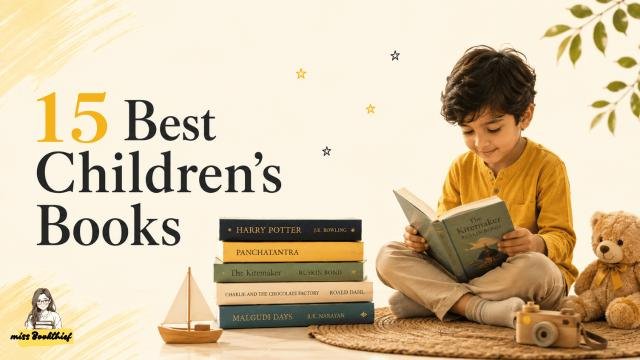
Books can open doors that children didn’t even know existed. A good children’s book can take a young reader to a chocolate factory, introduce them to talking animals, send them down a rabbit hole, or even help them understand history, culture, friendship and courage.
Reading from a young age does much more than improve vocabulary. Reading helps children develop imagination, empathy, curiosity and an understanding of the world around them. And thankfully, there is no shortage of wonderful books for young readers, from timeless classics to Indian stories rooted in culture and history.
Authors such as Roald Dahl, Milne, Judy Blume, Eric Carle and Lewis Carroll have created unforgettable worlds for generations of children. And Indian writers such as R.K. Narayan and Ruskin Bond to Sudha Murty, Roopa Pai and Vishnu Sharma, have given us equally wonderful literary treasures for children.
Here are 15 of the best children’s books to add to your child’s bookshelf.
Charlie and the Chocolate Factory by Roald Dahl

When Charlie discovers one of Willy Wonka’s coveted Golden Tickets, he gets the chance to enter the mysterious chocolate factory and meet its eccentric owner. What follows is a wildly imaginative adventure filled with chocolate rivers, unusual inventions and some very memorable children. Roald Dahl’s classic is entertaining on the surface but also sneaks in lessons about greed, kindness, humility, and good behaviour.
Winnie-the-Pooh by A.A. Milne

A.A. Milne’s beloved bear, Winnie the Pooh, lives in Hundred Acre Wood and is fond of honey. Pooh, who is well-known for his kind nature and straightforward intelligence, goes on wacky adventures with his pals Piglet, Eeyore, Tigger, and Christopher Robin. Pooh’s charming stories have enthralled audiences of all ages, imparting timeless lessons on generosity, friendship, and the happiness that may be found in the little things in life. It is the kind of book that children enjoy for the characters while adults quietly discover something meaningful between the pages.
Alice’s Adventures in Wonderland by Lewis Carroll

Alice follows a white rabbit that she notices pulling a watch out of its waistcoat pocket, and an odd series of events begins. The complete surreal tales of Alice’s Adventures in Wonderland and Through the Looking-Glass are included in this little book.
Malgudi Days by R. K. Narayan

R. K. Narayan’s collection of short stories, “Malgudi Days,” has garnered praise from readers worldwide. It was first published in 1943 and is comprised of thirty-two short stories that aptly depict rural life in that bygone age. The majority of the stories are set in the made-up village of Malgudi, and some people appear more than once. Among them is Swami, a charming little student in class 2, and the focus of the novel is on his home, school, and friends.
Panchtantra by Vishnu Sharma

Panchtantra, which translates to “five books,” is a compilation of various moral tales about animals with human-like characteristics and levels of intelligence. The teachings and stories are all loosely connected, yet the plots aren’t as straightforward and dull as most moral stories tend to be.
The Vedas and Upanishads for Children by Roopa Pai

The Vedas are the books that provide Hindu philosophy its foundation, despite the fact that they are not fiction. The Upanishads are an interpretation of them as well as a part of the oldest books in the world. Children will find this book to be a lovely introduction to the Vedic school of thinking, and adults will also find it to be interesting.
How I Taught My Grand Mother to Read by Sudha Murty

Sudha Murty is a teacher, social worker, and best-selling author. Her collection of stories offers insightful lessons on standing up for what’s right and having the guts to follow your dreams. It tells interesting tales of truancy, frugal living, and keeping word to maintain a well stocked local library.
A Christmas Carol by Charles Dickens

Chapman & Hall released the first edition of it on December 19, 1843. It narrates the tale of Ebenezer Scrooge and his metamorphosis as a result of a paranormal visit from the spirit of his former business partner, Jacob Marley, and some other ghosts.
A Little Princess By Frances Hodgson Burnett

A Little Princess is a classic children’s tale by Frances Hodgson Burnett, featuring Sara Crewe as a princess sent to England to attend Miss Minchin’s boarding school. Sara’s friends and imagination help her find happiness; despite being treated poorly by Miss Minchin,
Animal Farm by George Orwell

The oppressed animals of Manor Farm believe that when they defeat Mr. Jones, their master, and seize control of the farm, it will make their lives filled with equality and freedom. But over time, a crafty, brutal elite among them begins to take charge; this group is led by the pigs Napoleon and Snowball. The other animals quickly come to realize that they are not all as equal as they had believed, and they find themselves helplessly trapped as one kind of despotism gives way to another. The terrifying ‘fairy narrative’ by George Orwell is a timeless and scathing parody of idealism betrayed by corruption and power.
Kite Maker by Ruskin Bond

The themes of custom, mortality, loneliness, contentment, independence, kindness, pride, and change are explored in this Ruskin Bond’s novel. This could be significant because, metaphorically, Bond might be implying that Mehmood has developed along with the city or the changing environment.
Pashmina by Nishi Chanani

Priyanka Das, a young girl with unanswered questions about her mother’s abandonment of her home in India, finds a mysterious pashmina in a forgotten suitcase. She is transported to a vivid, colorful place, but questions arise about the real India soon. To uncover the truth, Pri must travel farther and find the family she never knew. This heartwarming graphic novel debut by Nidhi Chanani explores the hardship and self-discovery that comes from juggling two cultures and worlds.
A Children’s History of India by Subhadra Sen Gupta

A Children’s History of India is a comprehensive history of India, revealing the first cities, Mughal times, British rule, and India’s changes after independence. The book explores the baths, palaces, and flamboyant courts of Harappa, Ashoka, and Mughal courts, as well as the revolution of 1857 and Gandhi’s quest for freedom. It features fun activities and engaging prose, making learning history enjoyable for readers of all ages.
Daddy’s Turban By Inni Kaur

Daddy’s Turban is a bilingual book about a Sikh boy, Tegh, who is fascinated by his father’s turban and his desire to grow up quickly. The story celebrates Sikh culture and Dastar Bandi, a revered ceremony. Suitable for children aged 4-10. It also includes a multicultural essay on Dastar Bandi, useful for educators teaching the significance of turban wearing.
Harry Potter and the Sorcerer’s Stone by J.K. Rowling

Harry Potter discovers a purple wax seal with a coat of arms surrounded by a large letter ‘H’. He is unaware of Hogwarts until letters drop on his doormat, addressing him in green ink on yellowish parchment. His aunt and uncle confiscate them. On his eleventh birthday, Rubeus Hagrid announces Harry is a wizard and has a place at Hogwarts School of Witchcraft and Wizardry, marking the start of an incredible adventure.
What Makes a Great Children’s Book?
The best children’s books do more than keep young readers occupied.
They help children imagine more, question more and understand more.
A great children’s book can:
- Encourage creativity and imagination
- Build vocabulary and language skills
- Develop empathy and emotional intelligence
- Introduce children to different cultures and perspectives
- Help them understand history and society
- Encourage curiosity and independent thinking
- Make reading feel like an adventure rather than a homework assignment
And perhaps most importantly, the right book at the right age can turn a child into a lifelong reader.
How to Choose Books for Your Child
Not every wonderful book will be right for every child.
A four-year-old and a twelve-year-old naturally need very different reading experiences. When choosing books, consider the child’s age, reading ability, interests and attention span. And don’t worry if a child wants to read the same book again and again. Re-reading is reading too.
Final Thoughts: Best Children’s Books
Some books make children laugh, some make them think, and some teach them about cultures and history. And others simply provide a quiet place to escape for a while. From Chocolate factory and Hogwarts, to the ancient stories of the Panchatantra, these books offer young readers something invaluable: the freedom to imagine.
So, pick a book, make some reading time, and let the adventure begin.
Because sometimes, the book a child picks up today becomes the book they remember for the rest of their life.
Frequently Asked Questions About Children’s Books
What are the Best Children’s Books to read?
Charlie and the Chocolate Factory, Winnie-the-Pooh, Alice’s Adventures in Wonderland, Harry Potter and the Philosopher’s Stone, Panchatantra and books by Indian authors such as Sudha Murty, R.K. Narayan and Ruskin Bond.
Which books should a child read first?
Picture books and illustrated stories are generally good starting points for younger children. As their reading ability develops, they can move towards early readers, chapter books and longer novels.
Are classic books suitable for children today?
Yes. Many classic children’s books continue to be enjoyable for modern readers. However, parents may want to consider the language, themes and age suitability of individual books.
What are some Best Children’s Books from Indian writers?
Panchatantra, Malgudi Days, The Vedas and Upanishads for Children, The Kitemaker, Daddy’s Turban and A Children’s History of India are good options for children.
How can I encourage my child to read?
Let children choose books based on their interests, create a regular reading routine, read together and avoid turning reading into a chore. Finding the right book is often more effective than insisting on a particular book.
Should children read books outside their age group?
They can explore books slightly above or below their usual reading level, provided the themes are appropriate. Parents and educators can help children choose books that challenge them without becoming frustrating.