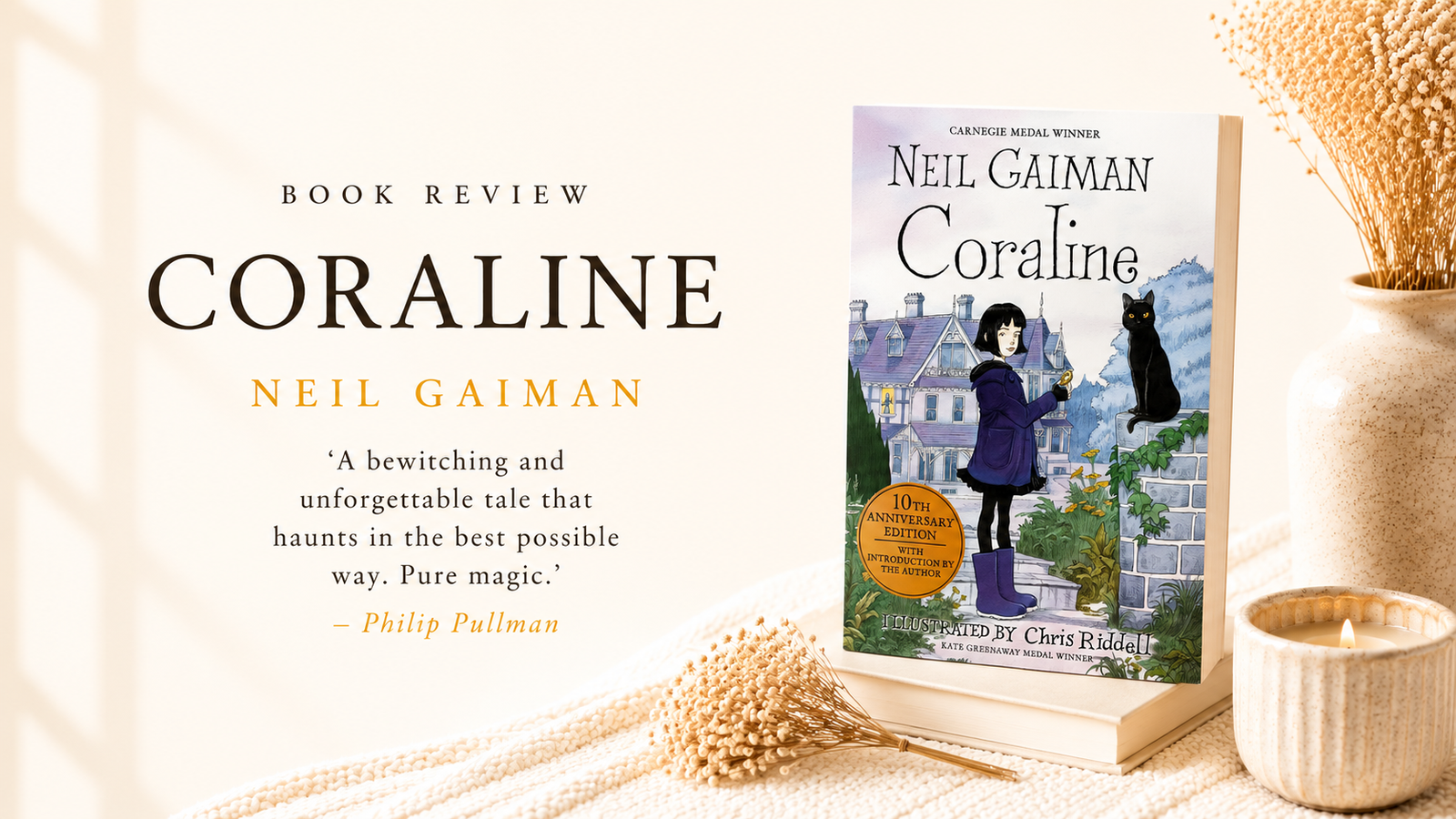
Coraline by Neil Gaiman: Review & Analysis
Plot Summary of Coraline by Neil Gaiman
There’s a reason why Coraline by Neil Gaiman remains readers’ favorites even today. But what is it about this story that bewitches readers so? We are going to talk about the various facets of this book that makes it a masterpiece.
When Coraline and her parents move into a sprawling old house divided into flats, boredom quickly drives her to explore every corner of her new home. Behind a mysterious locked door, she discovers a passage leading to what appears to be another version of her own world. At first glance, everything seems better there. The food is tastier, the garden is livelier, and her “Other Mother” and “Other Father” shower her with the attention she craves.
Yet beneath this perfect façade lurks something deeply unsettling. The Other Mother, with her button eyes and unnervingly warm smile, wants Coraline to stay forever, but only if she gives up far more than she realizes. As children disappear, souls remain trapped, and her own parents go missing, Coraline must rely on her wit, resilience, and courage to confront a force that thrives on temptation and control.
What begins as a whimsical adventure soon transforms into a chilling battle between illusion and reality, forcing Coraline to decide whether comfort is worth the price of freedom.
Review of Coraline by Neil Gaiman
At first glance, Coraline reads like a classic children’s fantasy filled with talking cats, hidden doors, and eerie adventures. However, Neil Gaiman gradually peels back that familiar surface to reveal a sophisticated gothic fairy tale that examines fear, loneliness, manipulation, and the quiet courage required to resist false promises.
Rather than relying on conventional horror, Gaiman creates unease through atmosphere and suggestion. The terror rarely comes from graphic imagery. Instead, it emerges from subtle distortions of the ordinary. A loving mother becomes possessive. A comfortable home becomes a prison. A dream world slowly reveals itself as a carefully constructed trap.
At the same time, the novel never loses sight of its emotional core. Coraline’s journey is not about defeating monsters alone. It is about learning to distinguish genuine love from obsessive control, temporary pleasure from lasting happiness, and bravery from the simple absence of fear. As a result, Coraline succeeds equally as children’s fiction and one of the best horror books to read for young adult audience. Younger readers may experience it as an unforgettable adventure, while older audiences will likely recognize its deeper psychological and symbolic layers.
Characters Analysis in Coraline by Neil Gaiman
Coraline
Coraline immediately stands apart from many young protagonists because she refuses to remain passive. Curious, stubborn, resourceful, and often impatient, she approaches problems with determination rather than despair. Importantly, Gaiman never portrays her as fearless. On the contrary, Coraline frequently experiences genuine terror. Nevertheless, she repeatedly chooses to act despite that fear, making her courage feel earned rather than effortless.
The Other Mother
The Other Mother, also known as the Beldam, ranks among modern fantasy’s most unforgettable antagonists. She rarely resorts to outright violence in the beginning. Instead, she seduces, manipulates, and offers perfection tailored to her victim’s deepest desires. Her button eyes have become iconic, yet they symbolize something far more disturbing than appearance. They represent the surrender of individuality and free will in exchange for comfort and certainty.
The Cat
The nameless black cat serves as Coraline’s enigmatic guide throughout the story. Independent, perceptive, and impossible to control, it exists comfortably between worlds while refusing to belong entirely to either. Although it often provides cryptic advice rather than direct assistance, the cat quietly encourages Coraline to trust her own judgment and confront danger on her own terms.
Setting & Themes in Coraline by Neil Gaiman
Gaiman builds much of the novel’s tension through setting. The old house feels isolated without becoming overtly sinister, while the hidden passage creates a liminal space between reality and nightmare. Meanwhile, the Other World mirrors Coraline’s everyday life with unsettling precision. It appears brighter, richer, and more exciting, but every detail carries a faint sense of artificiality. The longer Coraline stays, the more this manufactured perfection begins to decay, exposing the emptiness beneath its surface.
Throughout the novel, Gaiman explores several enduring themes:
- Courage in the face of fear
- Identity and personal agency
- The dangers of false perfection
- Childhood loneliness and emotional neglect
- Manipulation disguised as affection
- Freedom versus comfort
Ultimately, Coraline argues that authentic relationships, with all their imperfections, hold far greater value than flawless illusions designed to control us.
Writing Style in Coraline by Neil Gaiman
Neil Gaiman writes with remarkable economy, proving that simplicity need not sacrifice depth. His prose remains accessible to younger readers while quietly embedding layers of symbolism and psychological insight that reward adult audiences. Moreover, he balances whimsy and horror with exceptional precision. Moments of humour soften the darkness without diminishing it, while brief descriptive passages create vivid mental images that linger long after reading. The pacing in Coraline by Neil Gaiman also deserves a mention. Gaiman wastes very little space, allowing suspense to build steadily while ensuring that every encounter advances either the plot or Coraline’s emotional growth.
Strengths and Weaknesses of Coraline by Neil Gaiman
Strengths
- A memorable and courageous young protagonist
- One of modern fantasy’s most iconic villains
- Rich gothic atmosphere without excessive horror
- Accessible writing layered with symbolism
- Strong emotional and psychological themes
Weaknesses
- Its brevity may leave some readers wanting deeper world building
- Secondary characters receive limited development
- Younger readers sensitive to horror elements may find parts unsettling
Who Should Read Coraline by Neil Gaiman?
Coraline will appeal to readers who enjoy:
- Gothic fantasy
- Dark fairy tales
- Middle grade fiction with mature themes
- Psychological horror
- Neil Gaiman’s imaginative storytelling
- Stories about courage and self discovery
It is particularly rewarding for adults revisiting it, as many of its themes reveal greater complexity with age.
Final Verdict for Coraline by Neil Gaiman
Coraline succeeds because it understands that the scariest monsters rarely hide under the bed. Instead, they offer exactly what we think we want. Neil Gaiman transforms a seemingly simple adventure into a meditation on courage, choice, and identity, crafting a story that feels just as unsettling decades later. Whether you read it as a child discovering hidden worlds or as an adult recognizing the dangers of seductive illusions, Coraline remains a haunting reminder that true bravery lies in choosing reality, even when fantasy looks far more inviting.
FAQs
Q1. Is Coraline by Neil Gaiman worth reading?
Absolutely. It combines gothic fantasy, psychological suspense, and emotional depth in a way that appeals to both younger readers and adults.
Q2. Is Coraline a children’s book or horror novel?
It is primarily a middle grade fantasy novel, but it incorporates elements of gothic horror and psychological suspense that make it enjoyable for readers of all ages.
Q3. What is the main theme of Coraline by Neil Gaiman?
The novel explores courage, identity, free will, manipulation, and the importance of embracing imperfect but genuine relationships over artificial perfection.
Q4. Is Coraline scarier than the movie?
Many readers find the novel subtler but psychologically more unsettling, relying on atmosphere and implication rather than visual scares.
Q5. Why has Coraline become a modern classic?
Its memorable protagonist, timeless themes, haunting villain, and elegant blend of fantasy and horror have made it one of Neil Gaiman’s most enduring and widely discussed works.
Buy your Copy of ‘Coraline’ by Neil Gaiman today