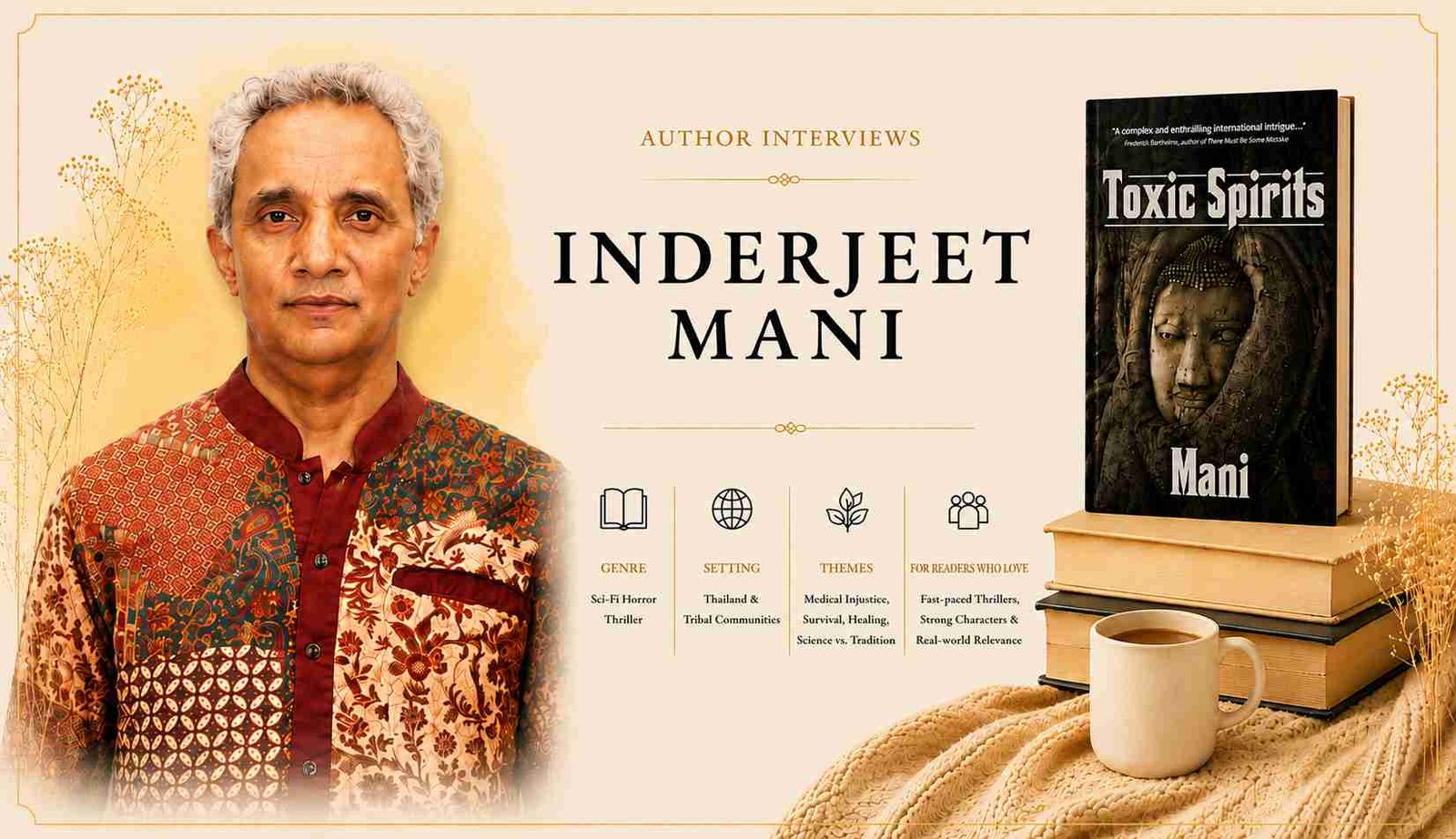

Benton, a widowed African-American intelligence analyst from Washington, retires to Thailand. At an expat bar, he is captivated by Siri, a beautiful tribal singer. When Siri disappears, he discovers that she had been speaking out about the side-effects from drug trials conducted on her hill-tribe. Benton’s investigations draw him uncomfortably close to Pierre, the seriously disturbed Indo-Cambodian doctor running the trials. Becoming an unwilling guinea-pig in the trials, Benton is transformed by the genetically-engineered drugs and falls in love with Mimi, a stunning and gifted young Thai-Australian muay thai boxer. As the genetic manipulations spiral out of control, spreading to the botanical treasures of Thailand’s Golden Triangle, the forces of tribal healing, high-tech medicine, and love battle to determine who will survive.
Read the full review : https://missbookthief.com/toxic-spirits-by-inderjeet-mani-book-review/
Read the interview with the author of Toxic Spirits, Mr Inderjeet Mani, here:
- Can you tell us a little bit about your book? Why did you choose this genre and what’s the story behind the title?
Toxic Spirits is a sci-fi horror thriller. It’s about the mischief carried out by Big Pharma on tribal communities in Thailand, based in part on real events, both in terms of drug trials on unsuspecting subjects as well as the extremely violent incendiary event which happened to our neighbour in Austin, Texas. The storyline is this: after retiring to Thailand, an American former intelligence analyst investigates the disappearance of a local singer, only to get dangerously entangled in a sinister medical trial. Subjected to genetically-engineered drugs, he must navigate an escalating, chaotic clash between high-tech medicine, tribal healing, and survival. As you can see, the genre is a natural fit for the subject matter.
2. What inspired you to write this story? How did you find the resources and research material for your book?
I retired to Thailand in 2008 to write. Although I had more time to write, I didn’t really find myself retiring. I instead worked as a volunteer teacher of math in the early 2000s with hill tribe children in the mountains near Chiang Rai. Their families called their mountains home, and they’d lived there for half a century or more, but they were treated as outsiders by the Thais, and at the tiime, they weren’t given Thai citizenship. I’ve always been drawn to the marginalized, and so I found them to be very interesting.
I was also close friends with the late Dr. Otome Klein Hutheesing, a well-known Chiang Mai-based Dutch anthropologist (someone who had married into the Nehru family), who introduced me to the Lisu tribe and one of their shamans. Herbal medicines was widely used by the Lisu and other tribes, living as they did in a botanically very rich environments, learning through trial and error which plants were helpful or harmful. While relaxing in a circular Lisu hut with Otome, I came across an article in The Independent that discussed Indian tribals being exploited by drug companies for clinical trials. I couldn’t help wondering how such medical mischief and injustice might extend to tribals in Thailand, and thus a novel about healing was born.
In a way, this book is both an introduction to anyone who plans to visit Thailand or who has done so already. It is also my love letter to Thailand.
3. What was the most challenging aspect of writing this book? How did you overcome it?
The main challenge was dealing with Pierre, the seriously disturbed Indo-Cambodian doctor and main villain of the book who kept speaking to me at all hours of the day and night! He had a powerful voice and did not leave me in peace! I had to move to another town for two weeks and lock myself in a room to write those horrifying parts.
Another challenge was that this is hard sci-fi, namely sci-fi that could become real in the near-term. So I based the genetics part on real science. It was a challenge to try and render all that in an accessible way to readers. But feedback from reviews made it clear I had succeeded. A doctor and expert in cancer drug development wrote that he was greatly impressed by the accuracy and verisimilitude of the biomedical aspects. Reviews have praised Toxic Spirits for the way it expertly balances a suspenseful plot with rich, complex characters, while at the same time creating a fast-paced, highly atmospheric thriller. You can imagine how thrilled I was when Frederick Barthelme, author of New Yorker stories and many novels and story collections wrote that it was a “A complex and enthralling international intrigue with a treasure of remarkable detail neatly packed into a short novel that dances on the edge of John le Carré territory. A rich read from start to finish.” Another reviewer, Colin Cotterill, author of whodunits such as The Coroner’s Lunch, from the Dr. Siri Paiboun mystery series, and sixteen other novels set in Laos and Thailand, also praised its accessibility and effects.
4. Are there any particular authors or books that have influenced the book?
None in particular. Thailand has a very strong ghost culture and a lively horror movie tradition, so I think some of it rubbed off on me. The novel’s international intrigue and stylish thriller aspects also suggested to several reviewers works by John le Carré.
5. What role did editing in the writing process? How did you decide when the manuscript was ready for publication?
My publisher’s editor did a fantastic job of editing. It was my first novel, and all my prior writing had been of a more literary kind rather than thriller material. He actually gave me a crash course on how to manage time, suspense, and other aspects of thriller writing. With novels it’s very important for a writer to keep track of the clock, though some famous writers have been inconsistent. The clock is also important for the reader, to make sure the reader can be cued as to how much time has elapsed between events, and make sure that any jumps in time are such that they minimize cognitive load on the user, and so that the variations in narrative pace are sensible and in tune with the structure of the story. Although I had written a book about narrative and time in literature, it was harder to actually put these discoveries in practice! I also took a course on screenwriting in case it was useful. We went through several edits, which reduced the length of the MS considerably. I also had several others read it and provide feedback. Thus, I knew when it was finally done.
6. Do you have any upcoming projects or ideas for future books that you’d like to share with your readers?
In the last year, three books of mine came out. Captain Mani’s War, which is an edit of my father’s WW2 dispatches, has been featured in several podcasts and newspapers. The Song of Love and Longing is my translation from the Sanskrit of Jayadeva’s Gita Govinda. Narrative and Generative AI is a scholarly book on AI and its use in storytelling. So, after so many books (eleven so far!) I am taking a break and traveling the world for a bit, while cogitating about a philosophical fable.
7. In the age of digital publishing and social media, how do you engage with your readers and promote your work?
I do what’s needed and what I feel comfortable doing. A lot depends on the book and its appeal.
8. How do you balance your writing career with other aspects of your life, such as work and family?
It was very difficult until I retired early at 50.
9. What do you intend your readers to takeaway from your book?
I have no message, but overall, the reader may want to take a deep breath and maybe a cold shower. Overall, it should inspire the reader to live well, love well, and be wary.
10. What’s the one advice you’d like to share with aspiring writers of the genre?
Write what you know, which is often prescribed by other writers, is the wrong advice! In fiction, you don’t have to write only what you know, as you don’t really know other people’s lives intimately. But you do have to sound plausible, and for that you have to rely on your personal experiences and feelings, as well as a lot of research on the background. In addition, you have to read widely, not just in the genre but the classics of world literature. I recommend against reading too much contemporary fiction, as it can dilute inspiration. Above all, believe in yourself and be persistent and diligent in your writing practice.