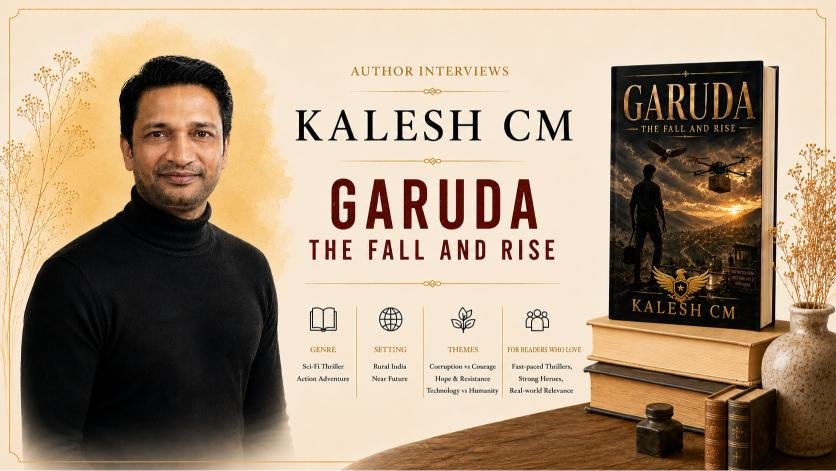
When Vikram loses his father to a counterfeit medicine, grief drives him to fight the corrupt system controlling rural Maharashtra. With a teacher and mechanic, he builds V-Link and Garuda, a drone network delivering authentic medicines to those cut off from help. What begins as a mission of hope becomes a dangerous battle against criminals, surveillance, corporate greed, and powerful enemies. Garuda: The Fall and Rise is a gripping techno-thriller about innovation, resistance, dignity, and technology built for everyone.

Read the full review : https://missbookthief.com/garuda-by-kalesh-cm-book-review/
Read the interview with the author of Garuda, Mr Kalesh CM, here:
- Can you tell us a little bit about your book? Why did you choose this genre and what’s the story behind the title?
Garuda: The Fall and Rise is a social and technological thriller about a young engineer who loses his father to counterfeit medicine and decides to challenge the system that allowed it to happen. With a teacher, a scrapyard mechanic, and a drone built from discarded machinery, he gives an isolated village a way to bypass corruption—quite literally.
I chose the thriller genre because injustice rarely moves slowly in real life. It arrives through blocked roads, fake medicines, frightened officials, and powerful people who expect silence.
The title came naturally. Garuda, the mighty mythical bird associated with the Ramayana, represents strength, protection, and freedom from bondage. In my novel, that ancient symbol is reborn as a cargo drone. “The Fall” is personal—grief, failure, and loss. “The Rise” belongs not only to Vikram, but to an entire community that finally learns to look upward.
2. What inspired you to write this story? How did you find the resources and research material for your book?
The seed of the story came from a very personal disruption. At the beginning of COVID-19, I lost my job in the UAE and returned to India, where I had to spend thirty days in mandatory isolation. During that period, even getting essentials felt unnecessarily difficult. I kept thinking: What happens to people in remote areas when roads fail, movement stops, or the supply chain simply forgets them?
At the same time, I was unemployed and desperately exploring start-up ideas. That is when the concept of using drones for essential deliveries began to take shape.
My research came from two places. The technical side—drone logistics, offline communication, supply chains, and counterfeit medicine—came largely from online research. But the emotional truth came from travelling through rural areas and seeing last-mile problems firsthand. Poor roads, delayed medicines, limited connectivity, and dependence on middlemen were not theories to me. They were lived realities.
So, the novel began with a simple question: What if technology reached the people who are usually reached last?
3. What was the most challenging aspect of writing this book? How did you overcome it?
The hardest part was making the technology believable without allowing it to overpower the human story. A drone can be impressive, but readers do not emotionally connect with machinery. They connect with grief, fear, courage, and the cost of resistance.
I also wanted the corruption to feel real without turning every antagonist into a cartoon villain. Systems are often more dangerous than individuals because ordinary people learn to cooperate with them.
I overcame this by repeatedly returning to one question: What does this moment mean for the people of the village? I simplified technical passages, rewrote scenes that felt too explanatory, and made sure every innovation created a new human consequence.
In the end, Garuda had to be more than a flying machine. It had to carry medicine, certainly—but also trust, defiance, and the dangerous idea that neglected communities do not always need permission to solve their own problems.
4. Are there any particular authors or books that have influenced the book?
Quentin Tarantino once said, “I steal from every single movie ever made.” I would say the same about books—I steal from every book ever written. Not the sentences, of course, but the courage, rhythm, questions, and emotional tricks that good writers leave behind.
I would not say Garuda was shaped by one particular novelist. Beyond that, I was influenced more by socially conscious fiction than by conventional science fiction—stories where technology matters, but people matter more. I admire writers who expose how power hides inside ordinary systems: transport, medicine, money, bureaucracy.
But the biggest influence was not a bookshelf. It was the road.
The villages I travelled through, the delayed medicines, poor connectivity, dependence on middlemen, and the quiet dignity of people solving problems with almost nothing—those experiences shaped the novel more than any single book.
So, while many writers influenced my imagination, real people gave the story its pulse.
5. What role did editing in the writing process? How did you decide when the manuscript was ready for publication?
Editing played a smaller role than most writers would proudly admit. I did not chase perfection. The book arrived with a certain momentum, so I wrote it, read it, noticed the imperfections—and decided not to polish away its pulse.
Perhaps laziness is part of my creative philosophy. Or perhaps that is simply the respectable name I give it.
I have always preferred the energy of something freshly made to the stiffness that can come from endless refinement. Too much editing can sometimes make a manuscript technically cleaner but emotionally colder.
I knew the book was ready when the flaws no longer distracted me from the story. It was not perfect, but it was alive. That mattered more.
At some point, a writer has to stop correcting the book and allow the book to leave home. Garuda reached that point when I could read it and still feel the urgency that made me write it in the first place.
6. Do you have any upcoming projects or ideas for future books that you’d like to share with your readers?
Yes. My next project begins with an old trunk discovered after a flood in a rural village. Inside are five letters, written forty years earlier and addressed to five different people.
Each letter carries something unfinished—a confession, a wound, a regret, or a truth that arrived decades too late.
The story explores guilt, grief, redemption, and the stubborn goodness that survives even in damaged people. I am interested in what happens when the past refuses to remain buried and when ordinary people are forced to confront the versions of themselves they thought they had escaped.
At heart, it is not really a story about a trunk or even a flood. It is about memory.
Because sometimes water does not merely wash things away. Sometimes it returns what we spent a lifetime hiding.
7. In the age of digital publishing and social media, how do you engage with your readers and promote your work?
Honestly, I am not a natural social-media creature. I am socially awkward, and for a long time my entire readership consisted of friends and family—some supportive, some trapped by blood relation.
Digital publishing has helped me reach beyond that very forgiving circle. I share extracts, ideas, book visuals, and the real experiences behind my stories. I try not to promote the book every five minutes. Nobody follows an author to be chased through the internet by a “Buy Now” button.
I prefer genuine conversations, even if they begin slowly. One thoughtful message from a reader means more to me than a thousand silent likes.
So my strategy is simple: write honestly, appear online occasionally, behave slightly uncomfortable, and hope the right readers discover the work.
8. How do you balance your writing career with other aspects of your life, such as work and family?
Balancing writing, work, and family is less a system and more a controlled emergency—which is fortunate, because I am an occupational health and safety professional.
As a Chartered Member of IOSH UK, my daily work is about dealing with people, identifying problems, assessing risks, and offering practical solutions. Writing is surprisingly similar. The hazards are different: unfinished chapters, disappearing ideas, family interruptions, and the occasional dangerous belief that I can finish everything in one evening.
My profession has trained me to observe people closely. Behind every unsafe act, conflict, or poor decision, there is usually a human reason. That understanding naturally enters my fiction.
I write around work and family rather than separately from them—early mornings, late nights, and small gaps in between. There is no perfect balance. I simply manage the competing risks and hope the residual risk remains acceptable.
9. What do you intend your readers to takeaway from your book?
I would like readers to take away one simple idea: failure is not the opposite of progress; often, it is the route.
Samuel Beckett wrote, “Ever tried. Ever failed. No matter. Try again. Fail again. Fail better.” That thought sits quietly at the heart of Garuda.
Vikram does not begin as a hero. He begins as a grieving, unemployed man with an idea that may not work. The village does not rise because someone arrives to rescue it. It rises because ordinary people stop waiting for permission.
I do not want readers to finish the book believing that drones will save society. Technology is only a tool. People save one another.
So the takeaway is this: when the road is blocked, do not spend your whole life complaining about the road. Sometimes, you build wings.
10. What’s the one advice you’d like to share with aspiring writers of the genre?
I am not sure I have earned the right to advise aspiring writers—I am still deciding whether I qualify as one myself.
But I have learned one useful thing: do not wait until you feel ready. Readiness is often just fear wearing formal clothes.
Write the story before you overanalyse it. Finish the imperfect draft. Research what must be accurate, especially when your fiction touches technology, medicine, politics, or real communities—but do not let research become a sophisticated method of avoiding the page.
For socially conscious thrillers, never begin with a message and then manufacture characters to carry it. Begin with people. Give them desires, contradictions, humour, bad decisions, and something real to lose. Readers may admire your argument, but they will remember the human being trapped inside it.
And perhaps the most practical advice: complete the book. An imperfect finished manuscript can be improved. A perfect unwritten novel is only a very impressive excuse.
Buy your copy now: