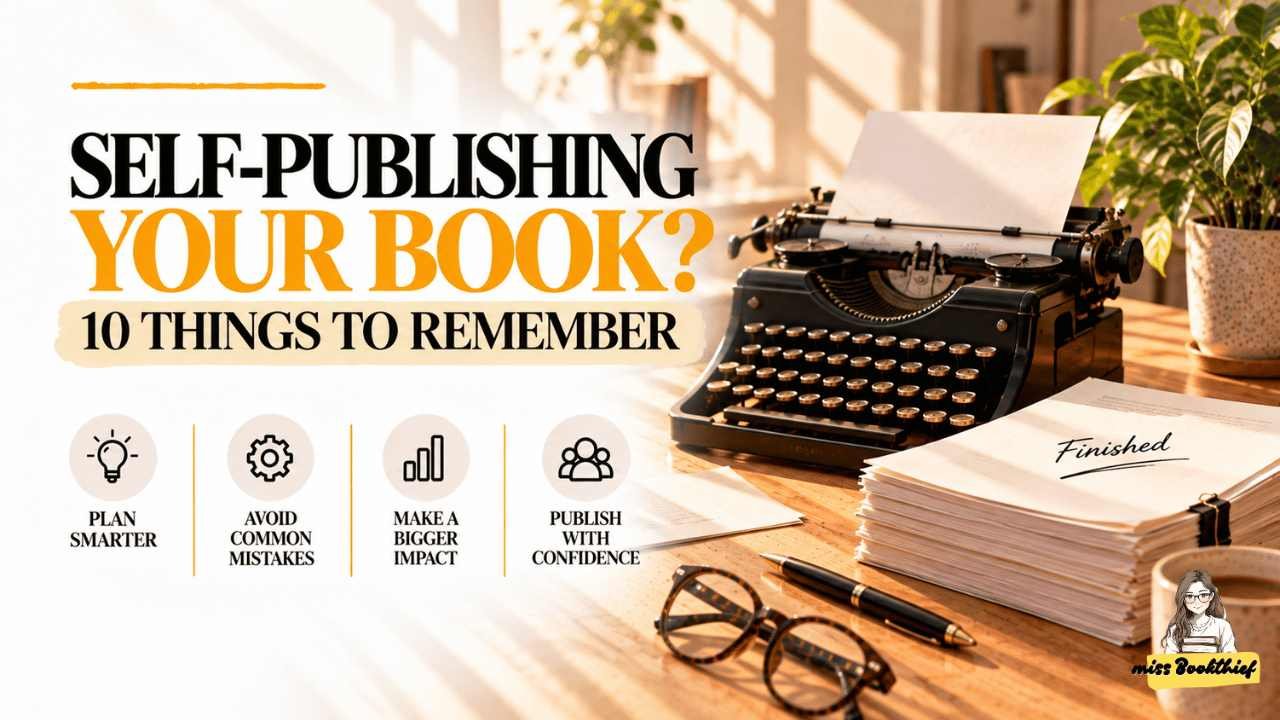
Finishing your manuscript can feel like the biggest hurdle in becoming a published author. However, once the last sentence is written, another set of important decisions begins. If you are planning to self-publish, you will need to think about everything from editing and cover design to printing, distribution, pricing, royalties, and the publishing agreement itself.
Unlike traditional publishing, where many of these decisions are handled by a publishing house, self-publishing puts much more control in the author’s hands. That control can be incredibly valuable, but it also means understanding what you are signing up for before you commit to a publishing company or service.
Therefore, before you upload your manuscript, sign a publishing package, or spend money on getting your book into print, it is worth taking a step back and looking at the entire process. A little research at this stage can help you avoid unnecessary costs, protect your rights, and make better decisions about your book.
Whether you are publishing a novel, memoir, poetry collection, children’s book, business book, or nonfiction title, here are 10 important things to consider before self-publishing your book.
1. Make Sure Your Manuscript Is Actually Ready
The first question you should ask yourself is not which self-publishing company you want to use. Instead, ask whether your manuscript is genuinely ready to become a finished book.
Completing a manuscript and preparing it for publication are two different things. Once the writing is finished, the book still needs to be reviewed for structure, clarity, consistency, language, grammar, and overall readability. Consequently, rushing from the final draft straight into publishing can mean overlooking problems that become much harder and more expensive to fix later.
This is particularly important when you have been working on the same manuscript for months or even years. Because you are so familiar with your own writing, you may automatically fill in gaps in your head or overlook sentences that a new reader would find confusing.
Don’t confuse editing with proofreading
It is also important to understand that editing and proofreading are not the same service. Developmental editing looks at the bigger picture, including structure, pacing, character development, narrative flow, or the organisation of a nonfiction book. Copy editing, on the other hand, focuses more closely on language, grammar, clarity, consistency, and sentence construction.
Proofreading generally comes later and focuses on catching remaining spelling, punctuation, typographical, and formatting errors before publication. Therefore, if a publishing package simply says that “editing” is included, ask what that actually means.
Before signing up, find out what type of editing is being provided, how many rounds are included, who will be editing your manuscript, and whether you will have the opportunity to review and approve the changes. That small amount of clarity can make a significant difference to the quality of the finished book.
2. Choose the Right Publishing Model
Self-publishing does not necessarily mean doing every single part of the process yourself. Instead, authors can choose how much of the publishing journey they want to manage independently and how much they want to outsource.
For example, you might choose to work with a self-publishing company that handles editing, design, printing, and distribution as part of a package. Alternatively, you could hire an independent editor, work with a separate cover designer, use a print-on-demand platform, and manage your own distribution and marketing.
Both approaches can work. The better choice depends on your experience, budget, available time, and how much involvement you want in the process.
Understand what you are actually paying for
Most importantly, don’t assume that every publishing package offers the same thing simply because the services have similar names. One company may offer substantial editorial support, while another may provide only basic proofreading. Similarly, “marketing” in one package could mean a social media announcement, while another company may offer a much broader campaign.
For that reason, look beyond the package name and examine the individual deliverables. Ask yourself which services you genuinely need, which ones you can handle yourself, and which areas require professional expertise.
Self-publishing gives you control, but that does not mean you have to personally perform every task. In fact, knowing when to bring in the right professional can be one of the advantages of taking the independent route.
3. Don’t Skip Professional Editing
Editing is one of the areas where authors can be tempted to save money. After all, if you have already read your manuscript several times, it can seem unnecessary to pay someone else to read it again.
However, professional editing provides something that repeated self-editing often cannot: distance.
An editor approaches the manuscript without the assumptions you carry as its author. As a result, they can identify weak transitions, repetitive passages, unclear arguments, inconsistent details, pacing problems, awkward sentences, or sections that simply do not work as well as they should.
For fiction, this may mean identifying problems with plot, character development, dialogue, pacing, or continuity. For nonfiction, it could mean strengthening the structure, improving the flow of ideas, removing repetition, or making complicated concepts easier to understand.
Ask what “editing” actually means
When a self-publishing company says that editing is included, don’t simply accept the phrase at face value. Instead, ask whether the service includes developmental editing, copy editing, proofreading, or some combination of these.
You should also ask how many rounds are included and whether you will receive the edited manuscript for your approval. If possible, find out who will be handling the editing and whether you can see examples of their previous work.
Ultimately, the goal is not to spend the most money on editing. Rather, it is to make sure the level of editorial attention matches what your manuscript actually needs.
4. Invest in a Professional Book Cover
Once the manuscript is ready, the next major consideration is how the book will look, in terms of design.
Readers naturally form an impression of a book from its cover, and that becomes even more important online. When your book appears alongside dozens or hundreds of competing titles, the cover may be reduced to a small thumbnail, giving a potential reader only a brief visual cue about what is inside.
Therefore, a good cover should do more than look attractive. It should immediately communicate the book’s genre, tone, subject, and intended audience.
A thriller, for instance, needs to create a different expectation from a romance novel, while a business book should communicate something different from a poetry collection. The design should make sense within its category while still giving the book its own identity.
Think about your reader
Before approving a cover, consider who you want to pick up the book. Ask whether the typography is readable, whether the title remains clear at thumbnail size, and whether the visual style accurately reflects the genre.
At the same time, remember that a physical book requires more than a front cover. If you are publishing a print edition, the spine and back cover also need to be professionally designed and correctly formatted.
Your cover is therefore both a design element and an important part of your book’s positioning. A professional cover can help communicate quality before the reader has even read the first page, and that’s makes the book cover design part so important.
5. Understand ISBNs
Another important part of the publishing process is the ISBN, or International Standard Book Number. An ISBN acts as a unique identifier for a book or publication and is used as part of the book’s commercial and bibliographic information.
In India, ISBNs are administered through the official ISBN system, and the government’s guidance recognises eligible self-publishing authors within that system.
However, authors should not simply assume that the publishing company will automatically handle everything correctly on their behalf. If your publisher or service provider is arranging the ISBN, ask exactly how it is being registered and whose details will appear as the publisher.
Ask your publishing company about the ISBN
Before publication, find out who is applying for the ISBN, whether you will receive the ISBN details, and how different editions or formats of your book are being handled.
This matters because your paperback, hardcover, and digital editions may have different publishing and identification requirements. Therefore, understanding the ISBN arrangement before publication is much better than trying to untangle it later.
More importantly, make sure you understand the relationship between the ISBN, the publisher listed for the book, and the rights you retain under your publishing agreement.
6. Know Who Owns the Copyright
Perhaps one of the most important things to understand before self-publishing is who owns the rights to your work.
Your manuscript is your intellectual property, and the publishing agreement you sign can determine which rights you give to another party. Therefore, never sign a contract simply because the publishing package looks attractive or because you are eager to see your book in print.
Read the agreement carefully and pay attention to copyright, publishing rights, distribution rights, digital rights, translation rights, audiobook rights, adaptation rights, territorial rights, exclusivity, contract duration, and termination.
Be particularly careful with exclusivity
An exclusive agreement may affect your ability to work with another publisher, distributor, or marketing agency in the future. It can also potentially affect how you sell or republish the book.
For that reason, ask straightforward questions before signing.
- Can you publish the book with another publisher?
2. Can you sell copies directly?
3. Can you work with a separate marketing agency?
4. Can you release an audiobook independently?
5. What happens to your rights if you terminate the agreement?
If the contract language is difficult to understand, consider getting independent legal advice before signing. A few hours spent understanding a contract can be far less costly than discovering later that you have agreed to something you did not intend to.
7. Compare Distribution Properly
Distribution is another area where authors need to look beyond the language used in a publishing package.
A company may advertise “wide distribution” or “worldwide distribution,” but those terms can cover very different arrangements. A book being technically available through a network does not necessarily mean that it will be actively promoted, stocked by bookstores, or discovered by readers.
Therefore, ask exactly where your book will be available and how readers will be able to purchase it.
Depending on your publishing goals, you may want access to Amazon, other online retailers, Indian bookstores, international retailers, libraries, wholesale distributors, or digital book platforms.
Availability is not the same as discoverability
This distinction is particularly important for new authors.
Distribution answers the question, “Where can someone buy my book?” Marketing answers a different question: “How will someone discover my book in the first place?”
For example, having your book listed on an online retailer means that a reader can purchase it. However, that does not necessarily mean the reader will see the listing among thousands of other titles.
Consequently, when comparing publishing companies, ask not only where your book will be distributed but also what, if anything, the company will do to help readers discover it.
8. Decide Between Print-on-Demand and Bulk Printing
If you are publishing a physical book, you will also need to decide how you want it printed.
Print-on-demand, or POD, allows copies to be produced as orders are placed, which means that authors do not necessarily have to invest in a large inventory before knowing how many copies they will sell. Bulk printing, by contrast, involves producing a larger quantity of books in a single print run.
Neither option is automatically better. Instead, the right choice depends on your expected demand, budget, storage situation, and plans for selling the book.
When print-on-demand may make sense
Print-on-demand can be particularly useful for first-time authors who do not yet know how large their readership will be. It can reduce the need for upfront inventory and can be convenient when books are primarily being ordered individually.
When bulk printing may make sense
Bulk printing may become more practical when you already have a substantial audience or know that you will need a large number of copies. For example, an author planning a book launch, speaking tour, literary event, or institutional order may have a clearer reason to print in larger quantities.
However, don’t make the decision based solely on the per-copy printing price. Although printing 1,000 books may make each individual copy cheaper, those savings mean little if hundreds of copies remain unsold in storage.
Instead, consider the entire financial picture, including printing, shipping, storage, expected demand, and the amount of money you are comfortable investing upfront.
9. Set Your Book’s Price Carefully
Pricing your book may seem straightforward, but it can become surprisingly complicated once production and distribution costs enter the picture.
Your final price may need to account for printing, retailer margins, distribution costs, discounts, taxes where applicable, and your expected royalty. At the same time, however, the price must make sense to the reader.
Therefore, don’t decide the price simply by adding up what you spent publishing the book.
Look at comparable books
Start by researching books that compete for the same audience. Look at their genre, page count, format, production quality, author profile, and retail price.
A short poetry collection, for example, has a very different cost structure from a 500-page fantasy novel. Similarly, a specialised professional book may have a different audience and price tolerance from a debut romance novel.
The goal is to find a price that works commercially while still making the book feel worthwhile to its intended reader.
Most importantly, remember that your publishing costs and your reader’s perception of value are two different things. Spending more to produce the book does not automatically mean readers will be willing to pay more for it.
10. Understand Your Royalty Structure
Finally, make sure you understand exactly how your royalties will be calculated.
A publishing package might advertise an attractive royalty percentage, but the percentage itself tells you very little unless you know what it is being applied to.
For example, royalties could be calculated on the cover price, net receipts, or another amount after certain deductions. Therefore, two agreements offering seemingly similar percentages could result in very different amounts reaching the author.
Ask for a real example
One of the simplest ways to understand a royalty structure is to ask the publishing company to show you the calculation.
For instance, you can ask:
“If my book sells for ₹499, how much will I actually receive from one sale?”
Then ask how that figure is calculated.
You should also find out when royalties are paid, how frequently statements are provided, what deductions are made, whether printing or distribution costs are deducted, how retailer discounts are treated, and whether you will have access to sales reports.
Ultimately, don’t compare publishing agreements by royalty percentage alone. Instead, compare the actual economics of the agreement and make sure you understand how much you can reasonably expect to receive from each sale.
Before You Sign: Questions to Ask a Self-Publishing Company
Once you have shortlisted a publishing company, resist the temptation to sign immediately. Instead, ask for a detailed proposal and compare it against other options.
The following questions can help you understand exactly what you are getting.
About your manuscript
Ask who will edit the book, what kind of editing is included, how many rounds are provided, and whether proofreading is included separately. If editing is an important part of the package, ask whether you can see examples of the editorial work.
About design
Find out who will design the cover, how many concepts you will receive, how many revisions are included, and whether interior formatting is part of the package. If you are publishing in multiple formats, also ask whether the files will be prepared appropriately for each one.
About publishing
Before signing, clarify who will be listed as the publisher, who handles the ISBN, who owns the copyright, and what publishing rights you are granting. These details should be clear in the agreement rather than left to verbal explanations.
About distribution
Ask where the book will be distributed and which retailers or platforms are included. You should also find out whether international distribution is available, how sales are reported, and whether additional distribution charges apply.
About printing
If you are publishing a physical edition, ask whether the book will be printed on demand or in bulk. You should also find out the cost of author copies, shipping arrangements, minimum quantities, and what happens if you require additional copies later.
About royalties
Ask how royalties are calculated and what deductions apply before your share is determined. In addition, find out when payments are made, how frequently statements are issued, and whether you will have access to detailed sales information.
About the contract
Finally, make sure you understand whether the agreement is exclusive, how long it lasts, what happens if you want to terminate it, and what happens to your rights and book listings after termination.
If an important promise is made during a sales call or meeting, ask for it to be added to the written proposal or agreement. That way, you have something concrete to refer back to later.
Your Pre-Publishing Checklist
Before your book goes live, make sure you have considered the following:
- Your manuscript has been professionally edited.
- Your manuscript has been proofread.
- Your cover has been professionally designed.
- Your interior formatting has been checked.
- You understand the ISBN arrangement.
- You know who is listed as the publisher.
- You understand who owns the copyright.
- You understand the publishing and distribution rights.
- You have compared distribution channels.
- You have decided between print-on-demand and bulk printing.
- You have set a commercially sensible price.
- You understand how your royalties are calculated.
- You have read the publishing agreement.
- You understand the exclusivity and termination clauses.
- You know what author copies will cost.
- You know exactly what marketing, if any, is included.
Most importantly, don’t think of publication as the point at which your responsibilities end. Once the book is published, another question immediately becomes important: How will readers discover it?
That is where book marketing enters the picture.
Final Word on Self-Publishing Your Book
Self-publishing gives authors something incredibly valuable: control over their publishing journey. You can have a say in how your book looks, when it is released, where it is distributed, how it is priced, and which professionals you choose to work with.
However, that freedom also means making informed decisions.
Rather than choosing a publishing company simply because it has the most attractive package, take the time to compare the actual services, costs, rights, royalties, and distribution arrangements. Similarly, don’t assume that the cheapest option is necessarily the most economical one. A lower upfront price can become expensive if you later need to pay separately for editing, design, formatting, or marketing.
Most importantly, read the contract before signing it. Understand what you own, what you are granting, what you are paying for, and what happens if you eventually decide to leave.
A self-published book should not simply be a manuscript that has been uploaded and printed. It should be a professionally edited, thoughtfully designed, properly formatted, commercially positioned book that you are confident putting in front of readers.
And once that book is ready, there is another part of the journey to think about: making sure those readers can actually find it.
Frequently Asked Questions
Is self-publishing a good option for first-time authors?
Yes, self-publishing can be a good option for first-time authors who want greater control over their book, publishing timeline, pricing, design, and distribution. However, because the author takes on more responsibility, it is important to understand the publishing process and choose professional support where necessary.
How much does it cost to self-publish a book in India?
There is no single fixed cost for self-publishing a book in India because the total depends on factors such as editing, proofreading, cover design, formatting, printing, distribution, and marketing. Therefore, authors should compare the individual services included in different publishing packages rather than comparing only the headline price.
Do I need an ISBN to self-publish a book in India?
ISBN requirements depend on the specific publication and publishing arrangement. India has an official ISBN system, and eligible authors and publishers can apply through it. Authors should check the requirements applicable to their specific book and format.
Who owns the copyright when I self-publish?
The exact arrangement depends on the agreement you sign with your publishing service provider. Therefore, authors should carefully review the copyright and rights clauses before signing and should not assume that paying a company for publishing services automatically transfers ownership of the work.
Is print-on-demand better than bulk printing?
Neither option is automatically better. Print-on-demand can be useful when demand is uncertain because it reduces the need to maintain a large inventory. Bulk printing, meanwhile, can make sense when an author has predictable demand or needs a substantial number of physical copies. The right choice depends on your budget, expected sales, storage requirements, and publishing plans.
Should I sign an exclusive self-publishing contract?
An exclusive contract should be considered carefully because it may restrict your ability to work with other publishers, distributors, or service providers. Before signing, make sure you understand exactly which rights are exclusive, how long the restriction lasts, where it applies, and what happens if you terminate the agreement.
How do I choose the best self-publishing company?
Rather than looking for one universally “best” company, compare providers based on the services you actually need. In particular, look at editing, design, formatting, printing, distribution, royalties, rights ownership, contract terms, customer support, and any marketing services included in the package.
Can I use one company for publishing and another for marketing?
Yes. Publishing and marketing are separate functions. An author can use one company for editing, production, publishing, and distribution while working with a separate specialist for marketing, Amazon optimisation, publicity, advertising, or author branding.
Should I print my book before I know how many copies I will sell?
Not necessarily. If demand is uncertain, print-on-demand can reduce the financial risk associated with maintaining a large inventory. On the other hand, authors with an established audience or confirmed bulk demand may find that a larger print run makes more financial sense.
What should I check in a self-publishing contract?
Before signing, carefully review the clauses relating to copyright, publishing rights, exclusivity, contract duration, termination, royalties, distribution, printing costs, marketing obligations, and ownership of your book files and intellectual property. If anything is unclear, ask the company to explain it or seek independent professional advice.