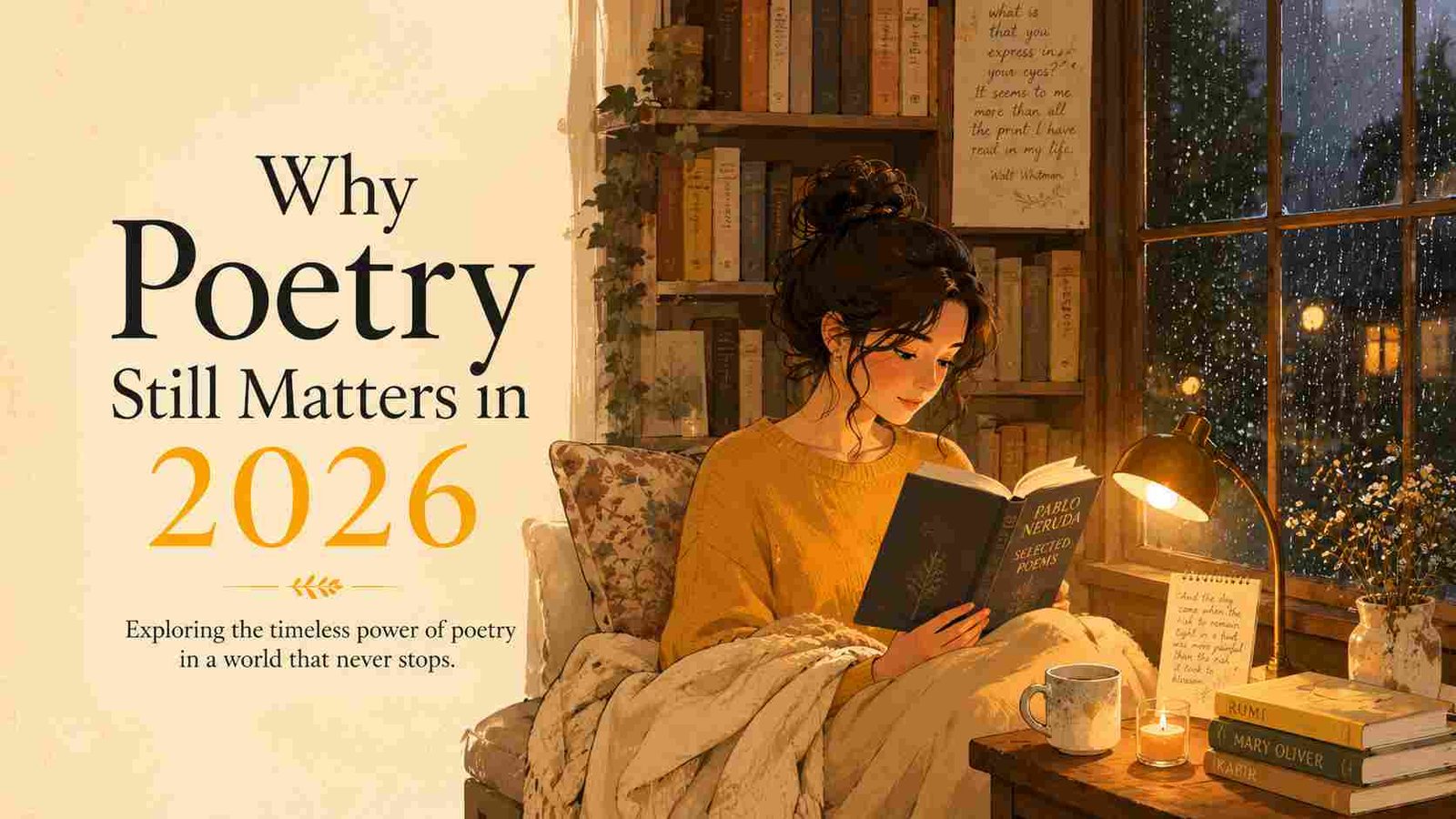
We live in a world where almost everything competes for our attention. Notifications interrupt conversations. Algorithms reward speed over reflection. Headlines grow shorter while opinions become louder. Every day, we consume hundreds of words, yet somehow understand fewer of them. And then there is poetry. So today we are going to talk about – Why Poetry Still Matters.
It asks nothing more than a few quiet minutes. It cannot be skimmed in the same way as a news article or a social media post. It asks us to linger over a single line, return to a metaphor, or sit with an emotion that refuses to be explained away. In an age obsessed with instant answers, poetry still values meaningful questions. That is perhaps why, even in 2026, poetry continues to matter.
Why Poetry Still Matters: Because Poetry Has Always Been More Than Literature
Long before stories were printed in books, they were spoken aloud.
Poetry was how civilizations remembered their histories, celebrated victories, mourned losses, questioned power, and passed wisdom from one generation to another. Across cultures, poems became songs, prayers, letters, revolutions, and conversations with the self. From Kabir’s dohas and Rumi’s mystical verses to Pablo Neruda’s love poems and Gulzar’s quiet observations, poetry has always reflected what it means to be human. Its form may change, but its purpose rarely does.
Why Poetry Still Matters: Because In a Fast World, Poetry Slows Us Down
Modern life encourages constant transition.
We scroll before we think. We react before we understand. We consume before we feel.
Poetry quietly resists that rhythm. A single poem often says in twenty lines what an essay cannot express in two thousand words. It invites us to notice details we would otherwise overlook: the silence after an argument, the comfort of familiar places, the weight of memory, or the beauty hidden in everyday routines.
Reading poetry isn’t about escaping life. It’s about paying closer attention to it.
Why Poetry Still Matters: Because Poetry Gives Language to Emotions We Cannot Explain
There are moments when ordinary language feels insufficient.
The excitement of falling in love. The ache of losing someone. The uncertainty of beginning again. The quiet relief of finally understanding yourself.
Poetry has always existed for these moments. It helps us articulate emotions that often remain unnamed, reminding us that our most personal experiences are often shared by countless others. Perhaps that is why readers return to the same poems at different stages of life and discover entirely new meanings each time.
Why Poetry Still Matters: Because Poetry Builds Empathy
One of literature’s greatest strengths is its ability to help us experience lives different from our own. Poetry achieves this with remarkable precision. Within a few carefully chosen lines, we are invited into another person’s memories, fears, dreams, and questions. We begin to see the world through perspectives we may never have encountered otherwise.
In doing so, poetry quietly reminds us that understanding often begins with listening.
The Rise of Contemporary Poetry
For many years, poetry was seen as something confined to classrooms and literary anthologies.
Today, that perception is changing. Contemporary poets are finding readers through books, spoken word performances, independent publishing, book clubs, and digital platforms. They are writing about identity, relationships, mental health, migration, belonging, grief, and hope in ways that feel immediate and deeply personal.
This new generation has introduced poetry to readers who may never have picked up a traditional collection, proving that verse continues to evolve alongside society.
Why MissBookThief Is Beginning This Journey
Books have always been at the heart of MissBookThief, but so is poetry. This comes from the heart of the Founder, Asha Seth, a published poet herself and a lover of poetry, in all its glorious forms.
Over the years, we’ve celebrated novels, memoirs, nonfiction, and debut authors from around the world. Yet poetry has always held a special place within literature. It distills complex emotions into a handful of unforgettable lines and often stays with us long after the final page.
With the launch of our Poetry section, we hope to create a space where readers can discover timeless classics alongside contemporary voices, revisit beloved poets, and perhaps even find the poem they didn’t know they needed.
This isn’t simply a collection of articles. It’s an invitation to slow down, read more closely, and celebrate the enduring power of poetry.
Where This Journey Begins
Over the coming months, we’ll explore:
- Contemporary Indian poets
- Nobel Prize-winning poets
- Poetry collections worth reading
- Love poems from around the world
- Literary comparisons
- Poems explained
- Reading guides for beginners
- Interviews with poets
- The stories behind remarkable collections
Whether you’re discovering poetry for the first time or returning to it after many years, we hope this space becomes one you revisit often.
Final Thoughts on Why Poetry Matters
Poetry has survived wars, revolutions, technological change, and countless shifts in the way we communicate. It continues to survive because it answers a timeless human need: the desire to understand ourselves and one another. In 2026, perhaps poetry matters more than ever. Not because the world has become quieter.
But because it hasn’t.
Sometimes the most powerful thing we can do is pause, read a few honest lines, and remember that beneath our different stories, we are all searching for the same things: connection, meaning, hope, and home.
Welcome to the Poetry section at MissBookThief. Come back for more engaging pieces.
Frequently Asked Questions
Why is poetry still relevant today?
Poetry remains relevant because it captures universal human emotions with remarkable depth and simplicity. In an increasingly fast-paced world, it encourages reflection, empathy, and meaningful connection.
What are the benefits of reading poetry?
Reading poetry can improve emotional awareness, creativity, language appreciation, and critical thinking. It also offers comfort, inspiration, and new perspectives on everyday life.
Is poetry only for literature lovers?
Not at all. Contemporary poetry has become more accessible than ever, with collections that explore relationships, identity, mental health, nature, and modern life in relatable ways.
How can beginners start reading poetry?
Begin with poets whose themes resonate with you, such as love, nature, or self-discovery. Reading one poem at a time and revisiting it can often be more rewarding than rushing through an entire collection.
What can readers expect from MissBookThief’s Poetry section?
Readers can explore poet spotlights, book reviews, poetry guides, literary comparisons, curated reading lists, and features on both celebrated classics and contemporary voices from India and around the world.