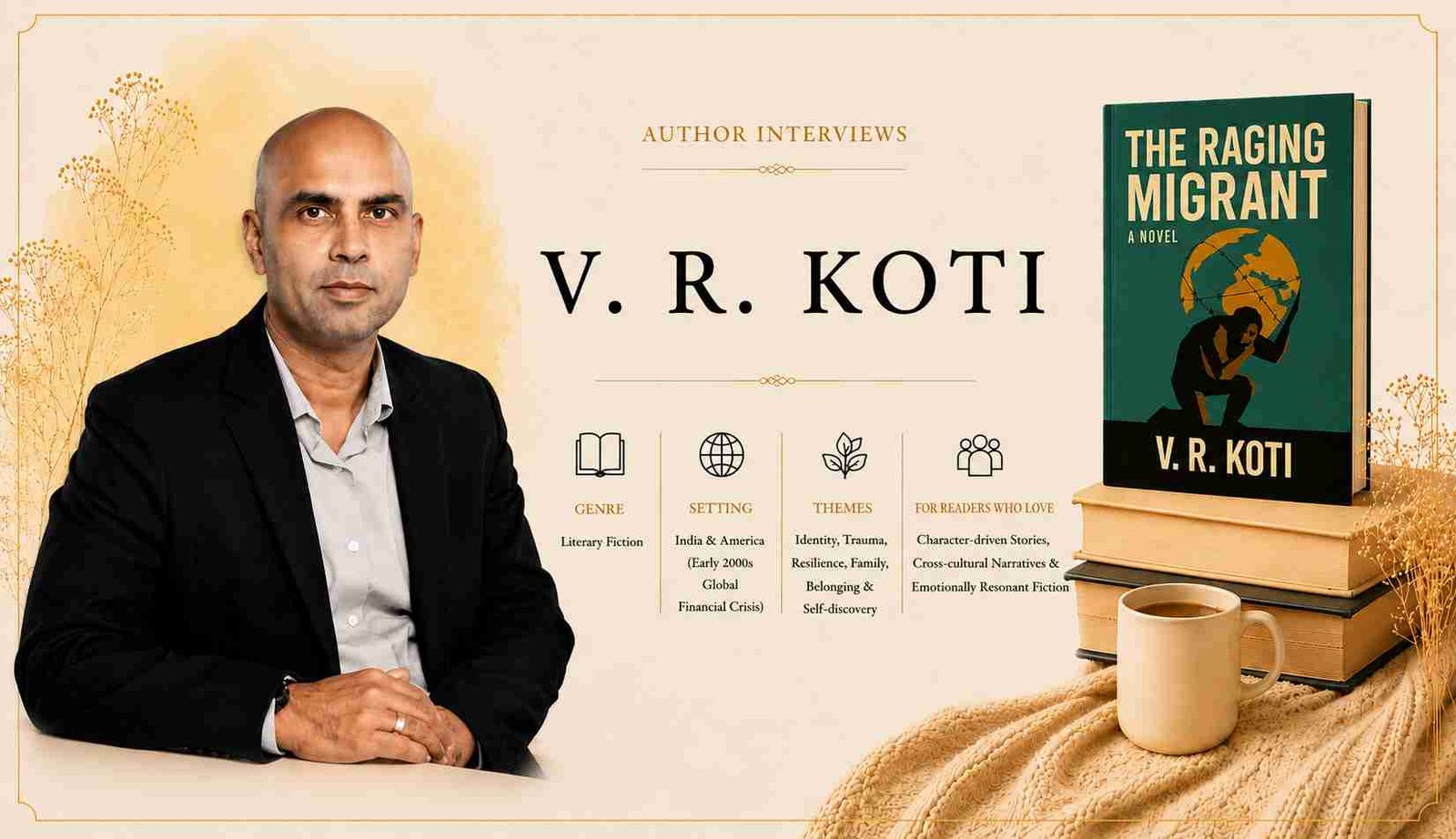

The Raging Migrant is a powerful coming‑of‑age story about a young man navigating migration, love, violence, and identity across India and the United States. As Krishna Kant “KK” Sharma chases opportunity, he is forced into impossible choices—between silence and action, loyalty and self‑preservation, love and freedom.
This novel explores the unseen costs of migration, the residue of trauma, and the fragile balance between what the world demands and what the self can bear. Thoughtful, intense, and deeply human, it is a story for anyone who has ever lived between expectations—and learned that survival is never neutral.
Read the book review: https://missbookthief.com/the-raging-migrant-book-review-vr-koti/
Read the interview with the author of The Raging Migrant, Mr V. R. Koti, here:
- Can you tell us a little bit about your book? Why did you choose this genre and what’s the story behind the title?
I was interested in a deeper exploration of the protagonist’s psychology and how characters can drive the plot, as opposed to characters being mere plot devices. This automatically pushed the genre into Literary Fiction, which I realized later in the process of writing the novel.
I considered several titles, but The Raging Migrant felt best suited to the novel’s psychological focus. The title keeps attention on the protagonist, whose trauma, resilience, and growth remain constant as changing environments test him. Here, rage is not outward anger, but an internal pressure carried in the body. It is a force shaped by inheritance, uneven growth, and limited agency. It appears as silence, nightmares, teeth grinding, and moments when the body reacts before the mind can respond, because the pressure has nowhere else to go.
2. What inspired you to write this story? How did you find the resources and research material for your book?
The idea for The Raging Migrant began around 2011, when I started to recognize how many migrants live layered lives: presenting a calm exterior while carrying immense strain within. It felt like a story that needed to be told. In many ways, I would say it came through me rather than from me.
Migration stories often focus on success and triumph: an outsider whose extraordinary diligence leads to integration and recognition. We are raised to believe that good intentions lead to good outcomes and that resilience will eventually help us achieve our goals. But what happens when someone remains good and resilient without enough self-awareness? What if they never learn inaction or stillness? What if survivor’s guilt drives them to overcorrect? Learned behaviour that helped in one setting becomes a limitation in another setting. These ideas inspired The Raging Migrant.
The resources and material for this story came largely from lived experience across continents and from observing systems and institutions that remain indifferent to individual intentions. The metaphor of the Chakravyuha—a labyrinth that is easy to enter but difficult to escape—also served as an underlying influence.
3. What was the most challenging aspect of writing this book? How did you overcome it?
At any given moment, several forces press on the protagonist: family dysfunction, financial strain, physical trauma, and immigration bureaucracy, among others. When these pressures overlap, the choices before him become morally ambiguous. Guiding him through this Chakravyuha was the most challenging part of writing the book. The only way forward was to make time scarce and let him act first and understand later, even when action might be flawed, because inaction felt morally unacceptable.
I hope readers will decide whether I have met that challenge successfully.
4. Are there any particular authors or books that have influenced the book?
The idea of a protagonist exiled by family dysfunction is as old as the Ramayana and the Mahabharata. Jhumpa Lahiri’s The Namesake was a pioneering work in its exploration of cross-cultural identity. More recently, Sebastian Junger’s In My Time of Dying deeply moved me with its reflections on mortality and the possibility of an afterlife (underscoring how one lifetime never seems to be enough to achieve one’s full potential).
5. What role did editing in the writing process? How did you decide when the manuscript was ready for publication?
In the US, good editors are hard to find and they are expensive. And their schedule may not always complement the author’s. I wish I had read Susan Bell’s The Artful Edit: On the Practice of Editing Yourself along with the other writing guides. I’m reading it now and, in a way, I’m still learning structural editing. I did rewrite The Raging Migrant some to deal with survival first, followed by reckoning. I’m curious to see reader feedback about how it worked.
When it comes to micro-editing, I combed through the novel four to five times and had the help of three beta readers. When I realized that the edits I was making were not enhancing the value of the story anymore, I knew the manuscript was ready for publication.
6. Do you have any upcoming projects or ideas for future books that you’d like to share with your readers?
I am torn about writing a sequel to The Raging Migrant. I’m hoping time will help me decide.
After publishing The Raging Migrant, I started writing a novel with the working title Yours Tentatively. It is a high-stakes contemporary drama set against the backdrop of the 2009 global financial crisis, again spanning India and America. It explores how a smart and stubborn professional’s logical optimization of life buckles under the pressure of a rapidly changing world.
7. In the age of digital publishing and social media, how do you engage with your readers and promote your work?
The landing page of The Raging Migrant book website (theragingmigrant.com) has a comment box that I will be closely monitoring for reader feedback. Similarly, readers can leave a review on Amazon and Goodreads. Readers can follow me on Instagram at @koti_creative, I also share my photography there. Having said all this, the primary medium for an author to engage with readers is the quality of their writing. That is what I will be focused on, more than any technology.
8. How do you balance your writing career with other aspects of your life, such as work and family?
In the construction industry, my bread and butter, business tends to be cyclical. I switch to writing when I’m waiting for my next project to start. Plotting also happens when your child’s tennis or swimming lessons are in progress. More recently, I’m targeting 1000 words per day when life does permit writing. When I feel stuck with a scene or a character, I patiently wait for the next step to come to me instead of forcing progress.
9. What do you intend your readers to takeaway from your book?
Whether you can change your zip code or not, you can travel, learn, grow, and continue to explore belonging.
10. What’s the one advice you’d like to share with aspiring writers of the genre?
I must borrow from the author Richard Powers whose advice I found useful. If you’re dealing with these three layers of drama in your work, you’re highly likely to produce good quality literary fiction: protagonist vs. self, protagonist vs. others, and protagonist vs. their environment.