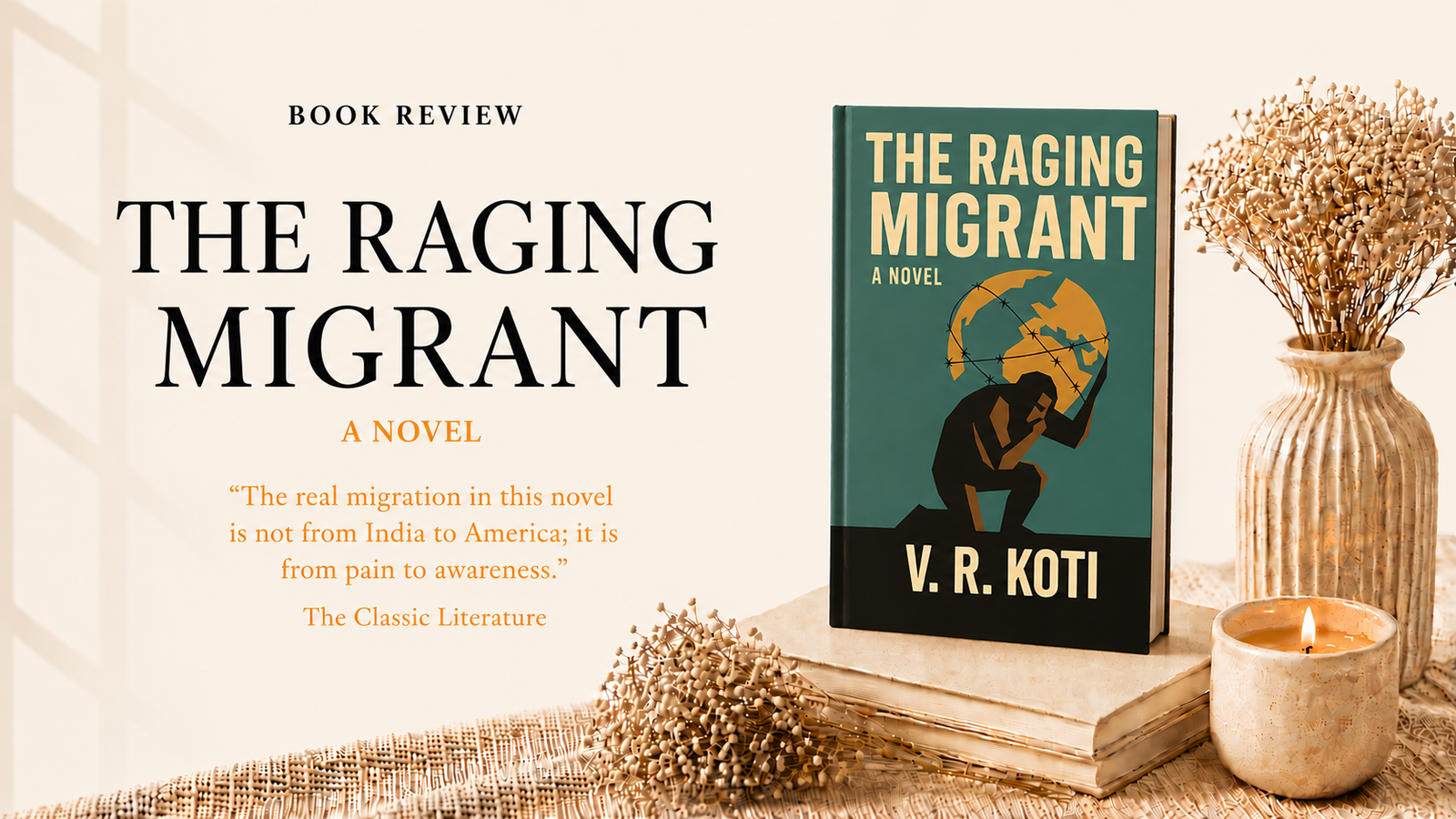
Migration stories are often built around departure and arrival. The Raging Migrant by V. R. Koti is more interested in everything that refuses to fit neatly between those two points.
At its centre is Krishna Kant Sharma, better known as KK, a young architect who begins his adult life amid financial instability and family dysfunction in India. He wants a career, independence, love and eventually a life abroad. Yet as his world expands from his hometown to Delhi and later the United States, KK discovers that geography can change much faster than the person doing the travelling.
What emerges is not simply an immigrant novel, but a story about adaptation in its messier sense: learning when to fight, when to walk away, how to love without losing yourself, and how to recognize the emotional patterns you carried across the border in your own luggage.
Plot Summary of ‘The Raging Migrant’ by V. R. Koti
Krishna Kant Sharma, or KK, has recently graduated as an architect when his family begins falling apart under debt, alcoholism and constant conflict. Determined to build a different future, he leaves home for a job in Delhi. There, friendship, work and an unexpected romance with Miranda “Mira” Chatterjee begin reshaping his life. Mira becomes central to KK’s future, but her family’s expectations also push him towards further education and greater professional ambition.
Eventually, KK’s ambitions take him to the United States for graduate studies. What initially appears to be another step towards the life he has imagined becomes a far more complicated education in culture, relationships, race, immigration, work, violence and belonging. His instinct to intervene whenever something seems wrong repeatedly places him in difficult situations, while distance complicates his relationship with Mira. Over time, KK is forced to confront a harder truth: changing countries may offer new opportunities, but it cannot automatically change the habits, anger and emotional inheritance a person carries within.
Review of ‘The Raging Migrant’ by V. R. Koti
The Raging Migrant works best when read not simply as a story about immigration, but as a novel about adaptation. Early in the book, KK’s grandmother compares survival to a chameleon changing colours according to its environment. That idea quietly becomes one of the novel’s organising principles. KK moves through different cities, relationships and social systems, constantly adjusting himself, although not always in the ways he actually needs to.
Koti also makes an interesting choice by refusing to romanticise either India or America. Delhi is energetic but exhausting, filled with professional hierarchies, financial pressure and social expectations. America offers education and possibility, yet it also confronts KK with isolation, unfamiliar systems, racial and cultural assumptions, immigration anxiety and violence. The contrast gives the book greater credibility because migration is neither presented as an escape nor condemned as a mistake. It is simply another complicated environment in which KK must learn how to exist.
Most importantly, the novel gradually turns its gaze inward. KK begins life believing strength means enduring hardship, helping others and confronting injustice. However, therapy, trauma and his deteriorating relationship with Mira force him to reconsider that definition. By the final chapters, the real transformation is not that KK has become less courageous, but that he has begun distinguishing courage from impulsiveness. His answers during the final mediated meeting reveal how far he has travelled psychologically: he would now protect his self-worth, respect his physical limits, involve authorities rather than automatically intervene, and refuse to make enormous emotional decisions in the heat of the moment.
Character Analysis in ‘The Raging Migrant’ by V. R. Koti
Krishna Kant “KK” Sharma
KK is earnest, idealistic, hardworking and often frustratingly impulsive. His instinct is to help, fix and intervene, but the novel gradually asks whether good intentions are enough when actions repeatedly create consequences for oneself and others. His development from reactive young man to someone capable of reflection forms the emotional spine of the novel.
Miranda “Mira” Chatterjee
Mira begins as KK’s romantic ideal but gradually becomes much more important to his development. Independent and emotionally perceptive, she eventually demands something more difficult than love from KK: accountability and evidence that he is genuinely capable of changing.
Piyush
KK’s Delhi roommate becomes one of his most important friendships. Thoughtful, well-read and quietly supportive, Piyush frequently offers a different way of looking at ambition, relationships and success. His friendship also indirectly leads KK to Mira.
Bianca “Bina” Chatterjee
Mira’s twin sister is protective, opinionated and deeply involved in her sister’s life. Although her interference often frustrates KK, she also forces the novel to examine the uncomfortable boundary between family concern and control.
Yatzil
Yatzil becomes an important presence during KK’s American life. Independent and direct, she offers him both friendship and perspective, particularly around relationships and self-respect. Her observation that one’s relationship with oneself precedes relationships with others captures an important shift in KK’s journey.
Settings in The Raging Migrant
India
KK’s early life unfolds across his hometown and Delhi, where family obligations, financial pressures, workplace hierarchies and romance shape his ambitions. Delhi especially functions as his first real experiment with independence.
Arizona, United States
America represents possibility, but also disorientation. University life, unfamiliar cultural codes, financial pressures and new friendships force KK to reconsider assumptions he once took for granted. Even ordinary experiences become part of learning how to function in a new country.
Between Two Countries
Eventually, the most important setting is the psychological space between India and America. KK belongs fully to neither version of his life anymore. The novel uses that in-betweenness to explore what migrants retain, discard and reinvent.
Major Themes in ‘The Raging Migrant’ by V. R. Koti
Migration and Belonging
Migration is not presented simply as physical relocation. KK must learn new social codes while deciding which parts of himself should adapt and which deserve to remain intact.
Family and Inherited Patterns
KK begins the novel determined to create a healthier family than the one he grew up in. Yet adulthood reveals how easily people can reproduce patterns they consciously reject. His father’s behaviour becomes particularly important when therapy forces KK to examine what he has inherited emotionally.
Anger and Impulsiveness
The “raging” in the title works on more than one level. KK repeatedly responds to injustice through immediate action. Gradually, however, the novel questions whether reacting quickly is always bravery or sometimes simply anger wearing heroic clothes.
Love and Emotional Maturity
KK and Mira’s relationship begins with romantic intensity but eventually encounters the harder work of partnership. Love alone cannot compensate for poor communication, impulsive decisions or a lack of emotional safety.
Masculinity and Self-Worth
KK initially connects worth with achievement, protection and endurance. His journey gradually challenges those ideas, particularly when he learns that refusing humiliation, asking for help and walking away can require their own forms of strength.
Identity Across Cultures
Living abroad makes KK increasingly aware of how identity changes according to context. He is an architect, student, Indian, immigrant, husband, son and outsider, but none of those labels alone completely defines him.
Survival vs Growth
Early KK knows how to survive. The later novel asks whether survival skills remain useful after the immediate danger disappears. Sometimes the armour that protected a person yesterday becomes the weight preventing them from moving forward.
V. R. Koti’s Writing Style in The Raging Migrant
Koti writes The Raging Migrant in a conversational first-person voice that keeps readers close to KK’s thinking. His observations are frequently humorous, self-questioning and slightly irreverent, even when the novel moves through heavier subjects such as family dysfunction, violence, racism, grief and marital conflict.
The prose also pays close attention to ordinary details: public phone booths, food, workplaces, public transport, student accommodation, immigration interviews and changing technology. These details help anchor KK’s journey in a recognisable social world rather than treating migration as an abstract idea.
The episodic structure occasionally makes the book feel more like a collection of defining life incidents than a tightly plotted conventional novel. Yet this approach suits KK’s journey because his transformation happens through accumulation. One experience rarely changes him completely. Instead, lessons pile up until he finally begins recognising the pattern.
Who Should Read ‘The Raging Migrant’ by V. R. Koti
This book should particularly appeal to readers interested in:
- Contemporary Indian fiction
- Immigration and diaspora stories
- Indian characters navigating life in America
- Coming-of-age stories about adulthood
- Family and relationship dramas
- Cross-cultural relationships
- Stories about identity and belonging
- Novels exploring masculinity and emotional growth
- Character-driven fiction about second chances
Final Verdict
The Raging Migrant begins with a young man who desperately wants to escape the instability surrounding him. He leaves home, builds a career, falls in love, travels across continents and pursues the future he believes will solve many of his problems. But V. R. Koti ultimately turns that familiar migration arc inside out.
KK discovers that distance cannot erase family history, achievement cannot guarantee self-worth, and love cannot thrive indefinitely without emotional responsibility. The further he travels geographically, the more urgently he must confront himself. The final mediated conversation with Mira captures that transformation beautifully. When confronted with situations that once triggered impulsive decisions, KK now imagines responding with boundaries, patience and restraint. Crucially, when asked whether he would immediately marry Mira again, his answer is essentially yes, but not today. The feeling remains; the impulsiveness has changed.
And that may be the novel’s most convincing definition of growth. By the end, the threatened annulment is withdrawn, but the resolution does not suggest that every problem has magically disappeared. Instead, KK and Mira are given the possibility of rebuilding with greater awareness than before.
Buy your copy below

Frequently Asked Questions
What is ‘The Raging Migrant’ about?
The Raging Migrant follows Krishna Kant “KK” Sharma, a young Indian architect whose journey takes him from a troubled family life in India to Delhi and eventually the United States. Through career struggles, migration, relationships and personal crises, he gradually confronts his ideas about success, love, masculinity and belonging.
Who wrote ‘The Raging Migrant’?
The novel is written by V. R. Koti, a pen name. The author lives near Atlanta, Georgia, works in green-building consulting and draws upon experiences involving migration, love, loss and adaptation across cultures.
What genre is ‘The Raging Migrant’ by V. R. Koti?
It can broadly be described as contemporary fiction, immigrant fiction and a coming-of-age novel, with strong elements of family drama, romance and social commentary.
Is ‘The Raging Migrant’ an immigrant story?
Yes, but immigration is only one dimension of the book. The novel also examines family dysfunction, relationships, identity, anger, cultural adaptation and emotional growth.
Where is ‘The Raging Migrant’ set?
The story moves between India and the United States, with Delhi and Arizona playing particularly important roles in KK’s development.
What are the main themes of ‘The Raging Migrant’ by V. R. Koti?
Major themes include migration, belonging, family, inherited behaviour, masculinity, anger, relationships, self-worth, cultural adaptation and personal growth.