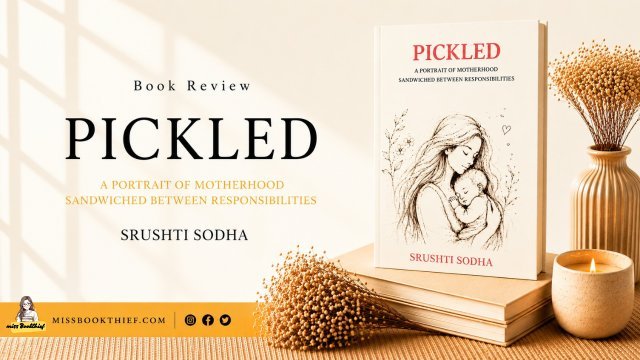
What if the person who held an entire family together slowly became invisible within the very family she built?
Pickled by Srushti Sodha is a sensitive exploration of motherhood, caregiving, identity, sacrifice, and the complicated inheritance passed from one generation of women to another. The book examines the kind of love that rarely announces itself. It appears in packed lunches, remembered medicines, phone calls, family meals, homemade snacks, etc.
Written from the perspective of a daughter approaching motherhood herself, Pickled by Srushti Sodha looks backwards with a newly acquired understanding. Things that once felt ordinary begin to reveal the enormous amount of effort behind them. The mother who always seemed available was not magically free of exhaustion. Someone had repeatedly chosen to be available.
And that is where the book finds its emotional heart. It is not simply a story about mothers. It is about seeing the women behind the role of motherhood and understanding what we inherit from them, what we should preserve, and what we might need to change.
Plot of Pickled by Srushti Sodha
Pickled by Srushti Sodha is not a conventional plot-driven book. Instead, it is a reflective portrait of motherhood and family life, centred on women who find themselves responsible for multiple generations at once.
The book explores the experience of being a mother to children while simultaneously being a daughter to aging parents, a partner, a caregiver and the person responsible for maintaining countless household and emotional routines. The idea of being “sandwiched” between responsibilities becomes an emotional reality rather than simply a demographic description.
The narrator’s pregnancy becomes an important emotional threshold. As she prepares to become a mother herself, she begins reconsidering her own childhood and her relationship with her mother. What once seemed like ordinary care begins to look like a carefully constructed sense of safety.
Food, family rituals, phone calls, advice and everyday routines suddenly reveal themselves as acts of love that required time, attention and sacrifice.
Book Review: Pickled by Srushti Sodha
The greatest strength of Pickled by Srushti Sodha is its ability to make the invisible visible.
The book looks closely at the countless forms of care that rarely receive recognition. A mother remembers who has eaten, who needs reassurance, whose medicine needs replenishing and which family member might need a phone call. None of these acts appears extraordinary individually. Together, they create the invisible architecture that keeps a family functioning.
What makes the book particularly effective is that it does not reduce motherhood to either sacrifice or sainthood. The women it portrays are tired, but they are also funny, capable, affectionate, proud and resilient. Their caregiving can be both labour and love. Their sacrifices can be meaningful while still carrying a cost.
Pickled by Srushti Sodha is therefore less interested in telling readers what motherhood should look like and more interested in asking them to look closely at what motherhood has looked like for generations of women.
The book’s most powerful question may be this: can we preserve the depth of maternal love without preserving the expectation that a mother must disappear inside it?
Characters in Pickled by Srushti Sodha
The Mother
The mother represents a generation of women whose identities became deeply intertwined with caregiving. Her strength is quiet, expressed through consistency, emotional awareness and the ability to anticipate what others need.
The Daughter
The daughter is the emotional lens through which the story unfolds. Approaching motherhood herself, she begins to see her mother not only as a parent but as a woman who once had her own dreams, fears, ambitions and limitations.
The Sandwich-Generation Woman
This is a broader portrait rather than a single character. She is simultaneously a mother, daughter, partner, caregiver and keeper of family traditions, constantly negotiating the needs of several generations.
The Next Generation
The younger women represent possibility. They can inherit warmth, loyalty and emotional availability while questioning whether self-erasure should remain part of the definition of good motherhood.
Settings in Pickled by Srushti Sodha
The Home
In Pickled by Srushti Sodha, home is more than a physical location. It is a feeling created through routine, attention, memory and the reassurance that someone will notice when something is wrong.
The Kitchen
The kitchen becomes one of the book’s most meaningful emotional spaces. Chai, family meals, pressure cookers, snacks and homemade food become languages through which affection is communicated.
Distance & the World Beyond Home
The book also explores what happens when children grow up and leave. Education, careers and migration create physical distance, but caregiving adapts. Phone calls, messages and parcels become new ways of remaining present.
Major Themes in Pickled by Srushti Sodha
Motherhood & Identity
The book asks what happens when motherhood becomes the most visible part of a woman’s identity. It explores whether a woman can remain deeply devoted to her family while still retaining a self beyond caregiving.
Invisible Labour
Much of the work required to keep a family emotionally and practically functional is easily overlooked. Pickled by Srushti Sodha gives language and visibility to that hidden labour.
Intergenerational Love
Love travels between generations through habits, food, advice, traditions and emotional patterns. The book explores what daughters inherit from their mothers beyond material possessions.
Sacrifice
The book respects maternal sacrifice without romanticizing it. A woman can find genuine meaning in caring for her family while still deserving rest, ambition and personal space.
Selfhood
One of the book’s central questions is whether love requires self-erasure. Pickled by Srushti Sodha suggests that profound care and a strong individual identity do not have to be opposites.
The Meaning of Home
Home is created through hundreds of quiet acts. It is the feeling of being noticed, remembered and cared for, often before a need is even expressed.
Distance & Empty Nesting
A mother’s success eventually creates a paradox. She raises children who are capable of leaving, then has to live with the distance their independence creates. Pride and loneliness can coexist.
Writing Style in Pickled by Srushti Sodha
The writing in Pickled by Srushti Sodha is reflective, intimate and rooted in everyday observation.
Rather than depending on dramatic events, the book finds emotional significance in ordinary domestic moments. A pressure cooker, a cup of chai, a phone call, a newspaper morning or a parcel of food can become the starting point for a larger reflection on love, identity and family.
Humour is another important part of the book’s voice. Family life is allowed to be chaotic, repetitive, affectionate and funny. The theatrics around hunger, food, technology and parental concern add warmth and prevent the narrative from becoming overwhelmingly heavy.
Who Should Read Pickled by Srushti Sodha?
Pickled by Srushti Sodha is particularly suited to:
- Mothers who may recognize their own invisible labour
- Daughters who want to understand their mothers differently
- Sons who may have overlooked the emotional work within their families
- Expecting mothers thinking about the kind of motherhood they want
- Caregivers balancing responsibilities across generations
- Readers of reflective nonfiction
You do not need to be a mother to connect with the book. Its central question is much broader:
Who made your life feel safe, and what did that safety require from them?
Final Verdict
Ultimately, Pickled by Srushti Sodha is a book about seeing what has always been there.
It asks us to look beyond the word “mother” and notice the woman within it. To understand that the food on the table had a story. That the perfectly timed phone call was not accidental. That the remembered preference, packed parcel and quiet reassurance represented years of attention.
The book captures a realization many people experience only in adulthood: comfort does not simply happen. Someone creates it.
What makes Pickled by Srushti Sodha especially moving is that it does not ask us to choose between gratitude and change. We can honour the women who came before us without deciding that their sacrifices must become the blueprint for every generation that follows.
Buy your Copy Now

Frequently Asked Questions (FAQs)
What is Pickled by Srushti Sodha about?
Pickled: A Portrait of Motherhood Sandwiched Between Responsibilities explores motherhood, caregiving, invisible labour, identity, sacrifice and the relationship between mothers and daughters. It focuses particularly on women balancing responsibilities towards children, aging parents, partners and families.
Why is the book called Pickled?
The title is a metaphor for how women are shaped and transformed by years of responsibility, family expectations, love and caregiving. Like something pickled, they are preserved but also changed by time and experience.
What does Pickled by Srushti Sodha say about motherhood?
The book questions the idea that good motherhood must require complete self-sacrifice. It suggests that mothers can be loving and deeply caring while still maintaining their identities, ambitions and boundaries.
What is the sandwich generation in Pickled?
The “sandwich generation” refers to adults who find themselves caring for children while also supporting aging parents. In the book, this becomes an intensely emotional experience involving love, guilt, responsibility, memory and obligation.
Who should read Pickled by Srushti Sodha?
The book is especially relevant to mothers, daughters, sons, caregivers and people preparing for parenthood. Its broader themes of family, identity, emotional labour and caregiving make it relevant to a much wider readership.
Is Pickled a memoir?
The supplied material presents Pickled as an intimate and reflective portrait of motherhood rather than a conventional memoir narrowly focused on one exceptional life. Its larger purpose is recognition and reflection across generations.
What is the central message of Pickled by Srushti Sodha?
The central message is to preserve the love, warmth and care inherited from previous generations while questioning expectations that require women to erase themselves in order to prove their devotion.