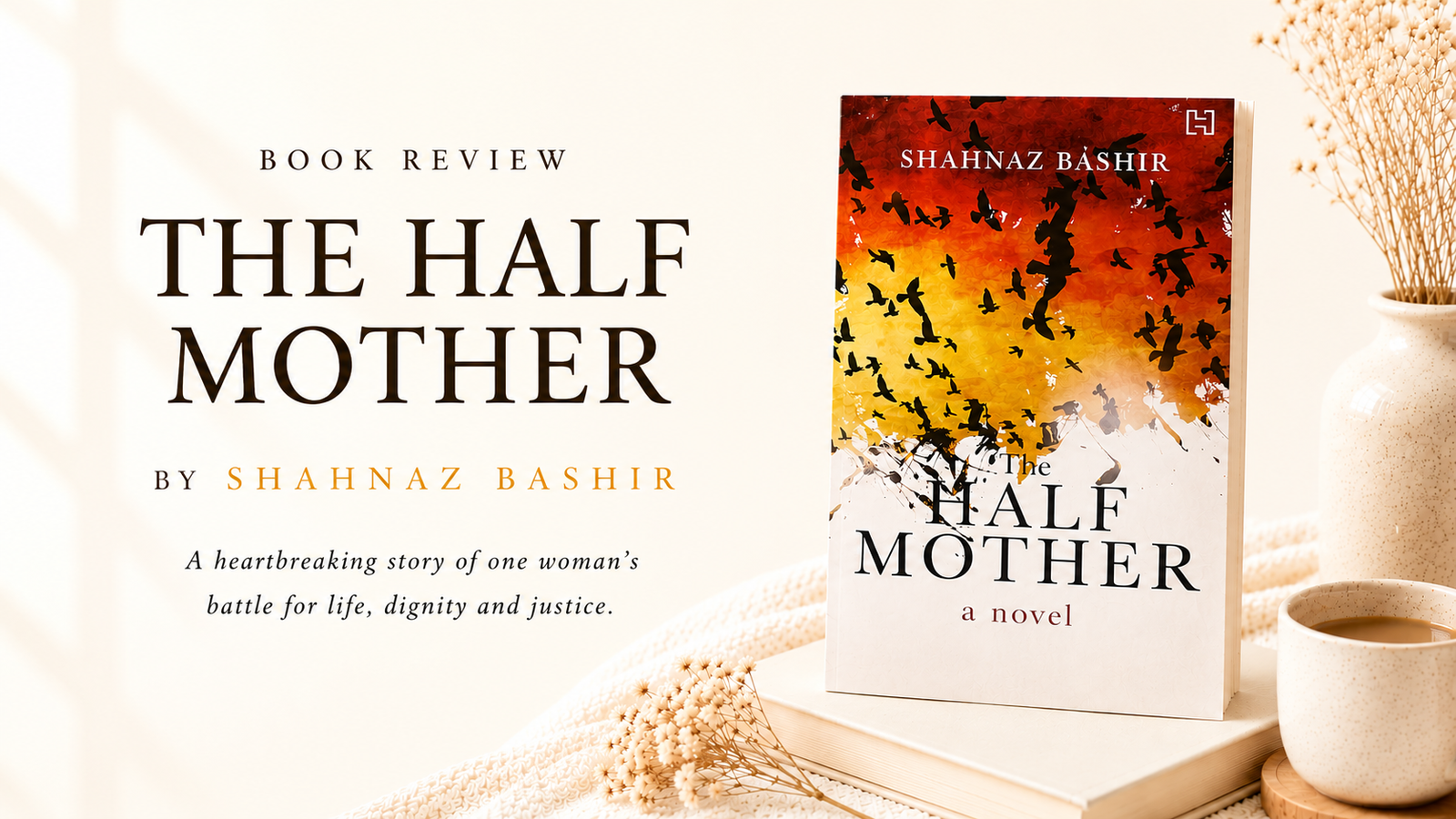
Some novels demand your attention through spectacle. Others earn it through quiet devastation. The Half Mother by Shahnaz Bashir belongs firmly to the latter. Set against the backdrop of conflict in Kashmir, the novel tells the deeply personal story of a mother’s search for her missing son, transforming individual grief into a poignant meditation on memory, resilience, and the unbearable weight of uncertainty.
Written with remarkable restraint and emotional intelligence, The Half Mother does not seek to sensationalize tragedy. Instead, it gently invites readers into the everyday lives of those forced to carry unanswered questions for years, making it one of the most affecting works of contemporary Indian literary fiction.
Plot Summary of The Half Mother by Shahnaz Bashir
Haleema, a widow living in a small village in Kashmir, has devoted her life to raising her only son, Imran. Her world shatters when security forces take him away during a search operation, after which he disappears without explanation or trace.
Unable to accept the silence surrounding his disappearance, Haleema embarks on a relentless search that leads her through police stations, army camps, hospitals, government offices, and countless rumours. With every passing year, hope begins to blur with despair, yet she refuses to abandon the possibility that her son might still return.
Meanwhile, the novel expands beyond Haleema’s personal journey to reveal the lives of countless families trapped in similar circumstances, where uncertainty itself becomes a form of suffering. Rather than offering easy resolutions, Bashir explores what it means to continue living when closure never arrives.
Review of The Half Mother by Shahnaz Bashir
At first glance, The Half Mother appears to tell the story of one missing young man. As the narrative unfolds, however, Shahnaz Bashir reveals a far more layered exploration of motherhood, grief, identity, and survival.
Instead of foregrounding politics, Bashir keeps his focus firmly on ordinary lives disrupted by extraordinary circumstances. He writes about waiting rooms, kitchens, village roads, and quiet conversations with such care that these seemingly mundane spaces become the emotional centre of the novel.
Moreover, the story draws much of its power from what remains unsaid. Silence, repetition, and unanswered questions slowly accumulate into an overwhelming portrait of endurance. Every rumour Haleema follows and every office she visits reinforces the exhausting emotional labour of searching without certainty.
Perhaps most strikingly, the novel refuses to simplify grief. Hope and despair coexist throughout Haleema’s journey, allowing readers to experience the psychological complexity of living between acceptance and possibility.
Rather than asking readers to witness conflict through headlines or statistics, The Half Mother encourages them to understand it through one mother’s unwavering love.
Characters Analysis in The Half Mother by Shahnaz Bashir
Haleema
Haleema forms the emotional core of the novel. Loving, determined, and quietly resilient, she refuses to surrender to uncertainty even as years pass without answers.
Importantly, Bashir portrays her neither as a symbol nor as an idealised figure. Instead, she remains profoundly human, balancing moments of vulnerability with extraordinary perseverance. Her relentless search becomes both an act of maternal devotion and a refusal to let silence erase memory.
Imran
Although Imran remains physically absent for much of the narrative, his presence permeates every chapter. Through memories and recollections, Bashir ensures that readers know him not simply as someone who disappeared but as a son, a young man, and the centre of Haleema’s emotional world.
His absence ultimately becomes one of the novel’s most powerful narrative devices.
Setting & Themes in The Half Mother by Shahnaz Bashir
Kashmir serves as far more than the novel’s backdrop. Bashir transforms its villages, mountains, orchards, and changing seasons into an integral part of the story’s emotional landscape.
The striking beauty of the valley exists in constant tension with the uncertainty experienced by its people. Everyday life continues through markets, family gatherings, and seasonal routines, yet beneath that surface lingers an unspoken anxiety that shapes every interaction.
Throughout the novel, Bashir thoughtfully explores themes such as:
- Maternal love and sacrifice
- Memory and unresolved grief
- Hope amid uncertainty
- Bureaucratic indifference
- Identity and belonging
- The emotional cost of prolonged conflict
- Endurance through quiet resilience
Importantly, the novel never sensationalises suffering. Instead, it examines its lingering effects on families, relationships, and everyday existence with remarkable compassion.
Writing Style in The Half Mother by Shahnaz Bashir
Shahnaz Bashir writes with subtlety and precision, trusting emotion to emerge organically rather than through melodrama. His understated prose allows ordinary moments to carry extraordinary significance.
Furthermore, he embraces silence as a storytelling tool. Repeated routines, unanswered questions, and extended periods of waiting mirror Haleema’s emotional reality, immersing readers in the slow passage of time that defines her search.
At the same time, Bashir’s descriptions of Kashmir remain vivid without becoming romanticised. The landscape retains its beauty while reflecting the complexities and contradictions of the lives unfolding within it.
The result is a style that feels both deeply literary and profoundly accessible.
Strengths and Weaknesses
- A moving and unforgettable central protagonist
- Elegant, restrained prose
- Rich exploration of motherhood and resilience
- Powerful emotional impact without sensationalism
- Evocative portrayal of Kashmir and everyday life
- Its measured pacing may not appeal to readers seeking plot driven fiction
- The deliberately understated narrative requires patience
- Several questions remain intentionally unresolved, prioritising emotional truth over narrative closure
Who Should Read The Half Mother?
This novel is especially recommended for readers who enjoy:
- Literary fiction
- South Asian literature
- Character driven storytelling
- Books about motherhood and family
- Emotionally resonant narratives
- Quiet explorations of grief and hope
- Contemporary Indian fiction
Readers who appreciate the works of Khaled Hosseini, Arundhati Roy, or Basharat Peer will likely find The Half Mother equally compelling.
Final Verdict
The Half Mother by Shahnaz Bashir is not a novel that relies on dramatic twists or sweeping revelations. Instead, it finds extraordinary emotional depth in persistence, memory, and the quiet refusal to give up. Through Haleema’s unwavering search for her son, Shahnaz Bashir crafts a story that speaks to the enduring power of maternal love and the resilience required to live with unanswered questions.
Long after the final page, it is not the events of the novel that stay with you, but Haleema herself, standing as a testament to hope that survives even in the face of impossible uncertainty. If you are looking for literary fiction that privileges empathy over spectacle and humanity over headlines, The Half Mother deserves a place on your reading list.
Frequently Asked Questions
Is The Half Mother worth reading?
Yes. It is a beautifully crafted literary novel that offers a deeply human exploration of motherhood, grief, resilience, and hope through intimate storytelling.
What is The Half Mother about?
The novel follows Haleema, a Kashmiri mother who tirelessly searches for her missing son after his unexplained disappearance, while exploring themes of memory, uncertainty, and endurance.
Is The Half Mother based on real events?
Although fictional, the novel draws inspiration from the experiences of families affected by enforced disappearances and prolonged conflict in Kashmir.
What genre is The Half Mother?
It is literary fiction with strong elements of contemporary Indian literature, social realism, and family drama.
Who should read The Half Mother?
Readers interested in emotionally layered literary fiction, South Asian narratives, and stories centred on motherhood, loss, and resilience will find it particularly rewarding.