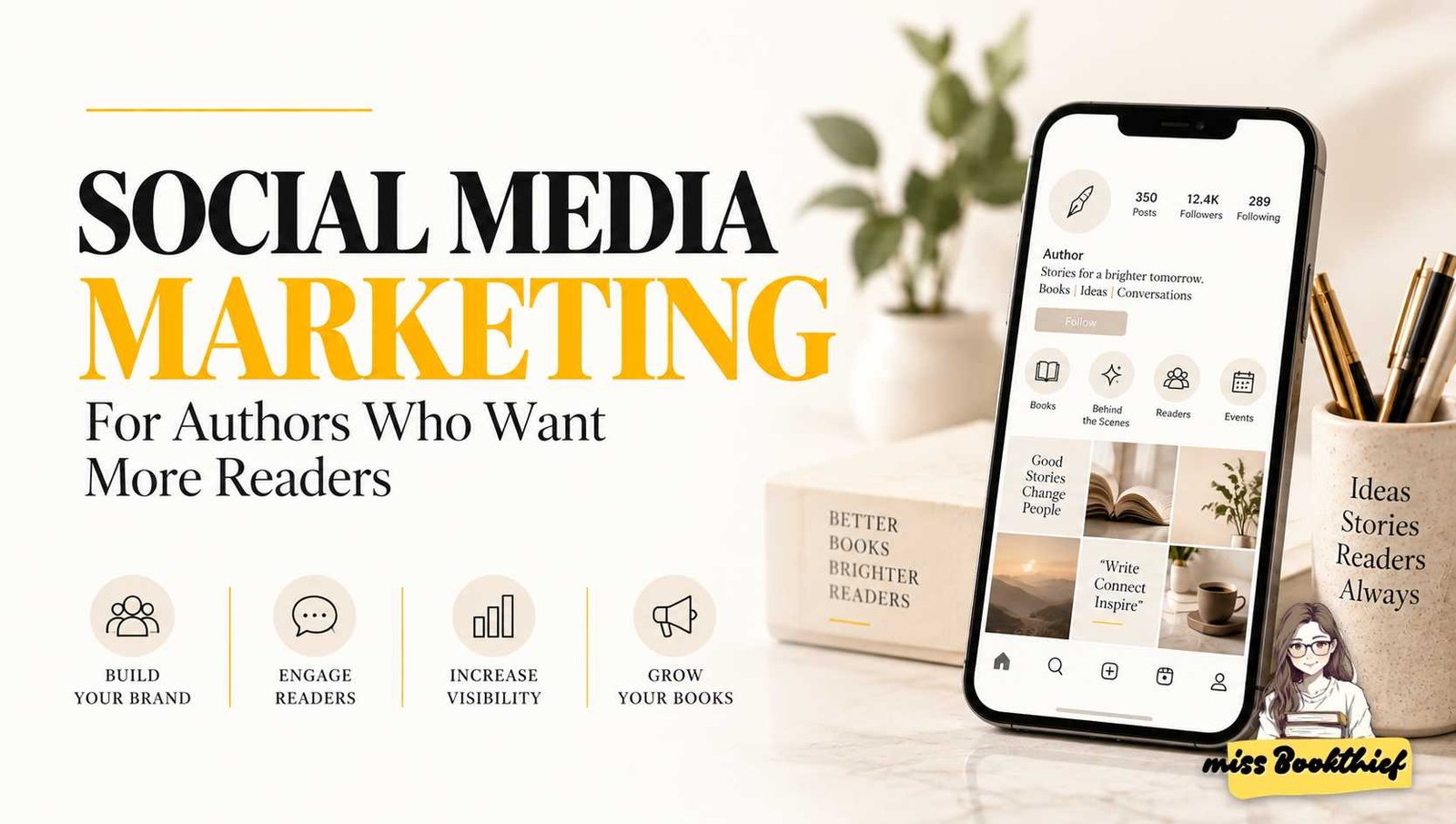
Social media has changed the way authors can find readers. You no longer have to rely entirely on traditional publicity, bookstore placement, or word of mouth to introduce your book to an audience. However, simply creating an account and posting your book cover occasionally is unlikely to build meaningful visibility.
For authors, effective social media marketing is about much more than promotion. It is about creating recognition, starting conversations, sharing your ideas, and giving readers a reason to follow you even when you are not asking them to buy your book.
Here are tips for social media marketing for authors for building a rewarding social media presence:
1. Understand What Social Media Can Actually Do for Authors
Social media can help an author become discoverable, but it should not be treated as a guaranteed sales machine. Its value lies in creating repeated opportunities for potential readers to encounter your name, your work, your ideas, and your personality. Over time, these encounters can build familiarity and trust, which can eventually influence a reader’s decision to pick up your book.
At the same time, social media can serve several purposes throughout an author’s career. It can support a book launch, attract media attention, encourage reviews, connect authors with influencers, build a community of readers, and keep an older book visible. Therefore, the goal should not always be an immediate sale. Sometimes, getting the right reader to remember your name is the more valuable outcome.
2. Know Who You Are Trying to Reach
Before deciding what to post, determine who you actually want to reach. An author writing historical fiction, for example, may be speaking to a very different audience from someone publishing a business book, romance novel, memoir, or children’s picture book. Consequently, the same social media strategy will not work equally well for every author.
Start by thinking about your ideal reader. What other books do they enjoy? What topics interest them? Which platforms do they use? Do they respond better to short videos, thoughtful discussions, visual content, recommendations, or longer-form posts? Once you understand the reader, your content becomes easier to plan because you are no longer creating posts for an imaginary crowd.
3. Choose the Right Social Media Platforms
Being present on every platform may sound ambitious, but it can quickly become exhausting. More importantly, spreading yourself too thin can result in several neglected profiles rather than one strong author presence. Instead, choose platforms based on your audience, your genre, and the kind of content you can realistically create.
Instagram can work particularly well for visually driven book content, while platforms such as YouTube can support longer conversations, interviews, readings, and educational content, and Facebook can still be useful for established reader groups and communities. The right strategy is not to be everywhere. It is to be consistent where your readers are.
4. Build an Author Profile That Can’t be Ignored
Your social media profile is often the first place someone encounters you after discovering your book. Therefore, it should immediately tell visitors who you are, what you write, and why they might want to stay connected. A vague biography or an account filled entirely with promotional graphics can make it difficult for a new visitor to understand what you offer.
Use a clear author name, recognisable profile image, concise biography, and an appropriate link to your website or book. Your profile should also have a consistent visual and editorial identity. If someone discovers one of your posts and visits your profile, they should be able to understand your author brand within a few seconds.
5. Stop Making Every Post about your Book
One of the easiest mistakes authors make is turning their social media account into a continuous sales pitch. Your book cover appears, followed by a purchase link, followed by another reminder about the book, followed by another post asking people to buy it. While promotion has its place, readers rarely follow an account because they want to see advertisements every day.
Instead, give people something worth following. Talk about the themes behind your book, share reading recommendations, discuss your writing process, introduce characters, answer reader questions, share interesting research, or explore ideas connected to your subject. This helps in building a great social media marketing strategy for authors.
6. Create Content That Readers will Consume
Good social media content does not have to be complicated. What matters is whether it gives your audience a reason to stop scrolling. For authors, that could mean a short video discussing a character, a carousel about books you recommend, an excerpt from your work, a story about how an idea developed, or a question that invites readers to share their opinions.
You can also create recurring content formats, which makes planning easier. For example, you might share a weekly reading recommendation, a behind-the-scenes writing post, a monthly Q&A, or a discussion around your book’s central themes. Consequently, your audience begins to recognise your content while you avoid reinventing your strategy every morning.
7. Use Reader Communities Strategically
Book influencers, book bloggers, reviewers, and online reading communities can help authors in their book marketing. However, follower count should not be the only factor you consider. An account with a smaller but highly relevant audience may be more valuable than a large account whose followers have little interest in your genre.
Start by identifying creators who genuinely discuss books similar to yours. Then, consider whether their audience matches the readership you want to reach. Depending on the campaign, collaboration can involve reviews, features, interviews, reading lists, author conversations, or other forms of reader-facing content. Most importantly, keep the focus on relevance and genuine reader interest rather than simply collecting promotional mentions.
8. Organic Content vs Paid Advertising
Organic social media and paid advertising can work together, but they serve different purposes in personal author branding. Organic content helps you develop an audience and maintain an ongoing relationship with readers. It gives people an opportunity to understand your voice, interests, books, and personality without requiring every interaction to lead directly to a purchase.
Paid advertising, meanwhile, can help put your book or content in front of a more targeted audience. However, paying for visibility does not automatically mean people will buy. Your creative, audience targeting, book positioning, landing page, and overall offer still matter. Therefore, advertising should amplify a strong marketing foundation rather than compensate for the absence of one.
9. Build a Long-Term Author Audience
A successful social media presence should not disappear when your book launch ends. In fact, the period after publication can be just as important because readers who discover you today may become readers of your next book tomorrow. Building that relationship requires consistency rather than a short burst of promotional activity.
Continue sharing useful, interesting, and relevant content after the launch campaign has finished. Encourage readers to visit your website, join your newsletter, follow your other channels, or engage with your wider work. Over time, this creates something more valuable than a temporary campaign audience: a group of readers who recognise your name and are interested in what you publish next.
10. Measure What is Actually Working
Social media provides plenty of numbers, but not every number tells you something useful. A post receiving thousands of views may look impressive, yet it may contribute little to your wider marketing objectives. Meanwhile, a smaller post that generates saves, shares, profile visits, website clicks, or meaningful conversations may be much more valuable.
Depending on your goals, this could include engagement, reach, profile visits, website traffic, book-page clicks, audience growth, enquiries, reviews, or sales. Once you understand which content produces meaningful results, you can invest more time in what works instead of simply posting more often.
Social Media Marketing for Authors vs. Book Promotion
Although the two terms are often used interchangeably, social media marketing and book promotion are not exactly the same thing. Book promotion focuses primarily on generating attention for a particular title. Social media marketing takes a broader view by building the author’s presence, audience, credibility, and relationship with readers over time.
This distinction matters because an author can continue benefiting from a strong social media presence long after one book’s launch campaign has ended. Your next book, interview, event, article, or speaking opportunity can all benefit from an audience that already knows who you are. In that sense, social media can become part of your long-term author platform rather than a temporary promotional tool.
How to Create a Social Media Marketing Plan for Your Book
A useful social media strategy should cover more than the week in which your book launches. Start by dividing your activity into three stages: pre-launch, launch, and post-launch. Each stage has a different purpose, so your content should evolve accordingly.
Before launch, focus on building curiosity and introducing the book. You might share the cover, excerpts, characters, research, writing stories, or advance-reader activity. During launch, you can increase book-focused content, reviews, interviews, influencer collaborations, and advertising. After launch, continue the conversation through reader engagement, evergreen content, publicity, seasonal opportunities, and ongoing promotion.
Most importantly, create a realistic publishing schedule. If you can consistently produce three strong posts a week, that is more useful than planning seven posts and abandoning the account after two weeks. Consistency gives your audience something to expect and gives you enough time to focus on your actual writing as well.
A Simple Social Media Checklist for Authors
Before launching your social media strategy, make sure you have:
- A clear author bio and profile image
- A defined target reader
- Two or three priority social platforms
- Consistent author branding
- A content plan
- A mixture of promotional and non-promotional content
- A book link or website link
- A plan for reader engagement
- A shortlist of relevant influencers and book communities
- A strategy for reviews and reader-generated content
- A clear approach to paid advertising, if required
- A way to track meaningful results
You do not need to implement everything simultaneously. Start with the foundations, learn what your audience responds to, and refine your strategy as you go. Social media works best when it becomes a sustainable part of your author platform rather than another overwhelming item on your publishing to-do list.
Final Word on Social Media Marketing for Authors
Social media gives authors something that was once much harder to build independently: direct access to potential readers. However, access alone does not create an audience. Readers need a reason to notice you, follow you, trust you, and eventually explore your work.
Therefore, think beyond the next sales post. Build conversations around your books, share ideas that matter to your readers, collaborate with relevant book communities, and remain visible after the launch excitement fades. Your book may be the reason someone discovers you, but your author presence is what can give them a reason to stay.
FAQs
What is social media marketing for authors?
Social media marketing for authors involves using platforms such as Instagram, Facebook, YouTube, TikTok, and others to build visibility, connect with readers, promote books, strengthen an author’s brand, and develop a long-term audience.
Which are some of the best social media marketing agencies for authors?
MISSBOOKTHIEF AUTHOR BRANDING, LEAD HEIGHT, MORE MARKETING, are some of the best social media marketing agencies for authors in India
Which social media platform is best for authors?
Instagram, Twitter, Pinterest are some of the best platforms for authors. The right choice depends on the author’s genre, target readers, content format, and marketing objectives.
How often should authors post on social media?
Authors should choose a posting schedule they can maintain consistently. Quality and relevance are generally more important than simply increasing posting frequency. A manageable schedule can also make it easier to balance social media with writing and other author responsibilities.
What should authors post on Instagram?
Authors can share book excerpts, reading recommendations, writing insights, behind-the-scenes content, character introductions, literary discussions, reader questions, reviews, short videos, and book-related visual content. Promotional posts can be included, but they should not dominate the entire account.
Do authors need to be on TikTok?
Not necessarily. TikTok can be valuable for authors whose target readers are active there, particularly when their content suits short-form video. However, authors should choose platforms based on their audience and ability to create suitable content rather than joining every new platform simply because it is popular.
How can authors promote their books without being too promotional?
Authors can balance promotional posts with useful and entertaining content. Discussing themes, recommending books, sharing writing experiences, answering questions, introducing characters, and participating in reader conversations can keep an account interesting while still creating opportunities to mention the author’s work.
Should authors pay for social media advertising?
Paid advertising can be useful when an author has a clear audience, strong creative, and a specific objective. However, advertising should not be viewed as a guarantee of sales. It works best when it supports a broader marketing strategy that includes strong book positioning and an effective sales page.
How can authors work with book influencers?
Authors should identify book influencers, bloggers, and reviewers whose audiences are relevant to their genre and readership. Instead of focusing only on follower numbers, consider engagement, content quality, audience relevance, and the creator’s history of discussing books similar to yours.
Can social media actually help sell books?
Yes, social media can contribute to book sales by increasing discovery, building reader trust, generating website or book-page traffic, supporting launches, and creating word-of-mouth opportunities. However, results vary considerably depending on the book, audience, content, platform, and overall marketing strategy.
Should authors hire a social media marketing agency?
An agency can be useful when an author needs strategic planning, content creation, audience development, influencer outreach, paid advertising, or campaign management. Before hiring one, authors should ask for clear deliverables, timelines, reporting, relevant experience, and an explanation of how the proposed strategy fits their book and readership.