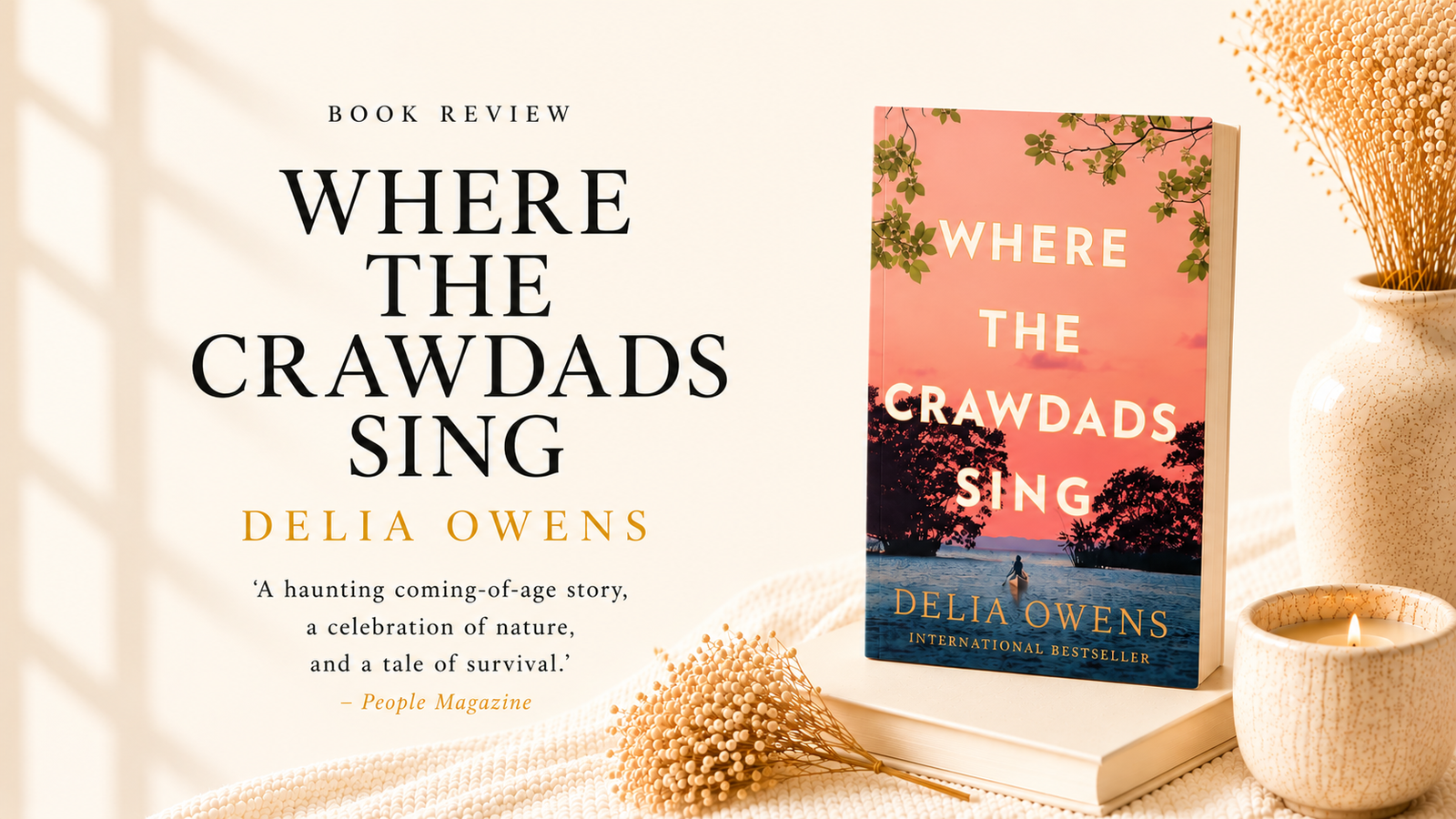
Set along the marshlands of coastal North Carolina, ‘the novel ‘Where the Crawdads Sing by Delia Owens’ follows Catherine Danielle Clark, affectionately known as Kya, who is abandoned one family member at a time until she is left to raise herself in near total isolation.
Shunned by the nearby town and labelled the “Marsh Girl,” Kya learns to survive by observing the natural world around her. The marsh becomes her teacher, protector, and closest companion, offering lessons in resilience that people repeatedly fail to provide.
Years later, when a well known local man is found dead under suspicious circumstances, Kya becomes the prime suspect. As the investigation unfolds, the narrative alternates between the murder mystery and Kya’s earlier life, gradually revealing the relationships, betrayals, and quiet triumphs that shaped her extraordinary journey.
Without relying solely on suspense, the novel carefully builds toward revelations that are as emotionally satisfying as they are thought provoking.
Review of Where the Crawdads Sing By Delia Owens
At first glance, Where the Crawdads Sing appears to combine two familiar genres: a coming-of-age story and a murder mystery. However, Delia Owens uses both frameworks to explore much larger questions about isolation, prejudice, and humanity’s relationship with the natural world.
Rather than presenting Kya merely as a victim of abandonment, Owens portrays her as a remarkably resourceful observer who develops wisdom through solitude rather than society. Consequently, readers witness not only her struggle for survival but also her intellectual and emotional growth.
The novel’s greatest achievement lies in its setting. Owens, herself a wildlife scientist, brings the marsh vividly to life through detailed descriptions of tides, birds, shells, insects, and changing seasons. Far from serving as a backdrop, nature becomes an active participant in the narrative, mirroring Kya’s inner world and reinforcing the book’s themes of adaptation and resilience.
Meanwhile, the mystery surrounding Chase Andrews introduces steady narrative tension without overshadowing the emotional heart of the story. The investigation functions less as the novel’s central purpose than as a mechanism for examining the assumptions communities make about outsiders.
Ultimately, Where the Crawdads Sing invites readers to reconsider who deserves empathy and how easily appearances can distort truth.
Characters Analysis in Where the Crawdads Sing By Delia Owens
Kya Clark
Kya stands among contemporary fiction’s most unforgettable protagonists. Curious, intelligent, fiercely independent, and emotionally vulnerable, she survives abandonment by cultivating a profound understanding of the natural world.
Importantly, Owens never portrays Kya as extraordinary because of superhuman abilities. Instead, her resilience emerges through patience, observation, and quiet determination, making her journey feel deeply authentic.
Tate Walker
Tate introduces warmth, education, and companionship into Kya’s isolated existence. Through their evolving relationship, the novel explores trust, forgiveness, and the transformative power of genuine kindness.
His encouragement of Kya’s intellectual curiosity becomes one of the story’s most hopeful threads.
Chase Andrews
Charismatic and socially admired, Chase represents the contrast between public reputation and private behaviour. His relationship with Kya introduces emotional complexity while contributing significantly to the novel’s central mystery.
Without revealing spoilers, his role encourages readers to question assumptions based on appearances and status.
Setting & Themes in Where the Crawdads Sing By Delia Owens
The North Carolina marsh forms the emotional and symbolic centre of the novel. Its waterways, wildlife, shifting tides, and hidden ecosystems provide both literal sustenance and philosophical insight.
Owens repeatedly demonstrates that nature operates according to its own forms of beauty, survival, and justice, challenging readers to reconsider conventional ideas about civilisation and wilderness.
Among the novel’s central themes are:
- Isolation and belonging
- Survival and resilience
- Nature as sanctuary and teacher
- Love and abandonment
- Social prejudice
- Identity and self worth
- Loneliness and human connection
- Justice and perception
Together, these themes create a story that feels simultaneously intimate and universal.
Writing Style in Where the Crawdads Sing By Delia Owens
Delia Owens writes with exceptional lyricism, balancing scientific precision with poetic observation. Her descriptions of marshland ecosystems are immersive without becoming overwhelming, allowing readers to experience the landscape through Kya’s perspective.
Moreover, the alternating timeline maintains narrative momentum while gradually revealing emotional and factual context. This measured structure enhances both the coming-of-age narrative and the central mystery.
Although the prose occasionally slows to linger on natural imagery, these passages enrich rather than interrupt the reading experience, reinforcing the novel’s meditative quality.
Strengths and Weaknesses in Where the Crawdads Sing By Delia Owens
Strengths
- A remarkable and deeply sympathetic protagonist
- Stunning descriptions of the natural world
- Seamless blend of literary fiction and mystery
- Emotionally resonant exploration of loneliness and resilience
- Thought provoking commentary on prejudice and belonging
Weaknesses
- The leisurely pace may not appeal to readers seeking constant action
- Certain plot developments have sparked debate regarding plausibility
- Nature focused passages may feel overly descriptive for some audiences
Who Should Read Where the Crawdads Sing?
This novel is especially recommended for readers who enjoy:
- Literary fiction
- Coming-of-age stories
- Character driven novels
- Atmospheric mysteries
- Nature writing
- Slow burn emotional narratives
- Stories about resilience and self discovery
Readers who appreciate Barbara Kingsolver, Kristin Hannah, or Anthony Doerr will likely find Where the Crawdads Sing equally compelling.
Final Verdict
Where the Crawdads Sing succeeds because it refuses to separate humanity from the landscapes that shape it. Through Kya’s unforgettable journey, Delia Owens crafts a novel about abandonment, survival, prejudice, and hope that resonates long after the mystery itself is resolved.
Its lush prose, emotionally layered characters, and immersive sense of place transform what could have been a conventional murder mystery into something far richer: a meditation on solitude, belonging, and the quiet resilience required to endure.
If you’re searching for a novel that combines literary elegance with compelling storytelling, Where the Crawdads Sing is a beautifully rewarding read.
Frequently Asked Questions
Is Where the Crawdads Sing worth reading?
Yes. It combines literary fiction, mystery, and coming-of-age storytelling while offering unforgettable characters and one of modern fiction’s most immersive natural settings.
What genre is Where the Crawdads Sing?
The novel blends literary fiction, mystery, coming-of-age, romance, and nature writing.
Is Where the Crawdads Sing based on a true story?
No. The story is fictional, although Delia Owens’ background as a wildlife scientist strongly influences its environmental detail and authenticity.
Why is Kya called the Marsh Girl?
Local residents isolate and stereotype Kya because she grows up largely alone in the marsh, leading them to define her by where she lives rather than who she is.
Is Where the Crawdads Sing more mystery or literary fiction?
While the murder investigation provides suspense, the novel primarily succeeds as a literary exploration of loneliness, resilience, nature, and human connection.