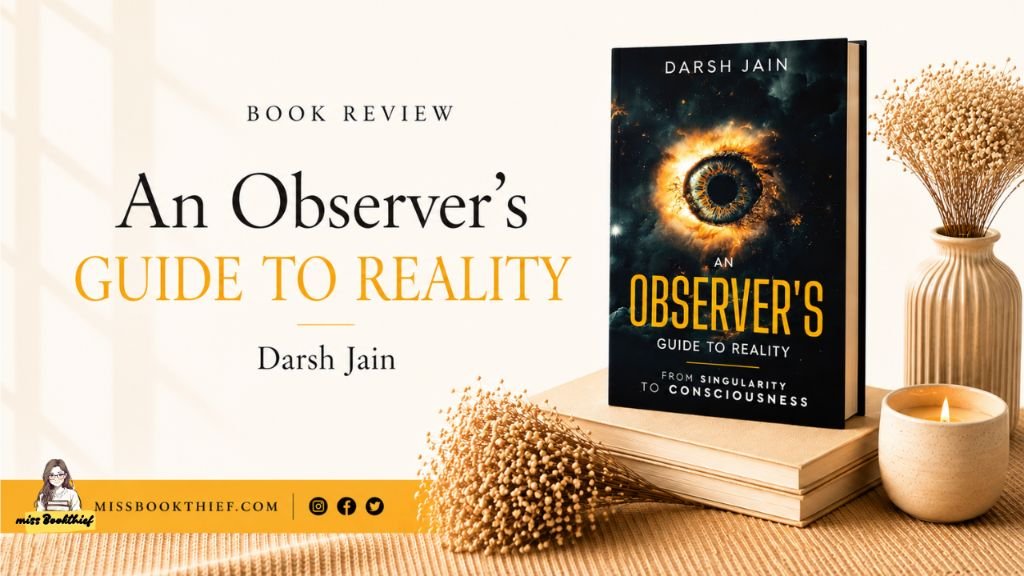
What began with the universe eventually became capable of asking a remarkable question: Who am I? An Observer’s Guide to Reality: From Singularity to Consciousness by Darsh Jain takes readers on an ambitious intellectual journey across cosmology, quantum mechanics, evolution, anthropology, neuroscience, philosophy, and consciousness. Rather than treating these disciplines as isolated subjects, Jain connects them into a continuous story that moves from the birth of the universe towards the human mind.
The book is ultimately less about collecting scientific facts and more about developing a habit of questioning. It invites readers to examine what they believe about reality, identity, free will, human behaviour, and consciousness, while remaining comfortable with uncertainty.
Plot Overview of An Observer’s Guide to Reality
An Observer’s Guide to Reality begins with some of humanity’s oldest questions: where the universe came from, how matter formed, how life emerged, and how matter eventually developed into beings capable of observing and questioning their own existence. From the Big Bang and quantum reality, the book moves through chemistry, biology, evolution, human societies, and eventually consciousness.
As the journey progresses, Darsh Jain shifts the focus from the universe around us to the human world we have constructed. The book explores how cooperation, language, culture, imagination, money, nations, laws, symbols, and collective beliefs shape human societies. It then turns inward, asking how memory, emotion, language, and neural activity contribute to our sense of self.
Book Review: An Observer’s Guide to Reality
The biggest strength of An Observer’s Guide to Reality is the scale of its ambition. Jain attempts to connect subjects that are usually presented separately, moving from physics to chemistry, biology to evolution, anthropology to society, and finally towards the mind. That structure gives the book a sense of intellectual momentum, because every subject becomes a stepping stone towards the next fundamental question.
What makes the journey particularly accessible is Jain’s decision not to overwhelm readers with technical terminology. Quantum mechanics, molecular biology, human evolution, neurobiology, free will, language, and consciousness can all become intimidating subjects, yet the book approaches them conversationally. The reader is invited to participate in the questioning rather than simply absorb information.
The book becomes most intriguing when it turns from explaining reality to questioning the observer experiencing it. Jain examines whether the feeling of “I” is a fixed entity or an ongoing narrative constructed through memory, emotion, language, and neural activity. The final invitation to “Observe the Observer” gives the entire journey a deeply personal dimension, encouraging readers to examine their own reactions, beliefs, fears, assumptions, and inherited ideas rather than accepting them automatically.
Core Ideas and Intellectual Journey
The Birth of the Universe
The book begins at the largest possible scale, exploring the origins of the universe and the formation of matter. This establishes the foundation for its eventual journey towards life and consciousness.
From Matter to Life
Jain connects physics and chemistry with biology and evolution, tracing the remarkable progression from fundamental matter towards increasingly complex forms of life.
Human Evolution
The book examines how Homo sapiens evolved not only physically but socially. Cooperation, language, imagination, and shared beliefs become central to understanding how humans built complex civilizations.
Imagined Orders
One of the book’s more thought-provoking ideas is that many structures we consider unquestionably real gain their power because people collectively believe in them. Money, nations, laws, symbols, and identities are examined through this lens.
Consciousness
The journey eventually moves inward towards the human mind. Jain explores how memory, emotion, language, and neural activity may contribute to the experience of having a self.
The Observer
The book’s central philosophical invitation is to observe our own thoughts and reactions rather than automatically identifying with them. Anger, fear, joy, beliefs, and assumptions become objects of examination.
Major Themes in An Observer’s Guide to Reality
Scientific Thinking
The book encourages readers to question assumptions, seek evidence, and remain intellectually curious. Jain emphasises inquiry rather than replacing one rigid belief system with another.
Consciousness and Identity
The book asks whether the “self” is fixed or continuously constructed by the brain. This turns a scientific exploration into a deeply personal investigation of identity.
Human Belief
Jain explores how collective beliefs create systems that shape everyday life. What feels permanent or natural may sometimes be maintained through language, culture, memory, and shared agreement.
Knowledge and Understanding
The author’s own journey began with civil services preparation and eventually led him to distinguish between collecting information and genuinely understanding life. That distinction becomes an important philosophical thread throughout the book.
Uncertainty
Rather than presenting itself as a final explanation of reality, the book embraces uncertainty. It encourages readers to recognise the limits of current knowledge and remain open to questioning what they think they know.
Human Connection to the Universe
The book ultimately connects the enormous scale of cosmology with the intimate experience of consciousness. Its central fascination lies in the fact that the universe eventually produced beings capable of observing and questioning it.
Darsh Jain’s Writing Style in An Observer’s Guide to Reality
Jain’s approach is deliberately accessible. Complex subjects such as quantum mechanics, molecular biology, evolution, neuroscience, and consciousness can easily become dense, but the book aims to explain them in conversational language rather than academic jargon.
The writing also benefits from its connected structure. Instead of treating science, philosophy, psychology, and human history as separate compartments, Jain builds bridges between them.
The result is an interdisciplinary reading experience that encourages curiosity rather than examination-style memorisation.
For readers already familiar with some of these subjects, the book may function less as a textbook and more as a way of seeing connections between ideas that are usually studied independently.
The Personal Journey Behind the Book
The book’s intellectual ambition is closely connected to Jain’s own journey.
According to the provided material, his preparation for the civil services examination exposed him to an enormous range of subjects. However, that experience also led him to an important distinction: collecting knowledge is not necessarily the same as understanding life.
That realisation eventually pushed him towards independent exploration across history, anthropology, evolution, biology, quantum mechanics, and philosophy.
This background gives the book a sense of personal curiosity. Rather than presenting itself as the definitive answer to reality, it approaches the subject with questioning, evidence, and humility.
Who Should Read An Observer’s Guide to Reality?
This book is particularly suited to readers who enjoy:
- Popular science
- Cosmology and the origins of the universe
- Human evolution
- Psychology and neuroscience
- Philosophy of mind
- Consciousness studies
- Questions about free will and identity
- Rational and scientific thinking
- Interdisciplinary nonfiction
- Books that challenge assumptions
It is especially suitable for curious readers who enjoy asking “why?” long after everyone else has stopped asking questions.
Final Verdict
An Observer’s Guide to Reality is an ambitious attempt to tell one enormous story: the story of how the universe moved from its earliest beginnings towards life, humanity, society, and eventually consciousness.
Its most interesting quality is not simply the range of subjects it covers, but the connections it tries to establish between them. Physics leads to chemistry, chemistry to biology, biology to evolution, evolution to human societies, and the story eventually turns inward towards the mind observing it all.
The book does not promise certainty. Instead, it makes a case for curiosity, evidence, rational inquiry, and the humility to admit that some questions remain unanswered.
Ultimately, An Observer’s Guide to Reality is not merely a book about the universe.
Buy your Copy Now

Frequently Asked Questions
What is An Observer’s Guide to Reality about?
The book explores the journey from the origins of the universe to human consciousness, connecting cosmology, quantum mechanics, biology, evolution, anthropology, psychology, and philosophy along the way.
Who wrote An Observer’s Guide to Reality?
The book is written by Darsh Jain, a writer, independent researcher, and thinker interested in the intersection of science, philosophy, psychology, and human evolution.
What does “Observe the Observer” mean?
It refers to the practice of examining our own thoughts, emotions, beliefs, and reactions rather than automatically identifying with them. It is one of the book’s central philosophical ideas.
Is An Observer’s Guide to Reality a science book?
It is an interdisciplinary nonfiction work that brings together science and philosophy. It explores subjects including cosmology, quantum mechanics, evolution, neuroscience, anthropology, consciousness, and human behaviour.
Is the book suitable for non-science readers?
The provided material indicates that Jain deliberately aims to make complex scientific ideas accessible through conversational explanations rather than overwhelming readers with technical terminology.
What is the main message of the book?
The book encourages readers to question assumptions, seek evidence, remain open to uncertainty, and examine their own thoughts and beliefs.