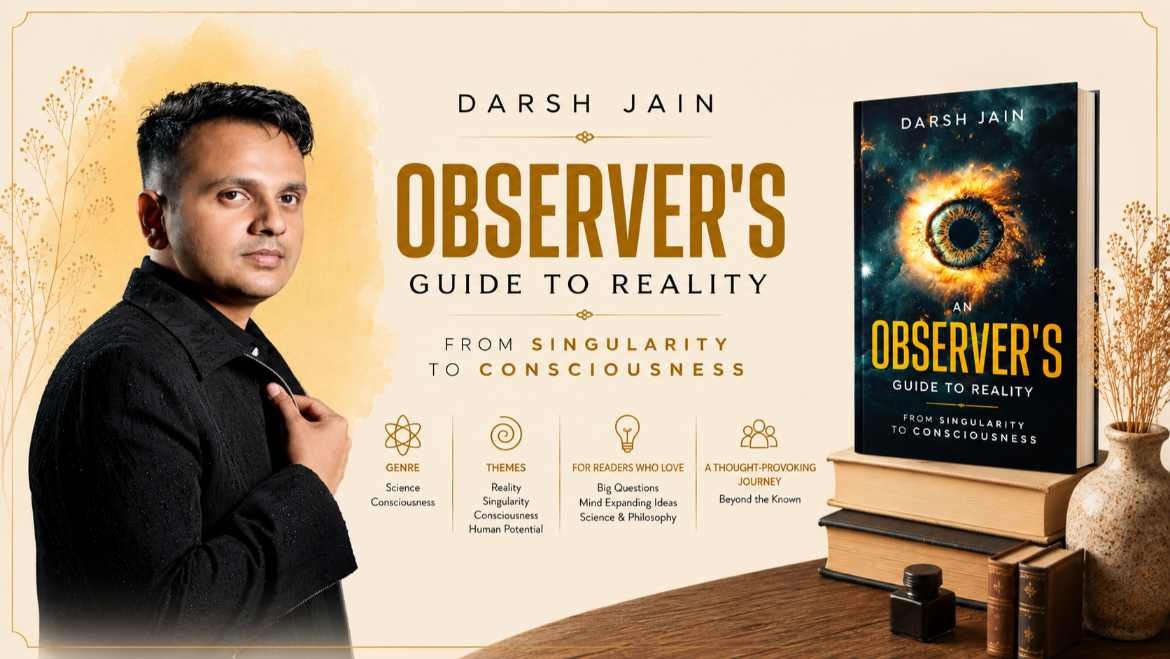
About the book
An Observer’s Guide to Reality is a philosophical journey through the origins of existence, the rise of life, and the imagination that gave birth to gods, morality, nations, and money. It asks how Homo sapiens, fragile and fleeting, learned to weave myths more powerful than physical laws and to create realities that live only in the collective mind. The book moves from the birth of the cosmos to the mysteries of consciousness, exploring how imagined orders shaped our past and continue to govern our present. It is both a reflection and a challenge, inviting readers to confront the fragile threads that bind meaning to an indifferent universe.

Read the full review : https://missbookthief.com/an-observers-guide-to-reality-book-review/
Read the full interview with Author Darsh Jain here:
- Can you tell us a little bit about your book? Why did you choose this genre and what’s the story behind the title?
An Observer’s Guide to Reality is a non-fiction exploration of some of the most fundamental questions about existence. It takes readers on a journey from the origin of the universe to the emergence of consciousness, drawing from science, philosophy, psychology, and human history to present a broader understanding of reality.
I chose this genre because I wanted to examine reality through evidence, observation, and reason rather than fiction. The title reflects the central idea of the book: before forming conclusions about life, we must first learn to observe reality as objectively as possible. I believe observation is the starting point of true understanding.
2. What inspired you to write this story? How did you find the resources and research material for your book?
The book was born from years of curiosity. I found myself asking questions about consciousness, free will, morality, religion, and the nature of human existence. Instead of accepting simple answers, I wanted to explore these questions with an open mind and understand them from multiple perspectives.
My research came from scientific literature, books by respected thinkers, academic lectures, neuroscience, evolutionary biology, physics, anthropology, and philosophy. I spent years reading, taking notes, comparing ideas, and connecting concepts across different disciplines before bringing them together into a single narrative.
3. What was the most challenging aspect of writing this book? How did you overcome it?
The greatest challenge was simplifying complex scientific and philosophical concepts without losing their depth or accuracy. I wanted readers from different backgrounds to understand the ideas without feeling overwhelmed or intimidated.
I overcame this through constant revision. Every chapter went through multiple drafts where I refined the language, improved the structure, and focused on clarity. Throughout the process, I kept asking myself one simple question: “Would a curious reader understand this?” That question guided every revision.
4. Are there any particular authors or books that have influenced the book?
Yes. Authors such as Yuval Noah Harari, Robert Sapolsky, and Jiddu Krishnamurti have significantly influenced the way I think about human nature, consciousness, and society. Their work encouraged me to question assumptions and approach complex subjects with curiosity rather than certainty. While their ideas inspired my thinking, the conclusions presented in the book are my own. My goal was not to repeat existing ideas but to connect knowledge from different fields into a fresh perspective.
5. What role did editing in the writing process? How did you decide when the manuscript was ready for publication?
Editing was one of the most important stages of the writing process. The first draft was about expressing ideas, while editing was about refining them into something that readers could easily follow and enjoy. I revised the manuscript multiple times to improve clarity, structure, and flow. I knew it was ready when every chapter communicated its purpose clearly and the book felt like one complete journey rather than a collection of separate ideas.
6. Do you have any upcoming projects or ideas for future books that you’d like to share with your readers?
Yes. I am currently working on my next book, The Absurdity of Thought, which explores the abstract and often irrational nature of human thought. It aims to examine how our thinking shapes our perception of reality, influences our decisions, and creates many of the beliefs and identities we take for granted. Alongside this project, I also plan to continue exploring themes related to consciousness, philosophy, and human behavior through future books and an online platform where these ideas can be shared through articles, videos, and meaningful conversations. My goal is to make complex ideas more accessible and encourage readers to question, reflect, and observe more deeply.
7. In the age of digital publishing and social media, how do you engage with your readers and promote your work?
I believe meaningful conversations create stronger connections than promotion alone. Through social media and my online platforms, I share thought-provoking ideas, discuss concepts from the book, and encourage readers to ask questions and think critically. Rather than simply promoting my work, I hope to build a community of curious minds who enjoy exploring science, philosophy, and the deeper questions about reality together
8. How do you balance your writing career with other aspects of your life, such as work and family?
Writing has always been a long-term commitment alongside my professional and personal responsibilities. Balancing everything requires discipline, consistency, and making time every day to read, reflect, and write, even during busy periods. I don’t see writing as something separate from life. Instead, I see it as a way of understanding life more deeply, which helps me stay motivated and continue learning every day.
9. What do you intend your readers to takeaway from your book?
More than providing answers, I hope the book encourages readers to ask better questions. If readers finish the book with greater curiosity, a more open mind, and the confidence to examine their own beliefs critically, then I will consider it a success. My intention is not to tell readers what to think, but to inspire them to observe reality more carefully and arrive at their own well-reasoned conclusions.
10. What’s the one advice you’d like to share with aspiring writers of the genre?
Write because you genuinely want to understand something, not because you already believe you have all the answers. Stay curious, be willing to challenge your own assumptions, and always let evidence guide your conclusions. Don’t rush the process. Read widely, think deeply, and write honestly. Authenticity, patience, and intellectual honesty will always outlast trends and leave a more meaningful impact on readers.