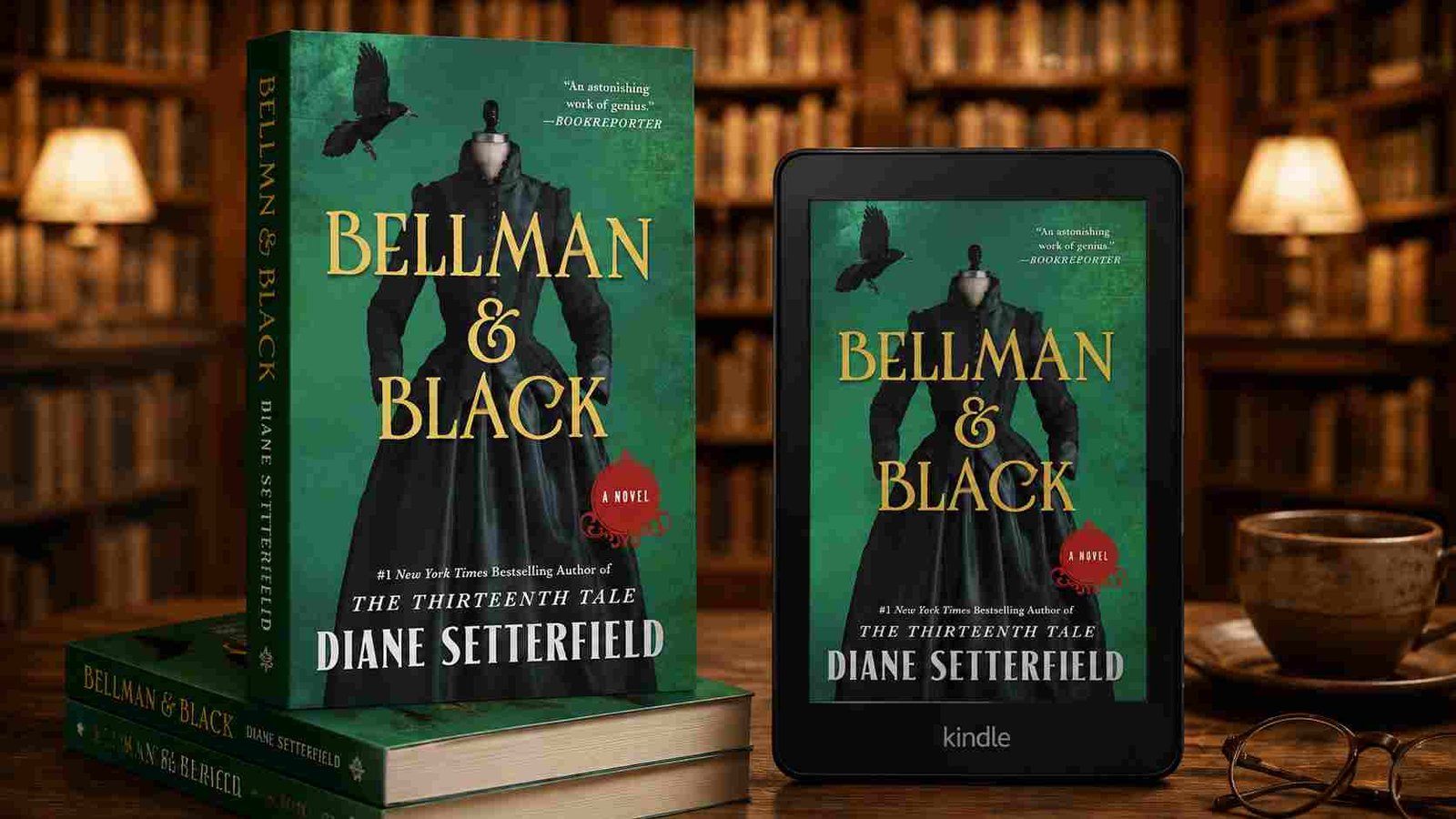
Some stories begin with a murder. Bellman & Black begins with a boy, a catapult, and a rook. What appears to be a thoughtless childhood accident quietly casts a shadow over William Bellman’s entire life, returning decades later when success, family, and prosperity can no longer protect him from grief. Diane Setterfield transforms that single impulsive moment into the foundation of a beautifully unsettling Gothic novel that explores mourning, obsession, memory, and the impossible desire to bargain with death.
Unlike traditional ghost stories filled with haunted houses and supernatural horrors, Bellman & Black offers something quieter and perhaps more disturbing. It asks what grief does to the living when they refuse to let it run its natural course, and that is why it is one of the best Diane Setterfield books.
Plot Summary of Bellman & Black
As a ten-year-old boy, William Bellman makes an extraordinary shot with his catapult, killing a rook perched high in a tree. Although the incident appears insignificant at the time, it leaves behind an unsettling sense that something has shifted. William grows into a successful businessman, building Bellman Mills into one of England’s most prosperous textile enterprises while enjoying a loving family and comfortable life.
However, tragedy gradually begins dismantling everything he has built. As death visits his family repeatedly, William becomes consumed by grief and desperation. In his darkest hour, he believes he encounters a mysterious stranger dressed in black and enters into a peculiar business arrangement that leads him to establish Bellman & Black, a luxurious department devoted entirely to the rituals of mourning. As his obsession deepens, William begins questioning whether he is running the business or whether grief itself has quietly taken control of his life.
Book Review: Bellman & Black
Bellman & Black is less concerned with frightening its readers than with quietly unsettling them. Diane Setterfield uses Gothic fiction not to tell a conventional ghost story but to examine how grief gradually alters memory, identity, and perception. The supernatural elements remain deliberately ambiguous throughout the novel, leaving readers uncertain whether William is truly haunted by an external presence or by the weight of his own unresolved guilt.
William Bellman is not presented as a tragic hero or a villain. Instead, Setterfield allows readers to witness how an intelligent, ambitious, and practical man slowly loses himself after repeated personal loss. His decision to build an extravagant business around death becomes one of the novel’s most striking metaphors, suggesting that grief, when left unresolved, can become an entire way of life rather than a passing emotion.
The novel’s deliberate pacing may not satisfy readers expecting constant suspense or dramatic twists. Instead, Setterfield favours atmosphere, symbolism, and psychological depth over conventional plotting. The result is a beautifully written Gothic meditation on mortality, memory, and the quiet devastation of mourning that lingers long after the final page.
Character Analysis in Bellman & Black
William Bellman
William is intelligent, disciplined, and relentlessly ambitious. His transformation from a successful businessman into a man consumed by grief forms the emotional centre of the novel, making his psychological decline both compelling and deeply tragic.
The Man in Black
Mysterious, enigmatic, and never fully explained, the Man in Black represents one of the novel’s greatest uncertainties. Whether supernatural figure, symbolic presence, or projection of William’s grief, he remains deliberately elusive throughout the story.
The Rooks
Although not conventional characters, the rooks become one of the novel’s most powerful recurring symbols. They quietly represent memory, death, consequence, and the unsettling persistence of the past.
Settings in Bellman & Black
Victorian England
The novel unfolds within nineteenth-century England, where commerce, industry, and social respectability provide an effective contrast to the deeply personal experience of grief and mourning.
Bellman Mills
William’s textile business represents order, discipline, and professional success. As the novel progresses, its efficiency stands in sharp contrast to the emotional disorder gradually overtaking William’s personal life.
Bellman & Black Store
The lavish department store dedicated entirely to mourning rituals becomes the novel’s defining setting. It transforms death into commerce while symbolising William’s inability to move beyond loss.
Major Themes in Bellman & Black
Grief and Mourning
The novel explores how grief can quietly consume every aspect of a person’s life when it remains unresolved. Mourning becomes not simply an emotional process but an identity.
Guilt and Consequence
William’s childhood act continues to echo throughout the narrative. Setterfield asks whether guilt ever truly disappears or merely waits for the right moment to return.
Death and Memory
Death is presented not as a single event but as something that continues shaping the lives of those left behind. Memory keeps both love and loss permanently alive.
Obsession
William’s growing fixation with mourning gradually replaces the life he once valued. The novel examines how obsession often disguises itself as purpose.
Commerce and Mortality
By turning mourning into a business, Setterfield offers an unusual reflection on how even humanity’s deepest emotions can become commercialised.
Fate and the Supernatural
The novel deliberately blurs the boundary between coincidence, destiny, and supernatural intervention. Readers are left to decide whether William’s tragedy is inevitable or self-created.
Gothic Elements in Bellman & Black
Rather than relying on ghosts or shocking horror, Bellman & Black embraces classic Gothic traditions through atmosphere, symbolism, isolation, mystery, and psychological unease.
The recurring presence of rooks, deserted landscapes, funeral rituals, dark clothing, and unanswered questions creates an almost dreamlike quality. The novel’s greatest mystery is not the identity of the Man in Black but the nature of grief itself.
This subtle approach makes the novel feel closer to psychological Gothic fiction than supernatural horror.
Diane Setterfield’s Writing Style in Bellman & Black
Diane Setterfield writes with remarkable elegance and precision. Her prose is richly descriptive without becoming excessive, allowing symbolism and imagery to emerge naturally through the narrative.
The novel unfolds slowly, rewarding patient readers with carefully constructed atmosphere rather than constant action. Setterfield also makes repeated use of recurring symbols, particularly rooks, textiles, mirrors, and black clothing, giving the novel a strong sense of thematic unity.
Readers who appreciated the literary richness of The Thirteenth Tale will recognise the same attention to mood, symbolism, and emotional complexity.
Who Should Read Bellman & Black?
This novel is particularly suited to readers who enjoy:
- Gothic fiction
- Psychological literary fiction
- Slow-burn mysteries
- Victorian novels
- Books about grief and loss
- Symbolic storytelling
- Atmospheric fiction
- Character-driven literary novels
- Diane Setterfield’s writing
Readers expecting a traditional horror novel may find its pace quieter than anticipated. Those who appreciate reflective, beautifully written Gothic fiction, however, are likely to find it deeply rewarding.
Final Verdict
Bellman & Black is ultimately a novel about the cost of refusing to let grief complete its natural journey.
Diane Setterfield transforms a simple childhood incident into an elegant meditation on memory, mourning, guilt, and the stories people tell themselves in order to survive unbearable loss. William Bellman’s greatest struggle is not against death itself but against the impossible hope that business, discipline, or determination can somehow negotiate with it.
Quiet, melancholic, and beautifully atmospheric, Bellman & Black offers readers a Gothic novel where the greatest hauntings occur not inside old houses but within the human mind.
Frequently Asked Questions
What is Bellman & Black about?
Bellman & Black follows William Bellman, whose successful life begins to unravel after devastating personal losses. His encounter with a mysterious man dressed in black leads him into an unusual business devoted entirely to mourning, forcing him to confront grief, guilt, and memory.
Is Bellman & Black a horror novel?
Not in the traditional sense. It is best described as Gothic literary fiction with psychological and supernatural elements rather than conventional horror.
Who wrote Bellman & Black?
Bellman & Black is written by Diane Setterfield, bestselling author of The Thirteenth Tale.
What do the rooks symbolize in Bellman & Black?
The rooks function as recurring symbols of death, memory, consequence, guilt, and the persistent presence of the past.
Is Bellman & Black worth reading?
If you enjoy atmospheric Gothic fiction, literary symbolism, and psychologically rich character studies, Bellman & Black is a rewarding and beautifully written novel.