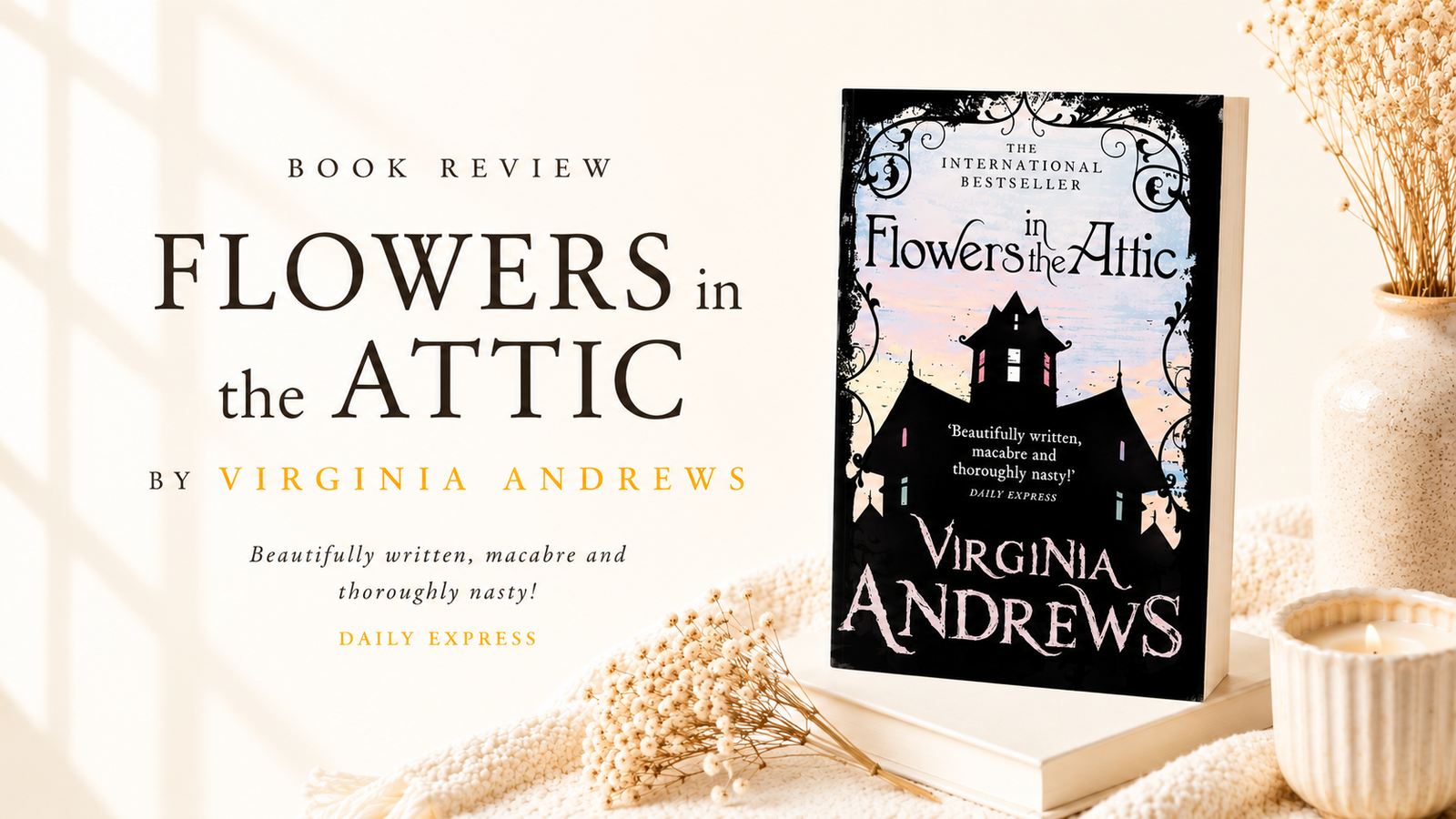
Few novels have divided readers quite like Flowers in the Attic by V. C. Andrews. Since its publication in 1979, V.C. Andrews’ gothic classic has shocked, fascinated, and unsettled generations with its exploration of family, confinement, manipulation, and survival. Its controversial subject matter often overshadows an important truth: beneath the sensational premise lies a deeply psychological story about children forced to grow up in impossible circumstances.
Dark, claustrophobic, and emotionally complex, Flowers in the Attic remains one of the most memorable gothic novels of the twentieth century.
Plot Summary of Flowers in the Attic by V. C. Andrews
Following the sudden death of their father, four siblings, Cathy, Chris, Cory, and Carrie Dollanganger, find their lives turned upside down. Desperate and financially vulnerable, their mother Corrine returns with them to the sprawling estate of her wealthy but estranged parents.
However, acceptance comes with an unimaginable condition. The children must remain hidden in an upstairs attic suite while Corrine attempts to regain her inheritance. What begins as a temporary arrangement stretches into months and eventually years of isolation.
Confined within a shrinking world of locked doors and whispered promises, the siblings create routines, nurture one another, and desperately cling to hope. Yet as time passes, manipulation, neglect, and betrayal gradually erode their innocence, forcing them to confront realities no child should ever face.
Without revealing major spoilers, the novel evolves into an unsettling examination of survival under emotional captivity and the devastating consequences of prolonged confinement.
Review of Flowers in the Attic by V. C. Andrews
At first glance, Flowers in the Attic appears designed to provoke through controversy alone. Yet V.C. Andrews constructs something more psychologically layered than its reputation often suggests.
Rather than relying solely on shocking revelations, the novel derives much of its power from atmosphere. The attic itself becomes an oppressive character, its locked windows, stale air, and shrinking freedoms mirroring the children’s emotional imprisonment. Consequently, readers experience not only physical confinement but also the slow erosion of trust, innocence, and identity.
Moreover, Andrews explores the devastating effects of conditional love and parental betrayal. Corrine’s repeated promises of imminent freedom become increasingly painful as readers witness hope repeatedly deferred. The resulting emotional tension proves just as disturbing as any external event.
Importantly, the novel should not be mistaken for conventional horror. Its greatest source of unease stems from human choices rather than supernatural forces. Family relationships become sites of manipulation, secrecy, and moral compromise, creating a story that lingers long after its final chapter.
While some narrative elements remain controversial and deeply uncomfortable, they serve the broader themes of isolation, power, and psychological damage rather than existing purely for shock value.
Characters Analysis in Flowers in the Attic by V. C. Andrews
Cathy Dollanganger
Narrating much of the novel, Cathy emerges as an intelligent, imaginative, and resilient protagonist. As the eldest daughter, she struggles to preserve both hope and normalcy while adapting to circumstances beyond her control.
Her emotional growth reflects the painful transition from innocence to awareness, making her one of the book’s most compelling voices.
Chris Dollanganger
Chris often assumes a protective role within the family. Rational, dependable, and deeply devoted to his siblings, he becomes an anchor during their prolonged confinement.
His growing maturity highlights the impossible responsibilities imposed upon children abandoned by the adults meant to protect them.
Corrine Dollanganger
Corrine stands among gothic fiction’s most morally complex maternal figures. Torn between ambition, fear, and affection, her decisions drive much of the novel’s tragedy.
Rather than presenting her as entirely one dimensional, Andrews depicts a woman whose selfishness and denial carry devastating consequences.
Olivia Foxworth
The children’s grandmother dominates the household with rigid discipline and religious absolutism. Cold, imposing, and emotionally distant, she embodies institutional authority stripped of compassion.
Her presence reinforces the novel’s exploration of control exercised under the guise of moral righteousness.
Setting & Themes in Flowers in the Attic by V. C. Andrews
Foxworth Hall functions as far more than an ancestral mansion. With its hidden rooms, locked spaces, and oppressive atmosphere, it becomes a classic gothic setting where architecture reflects emotional imprisonment.
Meanwhile, the attic symbolises suspended childhood itself. Time appears frozen, seasons pass unnoticed, and ordinary developmental milestones occur under extraordinary circumstances.
Throughout the novel, Andrews thoughtfully explores themes including:
- Childhood innocence and its loss
- Isolation and confinement
- Family dysfunction
- Power and manipulation
- Betrayal and conditional love
- Survival under emotional oppression
- Wealth, inheritance, and social expectations
Together, these themes elevate the novel beyond sensationalism into a disturbing study of resilience under impossible conditions.
Writing Style in Flowers in the Attic by V. C. Andrews
V.C. Andrews employs accessible prose enriched by gothic imagery and emotional intensity. Her first person narration creates immediacy while allowing readers intimate access to Cathy’s evolving perspective.
Furthermore, Andrews gradually builds suspense through repetition and delayed revelation rather than constant action. Everyday routines become increasingly unsettling as confinement stretches on, generating a pervasive atmosphere of dread.
Although the novel occasionally embraces melodrama, its emotional sincerity ensures that readers remain invested in the siblings’ fate throughout.
Strengths and Weaknesses in Flowers in the Attic by V. C. Andrews
- Unforgettable gothic atmosphere
- Emotionally engaging central characters
- Strong exploration of isolation and resilience
- Memorable narrative voice
- Powerful psychological tension
- Contains deeply disturbing subject matter that may not suit all readers
- Some plot developments require suspension of disbelief
- Melodramatic elements occasionally overshadow subtlety
Who Should Read Flowers in the Attic?
This novel is best suited for readers who enjoy:
- Gothic fiction
- Family dramas with psychological complexity
- Dark literary suspense
- Character driven narratives
- Stories exploring resilience under adversity
- Classic controversial novels
Readers should also be aware that the book addresses themes many may find emotionally challenging.
Final Verdict
Flowers in the Attic endures because it refuses to be easily categorised. Part gothic novel, part psychological drama, and part family tragedy, it presents a haunting portrait of children forced to navigate betrayal, confinement, and impossible moral circumstances long before they are ready.
Its controversial reputation may attract readers initially, but its emotional core and unforgettable atmosphere are what leave a lasting impression. If approached with awareness of its difficult themes, Flowers in the Attic offers a compelling and deeply unsettling reading experience that continues to provoke discussion decades after publication.
Frequently Asked Questions
Is Flowers in the Attic worth reading?
Yes. Despite its controversial subject matter, it remains a landmark gothic novel celebrated for its atmosphere, psychological complexity, and unforgettable storytelling.
Is Flowers in the Attic horror?
The novel blends gothic fiction, psychological suspense, and family drama rather than relying on traditional horror conventions.
Why is Flowers in the Attic controversial?
Its exploration of family dysfunction, abuse, manipulation, and taboo themes has generated debate since publication and may be distressing for some readers.
Is Flowers in the Attic suitable for young readers?
Given its mature themes and disturbing content, it is generally better suited to adult audiences.
What makes Flowers in the Attic so memorable?
Its claustrophobic setting, emotionally complex characters, gothic atmosphere, and exploration of survival under extraordinary circumstances contribute to its enduring impact.