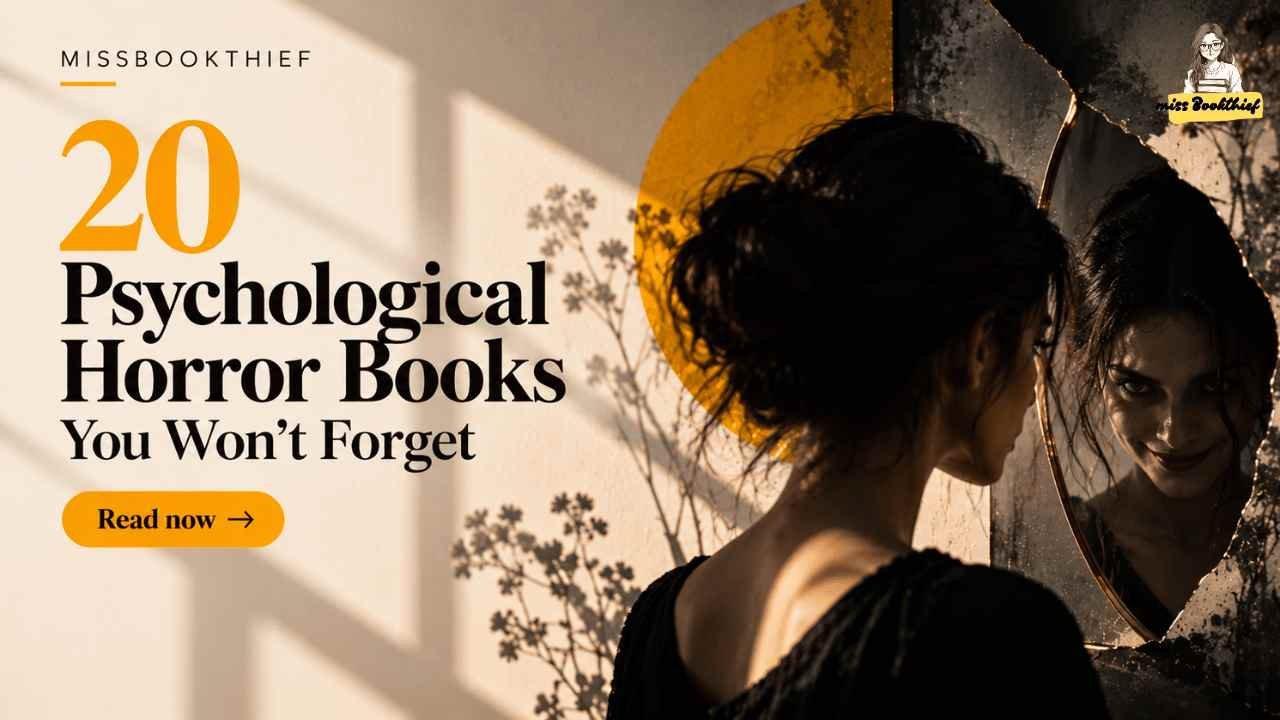
What is more frightening than a monster hiding under your bed? The possibility that the monster is inside your head. Psychological horror takes this route. It makes us question what we know, whom we trust, and whether the person telling the story can be believed at all.
A character begins to doubt their memories. A familiar room starts feeling strange. A seemingly ordinary relationship turns sinister. Before you know it, you are questioning every detail on the page.
The best psychological horror books do more than frighten us. They make us uncomfortable with our own assumptions about human nature, sanity, memory, and reality.
From unsettling literary classics to contemporary nightmares and Indian horror fiction, here are 20 psychological horror books that will get under your skin.
1. The Haunting of Hill House by Shirley Jackson
Four people arrive at Hill House, a mansion with a disturbing reputation, to investigate its supposed supernatural activity. Among them is Eleanor Vance, a lonely woman whose emotional vulnerability makes her particularly sensitive to the strange events unfolding around her.
But is Hill House genuinely haunted? Or is something happening within Eleanor herself?
Why it gets under your skin: Shirley Jackson makes readers question the reliability of perception. The house is frightening, but Eleanor’s increasingly fragile relationship with reality is what makes the novel truly disturbing.
Best for: Readers who enjoy haunted houses, unreliable perceptions, and slow-building dread.
2. We Have Always Lived in the Castle by Shirley Jackson
Merricat Blackwood lives with her sister, Constance, and their uncle in a large family home. The rest of the community treats them with suspicion, and the sisters have built a secluded life away from the outside world.
When a visitor arrives, the fragile balance of their household begins to shift.
Why it gets under your skin: Merricat’s unusual worldview makes the story fascinating and unsettling. Jackson gradually reveals the darkness beneath the family’s routines, leaving readers to decide how much they can trust the narrator.
Best for: Readers who love family secrets, disturbing characters, and quiet psychological horror.
3. The Shining by Stephen King
Jack Torrance accepts a winter caretaker job at the isolated Overlook Hotel, hoping to rebuild his life and repair his relationship with his family. But the hotel’s sinister history begins to affect him, and the isolation intensifies his existing struggles.
His young son, Danny, possesses an unusual sensitivity to the disturbing forces surrounding them.
Why it gets under your skin: Stephen King combines supernatural terror with the frightening possibility of watching someone you love change beyond recognition. The isolation, family tension, and gradual psychological deterioration make the hotel feel inescapable.
Best for: Readers who enjoy claustrophobic settings, family horror, and escalating tension.
4. Misery by Stephen King
Popular novelist Paul Sheldon is rescued after a car accident by Annie Wilkes, a devoted reader who claims to be his biggest fan. Initially, her care seems like a stroke of luck. Then Paul discovers that Annie’s devotion comes with terrifying conditions.
Trapped in her house, he realises that his survival depends on satisfying a woman whose behaviour becomes increasingly unpredictable.
Why it gets under your skin: The horror comes from captivity, obsession, and the imbalance of power between two people. Annie is frightening precisely because her actions are driven by recognisable human emotions taken to an extreme.
Best for: Readers who enjoy psychological tension, obsessive characters, and tightly confined settings.
5. I’m Thinking of Ending Things by Iain Reid
A young woman travels with her boyfriend to meet his parents at their remote farmhouse. She is already contemplating ending the relationship, but the journey takes increasingly unsettling turns.
Strange conversations, uncomfortable silences, and inexplicable details make the visit feel wrong. The deeper the story goes, the harder it becomes to understand what is really happening.
Why it gets under your skin: Reid creates a persistent sense of unease through uncertainty. Ordinary interactions become ominous, and the narrative encourages readers to question what they think they understand.
Best for: Readers who enjoy surreal storytelling, existential dread, and reality-bending fiction.
6. The Silent Patient by Alex Michaelides
Alicia Berenson appears to have an enviable life until she is accused of murdering her husband. After the incident, she stops speaking entirely.
Theo Faber, a psychotherapist, becomes determined to understand her silence and uncover what happened that night. As he investigates Alicia’s past, the case becomes increasingly complicated.
Why it gets under your skin: The novel plays with secrets, perception, and the difference between what people reveal and what they conceal. Its central mystery encourages readers to reconsider the story as new information emerges.
Best for: Readers who love psychological suspense, complicated characters, and twist-filled mysteries.
Genre note: This is primarily a psychological thriller, making it a good companion recommendation for readers who enjoy the suspenseful side of psychological horror.
7. The Vegetarian by Han Kang
In Han Kang’s internationally acclaimed novel, Yeong-hye decides to stop eating meat after a series of disturbing dreams. What begins as a personal decision becomes a source of conflict with her family and those around her.
As the story unfolds through the perspectives of different characters, Yeong-hye’s transformation challenges their assumptions about control, identity, and the human body.
Why it gets under your skin: The novel explores bodily autonomy, repression, alienation, and the violence that can hide beneath ordinary social expectations. Its horror is psychological and deeply uncomfortable rather than conventionally supernatural.
Best for: Readers who appreciate literary fiction, disturbing imagery, and stories that challenge conventional ideas of normality.
Content note: Includes disturbing imagery, violence, and themes of mental distress.
8. The Yellow Wallpaper by Charlotte Perkins Gilman
This influential short story follows a woman who is confined to a room as part of a supposed treatment for her mental health. With little stimulation or freedom, she becomes increasingly preoccupied with the room’s yellow wallpaper.
What begins as an irritating pattern gradually becomes the focus of an unsettling obsession.
Why it gets under your skin: Gilman draws readers into the narrator’s changing perception of her surroundings. The story exposes the psychological damage that can result from isolation, dismissal, and the denial of personal agency.
Best for: Readers who want a short but powerful read about confinement, obsession, and psychological distress.
9. The Turn of the Screw by Henry James
A young governess arrives at a country estate to care for two children. Before long, she begins seeing mysterious figures and becomes convinced that the children are connected to something sinister.
Yet the more certain she becomes, the more readers are invited to question her account.
Why it gets under your skin: Henry James builds terror through ambiguity. The story never makes it easy to separate supernatural events from the governess’s interpretation of them.
Best for: Readers who enjoy Gothic literature, unreliable narration, and stories that refuse to provide simple answers.
10. Rebecca by Daphne du Maurier
A young woman marries the wealthy Maxim de Winter and moves into his grand estate, Manderley. But the shadow of Maxim’s first wife, Rebecca, hangs over the household.
As the new Mrs de Winter struggles to find her place, she encounters secrets, manipulation, and a growing sense that she can never truly escape Rebecca’s influence.
Why it gets under your skin: Du Maurier creates psychological suspense through jealousy, insecurity, power, and the lingering influence of someone who is no longer alive. Rebecca’s presence shapes the novel even when she is absent.
Best for: Readers who enjoy Gothic suspense, complicated relationships, and stories built around secrets.
11. The Collector by John Fowles
Frederick Clegg is a socially isolated man who becomes obsessed with Miranda Grey, an art student. His fixation escalates into kidnapping, as he convinces himself that possessing Miranda will somehow make her love him.
The novel alternates between their perspectives, exposing the disturbing distance between Frederick’s rationalisations and Miranda’s reality.
Why it gets under your skin: The horror lies in obsession, control, and the way a person can justify cruelty to themselves. The contrasting viewpoints make the story particularly uncomfortable.
Best for: Readers interested in disturbing character studies and the psychology of obsession.
Content note: Kidnapping, coercive control, and psychological abuse.
12. The Last House on Needless Street by Catriona Ward
Ted lives in an isolated house at the edge of a forest, surrounded by secrets. His life is complicated by the people and animals around him, and the narrative shifts between perspectives that do not always fit together neatly.
As the story unfolds, the reader must reconsider what is happening inside the house and how its inhabitants are connected.
Why it gets under your skin: Ward uses fractured perspectives, uncertainty, and carefully controlled revelations to create a disturbing reading experience. The novel explores trauma and the ways people understand, or fail to understand, their own lives.
Best for: Readers who enjoy unconventional narratives, dark mysteries, and psychological twists.
Content note: Contains disturbing themes, including abuse and trauma.
13. The Grip of It by Jac Jemc
Julie and James move into a new house hoping to begin again. But the property feels increasingly wrong. Strange markings appear, rooms seem to change, and disturbing experiences begin to affect their relationship.
As the couple tries to understand the house, their confidence in their own perceptions starts to erode.
Why it gets under your skin: Jemc makes domestic life feel unstable. The house becomes a source of uncertainty, while the couple’s relationship adds another layer of psychological tension.
Best for: Readers who enjoy unsettling domestic horror and stories in which a home becomes anything but a refuge.
14. Bunny by Mona Awad
Samantha is a graduate student who feels alienated from her wealthy, tightly knit classmates. The group, who call one another “Bunny”, appear to live in a world of their own.
When Samantha becomes involved with them, their strange social rituals take increasingly disturbing turns.
Why it gets under your skin: Awad mixes social satire, surrealism, body horror, and psychological unease. The novel’s shifting reality makes it difficult to determine where imagination ends and something far more disturbing begins.
Best for: Readers who enjoy weird fiction, dark academia, and horror that breaks the rules.
Content note: Includes graphic and grotesque imagery.
15. The Cipher by Kathe Koja
When Nicholas and his girlfriend discover a mysterious hole in the floor of an apartment building, their curiosity quickly becomes obsession. The hole, which they call the Funhole, appears to contain something inexplicable.
As Nicholas becomes increasingly consumed by it, his relationships and sense of reality begin to unravel.
Why it gets under your skin: Koja explores obsession, bodily transformation, and the destructive pull of the unknown. The horror grows from the characters’ inability to leave a disturbing mystery alone.
Best for: Readers who enjoy experimental horror, grotesque imagery, and stories about dangerous curiosity.
16. The Devourers by Indra Das
Set partly in Mughal-era India and partly in modern Kolkata, Indra Das’s novel explores shapeshifters, identity, desire, and the monstrous possibilities within human nature.
The story unfolds through layered narratives that blur the boundaries between human and non-human, history and myth, attraction and fear.
Why it gets under your skin: Rather than relying on conventional scares, Das explores the unsettling sides of identity, violence, and transformation. Its atmosphere and morally complicated characters make it a compelling choice for readers who like their horror thoughtful and strange.
Best for: Readers interested in Indian speculative fiction, dark fantasy, and horror that examines the human condition.
Genre note: This is a blend of dark fantasy, speculative fiction, and horror rather than a strictly psychological horror novel.
17. Maya’s New Husband by Neil D’Silva
Neil D’Silva is known for bringing horror into recognisably Indian settings, combining unsettling situations with questions about family, belief, and the supernatural.
Maya’s New Husband explores a disturbing relationship and the dark secrets surrounding it. The novel draws readers into an atmosphere in which the familiar can become threatening and the truth is not always immediately apparent.
Why it gets under your skin: Its appeal lies in the unsettling relationship between ordinary domestic life and the darker forces beneath the surface. It offers readers an Indian horror perspective beyond the familiar Western haunted-house tradition.
Best for: Readers who enjoy contemporary Indian horror and stories rooted in relationships, secrets, and supernatural unease.
18. Khandav by Mahesh Rajmane
For readers looking to explore Indian horror beyond the most frequently recommended titles, Khandav by Mahesh Rajmane is worth adding to the discovery list.
Including regional Indian horror helps broaden the conversation beyond the familiar names of international horror fiction. It also creates space for readers to discover authors and storytelling traditions they may not encounter in mainstream English-language horror lists.
Why add it to your list: It brings a regional Indian title into a genre conversation that is often dominated by Western classics. For readers exploring Indian horror, it offers an opportunity to look beyond the usual recommendations.
Best for: Readers interested in discovering Indian horror authors and expanding their Halloween reading list.
Editorial note: Confirm the edition, language, publisher, and plot details of the book before publication so the description can be made more specific and accurate.
19. That Night by Nidhi Upadhyay
A group of childhood friends reunites years after a disturbing incident from their past. What should be a reunion becomes entangled with old memories, secrets, and the consequences of events they would rather forget.
As the story unfolds, the characters must confront what happened and how it continues to affect their lives.
Why it gets under your skin: The novel uses buried secrets, guilt, and the lingering effects of the past to create suspense. Its appeal lies in the way seemingly familiar relationships can conceal uncomfortable truths.
Best for: Readers who enjoy Indian suspense fiction, secrets between friends, and mysteries rooted in the past.
Genre note: This is primarily a psychological thriller rather than a conventional psychological horror novel.
20. Come Tomorrow: And Other Tales of Bangalore Terror by Jayaprakash Satyamurthy
Jayaprakash Satyamurthy’s collection brings together tales of terror rooted in Bangalore and its surrounding atmosphere. The stories move beyond conventional horror settings, exploring strange encounters and unsettling possibilities in recognisable urban spaces.
Why it gets under your skin: The collection is a reminder that horror does not need a remote castle or an abandoned mansion. The everyday city can provide its own unsettling backdrop, especially when familiar surroundings begin to feel unfamiliar.
Best for: Readers interested in Indian speculative fiction, urban horror, and stories that explore the strange beneath ordinary life.
Genre note: This is a broader horror collection, rather than a book devoted exclusively to psychological horror.
FAQs on Psychological Horror Books
What is psychological horror in literature?
Psychological horror creates fear through the mind, emotions, perceptions, and behaviour of its characters. It often explores paranoia, obsession, guilt, isolation, unreliable memories, and uncertainty about what is real.
What are the best psychological horror books for beginners?
The Silent Patient is a good starting point for readers who enjoy mysteries and twists. The Shining suits those who prefer intense, atmospheric horror, while The Yellow Wallpaper offers a short introduction to psychological unease.
Are psychological horror and psychological thrillers the same?
They overlap, but they are not identical. Psychological thrillers typically focus on suspense, secrets, and dangerous situations. Psychological horror places greater emphasis on dread, disturbing experiences, and the fear of losing one’s grasp on reality. Some books belong to both genres.
Are there Indian psychological horror books?
Indian writers have explored psychological unease, identity, guilt, obsession, and the supernatural in different forms. The Devourers by Indra Das blends dark fantasy and horror, while Maya’s New Husband by Neil D’Silva offers a contemporary Indian horror perspective. That Night by Nidhi Upadhyay is a useful choice for readers interested in psychological suspense.
Why are psychological horror books so disturbing?
They draw on fears that feel close to everyday life: losing control, being unable to trust someone, questioning your own memories, or discovering that a familiar person or place is not what it seemed. These fears can feel especially powerful because they do not always require a supernatural explanation.
Looking for more spooky reads? Explore our guide to the best horror authors and our list of famous ghost story writers and their most unforgettable stories for more inspiration.
Disclaimer: The list deliberately includes adjacent genres, such as psychological thrillers, Gothic fiction, dark fantasy, and supernatural horror, to broaden discovery. This is intended to help readers choose the right book and also keep the article credible.