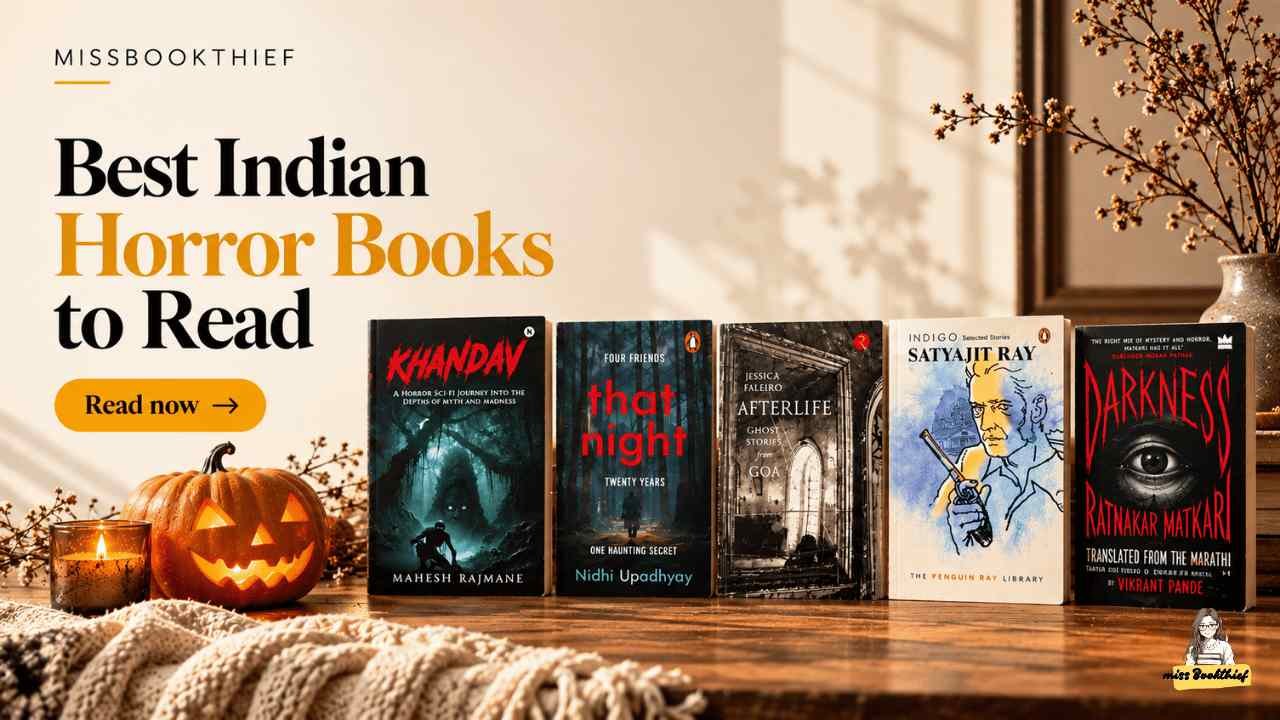
From haunted jungles and forgotten goddesses to Marathi horror classics, Hindi pulp fiction and chilling ghost stories, discover 15 Indian horror books that deserve a place on your reading list this horror season.
Indian horror has many faces. It lives in ancient folklore, lurks in forgotten forests, haunts ordinary homes and emerges from stories passed down through generations. And beyond the familiar ghost story lies a rich literary landscape of psychological terror, dark fantasy, supernatural mysteries and regional horror traditions.
If you’re searching for the best Indian horror novels to read, this list takes you beyond the usual recommendations. From contemporary writers such as Mahesh Rajmane and Neil D’Silva to regional literary voices such as Ratnakar Matkari, Narayan Dharap and Parshuram Sharma, these books showcase different ways Indian writers have imagined fear.
Some entries are full-length novels, while others are short-story collections or books exploring India’s supernatural folklore. Let’s explore these rare 15 horror books that deserve a place on your reading list.
1. Khandav by Mahesh Rajmane (English & Hindi)
Best for: Readers who enjoy mythological, psychological and science-fiction horror.
What happens when an ancient forest is more than a forest? What if the landscape itself possesses an intelligence that humans were never meant to encounter?
In Khandav: A Horror Sci-Fi Journey Into the Depths of Myth and Madness, Mahesh Rajmane blends horror, science fiction, mythology and psychological terror. When botanist Vikram disappears while investigating an ancient, uncharted jungle, journalist Maya sets out to uncover the truth.
Her search soon becomes a nightmare. The jungle appears to breathe and watch, memories become unreliable, and a forgotten goddess seems to exert an increasingly disturbing influence over those who enter her domain.
The novel moves beyond conventional haunted-house horror into a world where nature, mythology and the human mind collide.
Why read it: If you want contemporary Indian horror with an unusual premise, unsettling imagery, and a strong mythological dimension, Khandav deserves a place on your reading list. Rajmane is one of the top emerging horror authors in India.
2. Maya’s New Husband by Neil D’Silva
Best for: Readers who enjoy dark, disturbing contemporary horror.
Neil D’Silva is known for horror that draws on Indian cultural beliefs, supernatural traditions and the darkness within human relationships. In Maya’s New Husband, Maya Bhargava’s attempt to begin a new chapter in her life takes an increasingly sinister turn after she meets Bhaskar Sadachari.
What initially appears to be a new relationship gradually reveals disturbing secrets. The novel combines psychological unease with supernatural and violent elements, creating a story that challenges the boundary between everyday life and horror.
D’Silva’s fiction is a useful introduction to contemporary Indian horror in English, particularly for readers looking for stories that move beyond imported Gothic conventions.
Why read it: Choose this book if you enjoy unsettling relationships, dark secrets and contemporary horror rooted in an Indian setting.
3. Darkness by Ratnakar Matkari (Marathi)
Best for: Readers who love Marathi horror and short stories with unexpected turns.
Ratnakar Matkari was a major figure in Marathi literature, known for writing plays, children’s literature and stories that explored the mysterious and supernatural.
Darkness, translated into English from the Marathi collection Kalaratri, brings together 18 horror stories. Its tales explore frightening possibilities through ghosts, unexplained events and encounters that disrupt ordinary life.
Short-story collections are particularly effective for horror because each narrative can introduce a new setting, a fresh source of dread and a different kind of surprise. Matkari’s work also offers an opportunity to discover a regional horror tradition that deserves wider recognition.
Why read it: Pick up Darkness if you want to explore Marathi horror through compact, atmospheric stories.
4. Grahan by Narayan Dharap (Marathi)
Best for: Readers interested in classic Marathi horror fiction.
Narayan Dharap was one of the defining writers of Marathi horror and supernatural fiction. Over a long writing career, he created stories and novels that explored mysterious forces, frightening encounters and the unsettling possibilities of the unknown.
Grahan is one of his horror novels. Dharap’s fiction is known for building unease through ordinary settings that gradually become strange and threatening. His work also helped establish a distinctive tradition of Indian horror in Marathi, rather than simply reproducing the conventions of Western Gothic fiction.
For readers who want to explore horror beyond contemporary English-language publishing, Dharap is an important name to discover.
Why read it: Choose Grahan if you want to explore a classic regional horror writer whose work helped shape Marathi supernatural fiction.
5. Agiya Betal by Parshuram Sharma (Hindi)
Best for: Readers curious about Hindi horror and pulp fiction.
Indian horror has a long history in Hindi popular literature, including the pulp-fiction tradition that flourished through inexpensive paperbacks and serial storytelling.
Parshuram Sharma’s Agiya Betal is associated with this world of Hindi horror. The title itself evokes the supernatural vocabulary of Indian folklore, where beings such as betals occupy a space between the living and the dead.
Hindi horror pulp deserves attention because it reached readers through a different publishing ecosystem from contemporary English-language literary fiction. Its history reveals how Indian readers have sought supernatural thrills for decades.
Why read it: If you want to move beyond English-language horror and explore the Hindi pulp tradition, Agiya Betal is a title worth investigating.
6. The Waking Dead by Rohan Monteiro
Best for: Readers who enjoy supernatural mysteries with dark humour.
In The Waking Dead, a violent death opens the door to a mystery involving strange occurrences in the Indian heartland. The story follows Samir Grey as he investigates a haunting that draws him into a world of supernatural threats and unsettling secrets.
The novel incorporates Indian supernatural traditions and creatures, combining paranormal mystery with a darker sense of humour. Its premise gives readers a different experience from conventional haunted-house fiction, drawing on local folklore and the mysteries of small-town life.
Why read it: This is a good choice for readers who want Indian folklore, investigative storytelling and a supernatural plot that does not take itself entirely seriously.
7. The Devourers by Indra Das
Best for: Readers who enjoy literary horror and dark fantasy.
Set across contemporary Kolkata and seventeenth-century Mughal India, The Devourers begins with a strange encounter between a university professor and a mysterious stranger. The story gradually opens into a disturbing world of shape-shifters, violence, desire and transformations that challenge the boundary between human and beast.
Indra Das uses elements of fantasy and horror to examine identity, belonging and the monstrous possibilities within human nature. The novel’s unusual structure and historical settings make it a more literary and ambitious experience than a conventional ghost story.
Why read it: Read The Devourers if you enjoy dark fantasy, unsettling transformations and horror that explores questions of identity and humanity.
8. Ghost Stories from the Raj by Ruskin Bond
Best for: Readers who enjoy atmospheric ghost stories and old-world settings.
Ruskin Bond has long been associated with stories set in India’s hills, forests and small towns. His ghost stories draw on this gift for atmosphere, taking readers into lonely bungalows, quiet hill stations and encounters that are difficult to explain.
Ghost Stories from the Raj explores supernatural tales connected with the colonial period. Rather than depending on graphic horror, Bond often allows the setting and the gradual arrival of something inexplicable to create unease.
The result is a collection for readers who enjoy subtle, old-fashioned ghost stories.
Why read it: Choose this book if you prefer atmospheric storytelling, mysterious encounters and ghosts that are more unsettling than spectacular.
9. Indigo by Satyajit Ray
Best for: Readers who enjoy strange, imaginative supernatural fiction.
Satyajit Ray is best known for his cinema and detective stories, but his supernatural fiction offers another side of his imagination.
Indigo brings together stories that explore the uncanny, the inexplicable and the unsettling. In stories such as Fritz, childhood memories and seemingly harmless experiences acquire a deeply disturbing dimension.
Ray’s storytelling often begins with curiosity before gradually introducing something that does not fit ordinary expectations. His supernatural stories are particularly appealing to readers who enjoy mysteries that leave room for uncertainty.
Why read it: Pick up Indigo if you like eerie short fiction that combines imagination, mystery and psychological unease.
10. Afterlife: Ghost Stories from Goa by Jessica Faleiro
Best for: Readers interested in ghost stories rooted in place and community.
Goa is often associated with beaches and nightlife, but Jessica Faleiro’s Afterlife: Ghost Stories from Goa explores a darker, more mysterious side of the region.
The collection draws on Goa’s landscapes, histories and social world to explore supernatural encounters and the stories people tell about the dead. By rooting its ghost stories in a recognisable place, the book creates an atmosphere that feels distinct from generic haunted-house fiction.
It also demonstrates how regional identity and local history can give supernatural storytelling its own character.
Why read it: Choose this collection if you enjoy ghost stories that explore the relationship between place, memory and the supernatural.
11. Come Tomorrow: And Other Tales of Bangalore Terror by Jayaprakash Satyamurthy
Best for: Readers who enjoy urban horror and contemporary supernatural fiction.
Horror does not always require a remote village or an abandoned mansion. Sometimes, a familiar city can become the perfect setting for the strange and the terrifying.
In Come Tomorrow: And Other Tales of Bangalore Terror, Jayaprakash Satyamurthy explores unsettling stories connected with Bangalore. The collection offers an urban perspective on horror, drawing on the atmosphere of the modern city rather than relying exclusively on traditional Gothic settings.
For readers who live in Indian cities, this kind of fiction can make everyday surroundings feel unfamiliar in interesting ways.
Why read it: Pick this book if you enjoy urban legends, contemporary settings and horror that emerges from the spaces people inhabit every day.
12. That Night by Nidhi Upadhyay
Best for: Readers who enjoy dark secrets, psychological suspense and disturbing revelations.
Nidhi Upadhyay’s That Night centres on a group of friends whose lives are shaped by a traumatic event from their past. As the story unfolds, buried secrets and the consequences of earlier decisions come back to haunt them.
The book sits closer to psychological thriller and suspense than straightforward supernatural horror. However, it belongs on a broader Halloween reading list for readers who prefer human secrets, fear and the slow unravelling of relationships to ghosts and monsters.
Why read it: Choose That Night if you prefer tense storytelling in which the most frightening discoveries involve people and their pasts.
13. Daiva by K. Hari Kumar
Best for: Readers who enjoy horror inspired by Indian folklore and belief systems.
K. Hari Kumar writes fiction that draws on mythology, folklore and supernatural traditions. Daiva is an option for readers interested in horror and dark storytelling shaped by Indian cultural beliefs.
Folklore-inspired horror offers a different kind of atmosphere from stories built around familiar Western monsters. It can draw on local traditions, spiritual anxieties and the relationship between communities and the unseen world.
For readers seeking a wider understanding of Indian supernatural fiction, books such as Daiva offer an opportunity to explore how cultural context influences horror.
Why read it: Consider Daiva if you enjoy supernatural stories that engage with Indian folklore and belief systems.
14. The Book of Indian Ghosts by Riksundar Banerjee
Best for: Readers who want to explore India’s diverse ghost lore.
Not every frightening book needs to be a novel. The Book of Indian Ghosts explores the supernatural traditions and ghost stories found across India.
Riksundar Banerjee looks at regional beliefs, legends and supernatural beings, revealing how different communities have imagined the spirit world. These traditions include chudails associated with North Indian folklore, Bengal’s mechho bhoots and the muni pei of Tamil Nadu.
The book offers a cultural perspective on Indian horror, helping readers discover the folklore that has inspired countless supernatural tales.
Why read it: Choose this book if you want to explore the regional legends and supernatural traditions behind Indian ghost stories.
15. Dark Tales by Venita Coelho
Best for: Readers who enjoy unusual, atmospheric and imaginative horror.
Venita Coelho’s Dark Tales brings together stories that explore the eerie and the unsettling. The collection offers a different flavour of Indian speculative fiction, with dark imaginative elements that do not always fit neatly into conventional horror categories.
Short fiction allows writers to experiment with atmosphere, strange premises and unexpected turns. Collections such as this can be useful for readers who want to discover less familiar voices rather than limiting themselves to the best-known names in the genre.
Why read it: Explore Dark Tales if you enjoy imaginative short fiction and want to discover another contemporary Indian writer working with darker themes.
Which Indian Horror Book Should You Read First?
The best starting point for reading horror depends on the kind of horror you enjoy.
- For mythological and environmental horror: Khandav by Mahesh Rajmane.
- For contemporary dark horror: Maya’s New Husband by Neil D’Silva.
- For Marathi horror: Darkness by Ratnakar Matkari or Grahan by Narayan Dharap.
- For Hindi pulp horror: Agiya Betal by Parshuram Sharma.
- For dark fantasy: The Devourers by Indra Das.
- For classic ghost stories: Ghost Stories from the Raj by Ruskin Bond.
- For eerie short fiction: Indigo by Satyajit Ray.
- For Goa-inspired ghost stories: Afterlife: Ghost Stories from Goa by Jessica Faleiro.
- For urban horror: Come Tomorrow by Jayaprakash Satyamurthy.
- For Indian ghost lore: The Book of Indian Ghosts by Riksundar Banerjee.
Final Thoughts: Discover the Many Worlds of Indian Horror
Indian horror is not a single genre with a single voice. It is a landscape of regional traditions, unsettling folklore, contemporary nightmares and imaginative worlds where the familiar can become frightening.
From the ancient jungle of Khandav to Marathi horror classics, Hindi pulp fiction, urban supernatural tales and Goa’s ghost stories, these books offer different ways to experience the darker side of Indian literature.
This Halloween, go beyond the familiar recommendations. Pick a regional horror writer, explore a short-story collection or discover a contemporary novel that blends mythology with the unknown. You might find that your next unforgettable read comes from a literary tradition you have never explored before.
FAQs About Indian Horror Books
What are the best Indian horror novels to read this Halloween?
Some books to explore include Khandav by Mahesh Rajmane, Maya’s New Husband by Neil D’Silva, The Devourers by Indra Das and The Waking Dead by Rohan Monteiro. Readers interested in regional horror can also explore Marathi writers such as Ratnakar Matkari and Narayan Dharap.
Are there good horror books originally written in Indian languages?
Yes. Marathi horror has a rich tradition, with writers such as Ratnakar Matkari and Narayan Dharap. Hindi pulp fiction has also featured supernatural stories and horror novels, including works associated with Parshuram Sharma. Regional-language horror offers a wider view of Indian storytelling beyond English-language publishing.
Which Indian horror books explore mythology and folklore?
Khandav* by Mahesh Rajmane blends horror, science fiction and mythology. Daiva by K. Hari Kumar is another option for readers interested in folklore-inspired supernatural fiction, while The Book of Indian Ghosts explores regional supernatural traditions.
Are all the books on this list horror novels?
No. This list includes novels, short-story collections and a book exploring Indian ghost lore. The formats are identified in the descriptions because horror literature includes several forms, and not every compelling supernatural book is a full-length novel.
Who are some Indian horror authors worth discovering?
Explore Mahesh Rajmane, Neil D’Silva, Ratnakar Matkari, Narayan Dharap, Parshuram Sharma, Indra Das, Ruskin Bond, Satyajit Ray, Jessica Faleiro and Jayaprakash Satyamurthy. Their work spans different languages, literary traditions and approaches to horror.
Looking for more spooky reads? Explore our guide to the best horror authors and discover more writers to add to your Halloween reading list.